 Back
BackOrganic Chemistry Exam Review: Alkenes, Alkynes, Alcohols, and Phenols
Study Guide - Smart Notes
 Tailored notes based on your materials, expanded with key definitions, examples, and context.
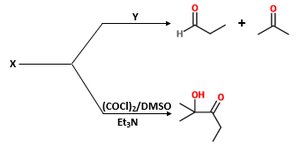
Q1. Identify “X” and “Y” in the following reaction:
Background
Topic: Oxidative cleavage and Swern oxidation
This question tests your understanding of oxidative cleavage of diols and the Swern oxidation reaction. You need to identify the starting diol (X) and the oxidizing agent (Y) that produces the shown products.
Key Terms and Formulas:
Oxidative cleavage: A reaction where a diol is split into two carbonyl compounds.
Swern oxidation: A method for converting alcohols to aldehydes or ketones using (COCl)2, DMSO, and Et3N.
Periodic acid (HIO4) and lead tetraacetate are common reagents for oxidative cleavage of diols.
Step-by-Step Guidance
Examine the products: Identify the carbonyl compounds formed. Here, you see an aldehyde and a ketone.
Work backwards: Combine the carbonyl fragments to deduce the structure of the original diol (X).
Consider the reagent (Y): The reaction produces two carbonyl compounds, suggesting oxidative cleavage. Typical reagents for this are HIO4 or Pb(OAc)4.
For the second reaction, note the use of (COCl)2/DMSO/Et3N, which is characteristic of Swern oxidation, converting an alcohol to a ketone or aldehyde.
Draw the structure of the diol and match it to the products to confirm your reasoning.
Try solving on your own before revealing the answer!
Final Answer:
X is 2-methylpentane-2,3-diol, and Y is HIO4.
Periodic acid cleaves the diol to give the shown carbonyl products. The Swern oxidation converts the alcohol to the ketone.
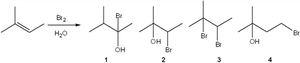
Q2. What is the major organic product obtained from the following reaction?
Background
Topic: Halohydrin formation from alkenes
This question tests your knowledge of the addition of bromine and water to an alkene, resulting in a halohydrin. You need to identify the major product based on regioselectivity and stereochemistry.
Key Terms and Formulas:
Halohydrin: A compound with a halogen and a hydroxyl group on adjacent carbons.
Regioselectivity: The preference for one direction of chemical bond making or breaking over all other possible directions.
Markovnikov's rule: The nucleophile (OH) attaches to the more substituted carbon.
Step-by-Step Guidance
Identify the alkene and the reagents: Br2 and H2O.
Recall the mechanism: Br2 forms a bromonium ion intermediate, which is attacked by water.
Determine which carbon gets the OH group: According to Markovnikov's rule, OH attaches to the more substituted carbon.
Assign the Br and OH groups to the correct carbons and check the possible products.
Try solving on your own before revealing the answer!
Final Answer:
The major product is structure 2: Br and OH on adjacent carbons, with OH on the more substituted carbon.
This follows the Markovnikov addition and halohydrin formation mechanism.
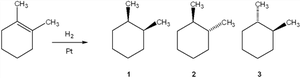
Q3. What is the major organic product obtained from the following reaction?
Background
Topic: Catalytic hydrogenation of alkenes
This question tests your understanding of the reduction of alkenes to alkanes using hydrogen gas and a platinum catalyst. You need to identify the stereochemistry of the product.
Key Terms and Formulas:
Catalytic hydrogenation: Addition of H2 across a double bond, converting an alkene to an alkane.
Stereochemistry: The spatial arrangement of atoms in molecules and its effect on the properties of the molecules.
Syn addition: Both hydrogens add to the same face of the double bond.
Step-by-Step Guidance
Identify the starting material: Cyclohexene with a methyl group.
Recognize the reaction conditions: H2 and Pt indicate catalytic hydrogenation.
Determine the product: The double bond is reduced to a single bond, forming cyclohexane.
Consider the stereochemistry: Hydrogenation is a syn addition, so both hydrogens add to the same face.
Try solving on your own before revealing the answer!
Final Answer:
The major product is structure 1: Both methyl groups are on the same face (cis) of the cyclohexane ring.
Catalytic hydrogenation produces the cis isomer due to syn addition.
