 Back
BackOrganic Chemistry Exam Review: Step-by-Step Guidance
Study Guide - Smart Notes
 Tailored notes based on your materials, expanded with key definitions, examples, and context.
Q1. Which of the following are ethers?
Background
Topic: Ethers and Epoxides
This question tests your ability to identify ether functional groups among several organic molecules. Ethers are compounds where an oxygen atom is bonded to two carbon atoms (R-O-R'). Epoxides are a special class of ethers with a three-membered ring.
Key Terms:
Ether: An organic compound with the general formula R-O-R', where R and R' are alkyl or aryl groups.
Epoxide: A cyclic ether with a three-membered ring.
Step-by-Step Guidance
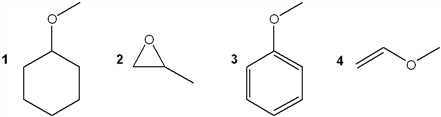
Examine each structure and identify the oxygen atom. Determine if the oxygen is bonded to two carbon atoms (ether) or forms a three-membered ring (epoxide).
For molecule 1, check if the oxygen is bonded to two carbon atoms. For molecule 2, see if the oxygen forms a three-membered ring (epoxide).
For molecule 3, determine if the oxygen is bonded to two carbon atoms, and for molecule 4, check the connectivity of the oxygen atom.
Compare your findings to the definition of ethers and epoxides. Remember, only ethers (not epoxides) should be counted for this question.
Try solving on your own before revealing the answer!
Final Answer: 1, 3, and 4 are ethers
Molecule 2 is an epoxide, not a typical ether. Molecules 1, 3, and 4 have oxygen atoms bonded to two carbon atoms, fitting the ether definition.
Q2. What is the IUPAC name of the following compound?
Background
Topic: Aldehydes and Ketones Nomenclature
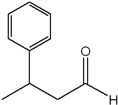
This question tests your ability to apply IUPAC rules to name a compound containing an aromatic ring and an aldehyde functional group.
Key Terms:
Aldehyde: A compound with a carbonyl group (C=O) bonded to a hydrogen atom and an R group.
IUPAC Nomenclature: Systematic method for naming organic compounds based on their structure.
Step-by-Step Guidance
Identify the parent chain: Find the longest carbon chain containing the aldehyde group.
Number the chain so that the aldehyde carbon is position 1.
Identify and name any substituents attached to the ring or chain.
Combine the names according to IUPAC rules, ensuring the aldehyde suffix "-al" is used.
Try solving on your own before revealing the answer!
Final Answer: 3-phenylbutanal
The parent chain is butanal, and the phenyl group is attached at the 3-position.
Q3. What is the major organic product obtained from the following reaction?
Background
Topic: Nucleophilic Addition to Carbonyls (Aldehydes)
This question tests your understanding of the addition of hydrogen cyanide (HCN) to an aldehyde, forming a cyanohydrin.
Key Terms and Formula:
Cyanohydrin: A compound formed by the addition of HCN to a carbonyl group.
Nucleophilic Addition: A reaction where a nucleophile adds to a carbonyl carbon.
Step-by-Step Guidance
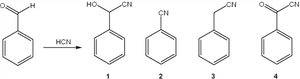
Identify the carbonyl group in the starting material (benzaldehyde).
Recognize that HCN adds across the carbonyl, with the cyanide ion attacking the carbonyl carbon and the proton adding to the oxygen.
Draw the product: The carbonyl carbon now has a hydroxyl group and a cyanide group attached.
Compare the product to the answer choices and select the structure that matches a cyanohydrin.
Try solving on your own before revealing the answer!
Final Answer: Benzaldehyde cyanohydrin (structure 1)
The product is a cyanohydrin, with both a hydroxyl and a cyanide group attached to the former carbonyl carbon.
Q4. What is the major organic product obtained from the following reaction?
Background
Topic: Addition of Alkynes to Carbonyls (Aldehydes)
This question tests your understanding of the addition of a terminal alkyne to an aldehyde, followed by hydrolysis.
Key Terms:
Alkyne Addition: Alkynes can add to carbonyl compounds in the presence of a catalyst.
Hydrolysis: The process of breaking a bond using water.
Step-by-Step Guidance
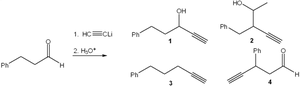
Identify the reactants: An aldehyde and a terminal alkyne (HC≡C–Cu).
Recognize the mechanism: The alkyne adds to the carbonyl carbon, forming a new carbon-carbon bond.
After addition, hydrolysis converts the intermediate to an alcohol.
Compare the product to the answer choices, focusing on the new bond and functional groups.
Try solving on your own before revealing the answer!
Final Answer: Structure 1 (alcohol with phenyl and alkyne groups)
The product is an alcohol formed by the addition of the terminal alkyne to the aldehyde carbon.
Q5. What is the major organic product obtained from the following reaction?
Background
Topic: Intramolecular Hemiacetal Formation
This question tests your understanding of how a molecule with both an alcohol and an aldehyde group can cyclize to form a hemiacetal under acidic conditions.
Key Terms:
Hemiacetal: A compound formed when an alcohol adds to an aldehyde or ketone.
Intramolecular Reaction: A reaction occurring within a single molecule.
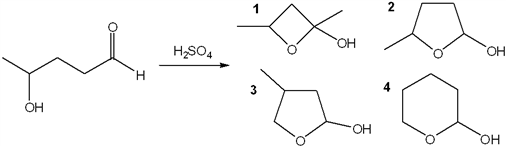
Step-by-Step Guidance
Identify the functional groups: Look for an alcohol and an aldehyde within the same molecule.
Under acidic conditions, the alcohol can attack the carbonyl carbon, forming a ring (hemiacetal).
Draw the possible ring sizes (5- or 6-membered) and check which is most stable.
Compare the ring structures to the answer choices and select the most likely product.
Try solving on your own before revealing the answer!
Final Answer: Structure 1 (five-membered ring hemiacetal)
The most stable product is a five-membered ring hemiacetal formed by intramolecular cyclization.
