 Back
BackOrganic Chemistry I: Chapters 1 & 2 Study Guide – Introduction and General Chemistry Foundations
Study Guide - Smart Notes
 Tailored notes based on your materials, expanded with key definitions, examples, and context.
Chapter 1: Introduction to Organic Chemistry
Learning Mindset and Academic Success
Organic chemistry requires not only scientific knowledge but also a resilient and growth-oriented mindset. This chapter emphasizes the importance of grit, mindset, and learning strategies for success in organic chemistry.
Fixed Mindset: The belief that ability is static and cannot be improved. Students with a fixed mindset may struggle to adapt and persist through challenges.
Growth Mindset: The belief that ability can be developed through dedication and hard work. This mindset leads to greater academic achievement and resilience.
Learning Centered Approach: Focuses on active engagement, using resources, and collaborating with peers to enhance understanding.
Study Strategies: Study early and often, use flashcards, and seek help from allies such as classmates and instructors.
Organic Chemistry as a "Secret Club": Success in this course is attainable with the right approach and persistence.


How the Brain Works: Information Processing
Understanding how the brain processes information can help students optimize their study habits. Information moves from the environment to short-term memory, working memory, and finally long-term storage.
Perceptual Register: Initial processing of sensory information.
Short-Term Memory: Temporary storage for immediate use.
Working Memory: Active manipulation of information for problem-solving.
Long-Term Memory: Permanent storage for future retrieval.

Chapter 2: General Chemistry Translated – Finding the Electrons
Valence Electrons and Atomic Structure
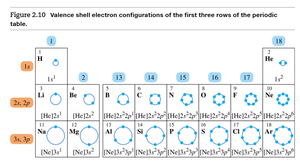
Valence electrons are the outermost electrons of an atom and are crucial for chemical bonding. The number of valence electrons determines an atom's reactivity and bonding behavior.
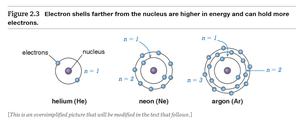
Electron Shells: Electrons occupy shells around the nucleus; shells farther from the nucleus are higher in energy and can hold more electrons.
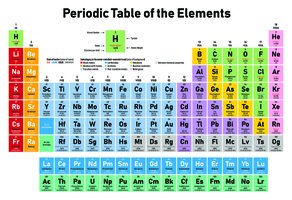
Periodic Table: The arrangement of elements reflects their electron configurations and chemical properties.
Atomic Size and Electronegativity
Atomic size and electronegativity are fundamental concepts for predicting chemical behavior. Larger atoms have weaker holds on their electrons, while smaller atoms are generally more electronegative.
Atomic Size: Increases down a group and decreases across a period.
Electronegativity: The tendency of an atom to attract electrons in a bond. Fluorine is the most electronegative element.
Types of Chemical Bonds
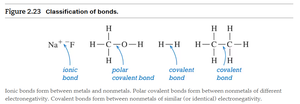
Chemical bonds are classified based on how electrons are distributed between atoms.
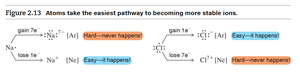
Ionic Bond: One atom transfers electrons to another, forming ions (e.g., NaCl).
Covalent Bond: Atoms share electrons equally (e.g., H2).
Polar Covalent Bond: Atoms share electrons unequally due to differences in electronegativity (e.g., H2O).
Nonpolar Covalent Bond: Atoms share electrons equally (e.g., O2).
Bond Polarity and Electronegativity Differences
The polarity of a bond depends on the difference in electronegativity between the bonded atoms.
Electronegativity Difference:
0 – 0.4: Nonpolar covalent
0.4 – 2.0: Polar covalent
2.0 – 4.0: Ionic
Ranking Bond Polarity: C-F > C-O > C-Cl > C-S > C-H > C-C (from most to least polar covalent)
Lewis Dot Structures and the Octet Rule
Lewis dot structures visually represent the arrangement of valence electrons in molecules. The octet rule states that atoms tend to form bonds to achieve eight electrons in their valence shell.
Octet Rule: Atoms bond to achieve a stable configuration with eight valence electrons.
Drawing Lewis Structures: Place the least electronegative atom (except hydrogen) in the center and arrange other atoms around it.
Formal Charge: Used to check the correctness of Lewis structures; the best structure minimizes formal charges.
Formal Charge Calculation
Formal charge helps determine the most stable Lewis structure for a molecule.
Formula:
Application: Calculate formal charge for each atom in a molecule to confirm the structure's correctness.
Charged Molecules and Reactivity
Charged molecules are important in organic chemistry mechanisms. Areas of electron deficiency (positive charge) are attacked by areas of electron excess (negative charge).
Key Principle: Negative attacks positive (NAP).
Example: The methyl cation (CH3+) cannot have all formal charges zero.
Double Bonds and Multiple Bonding
When single bonds cannot satisfy the octet rule, atoms may share additional pairs of electrons, forming double or triple bonds.
Double Bond: Two pairs of electrons shared between atoms (e.g., C=C).
Triple Bond: Three pairs of electrons shared (e.g., C≡C).
VSEPR Theory: Molecular Shape Prediction
Valence Shell Electron Pair Repulsion (VSEPR) theory predicts the three-dimensional shape of molecules based on electron pair repulsion.
Bond Angles:
sp3: 109.5°
sp2: 120°
sp: 180°
Application: Use Lewis structures to predict molecular geometry.
Dipole Moments
Dipole moments arise from differences in electronegativity and the spatial arrangement of atoms, resulting in partial charges within a molecule.
Direction: Dipole points from positive to negative charge.
Example: Water (H2O) has a strong dipole moment due to its bent shape and electronegative oxygen atom.
Atomic Orbitals and Hybridization
Atomic orbitals (s, p, d, f) combine to form molecular orbitals. Hybridization explains the observed shapes and bond angles in molecules.
Hybridization Types:
sp3: Tetrahedral, 109.5°
sp2: Trigonal planar, 120°
sp: Linear, 180°
Sigma Bond: Formed by direct overlap of orbitals.
Pi Bond: Formed by sideways overlap of p orbitals.
Resonance Structures
Resonance structures represent delocalized electrons within a molecule. The true structure is a hybrid of all possible resonance forms.
Arrow Pushing: Used to show electron movement between resonance forms.
Stability: Resonance structures with negative charge on the most electronegative atom are more stable.
Application: Resonance explains phenomena such as the stability of aromatic compounds and the behavior of functional groups.
Summary of Chapter 2 Skills
Counting valence electrons
Identifying bond types (ionic, covalent, polar covalent)
Drawing Lewis dot structures and satisfying the octet rule
Calculating formal charge
Drawing structures with double/triple bonds and charged atoms
Predicting dipole moments and molecular shapes
Understanding orbital hybridization
Drawing and evaluating resonance structures
