 Back
BackCHP 4 STUDY GUIDE
Study Guide - Smart Notes
 Tailored notes based on your materials, expanded with key definitions, examples, and context.
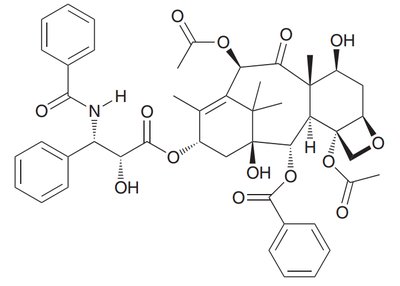
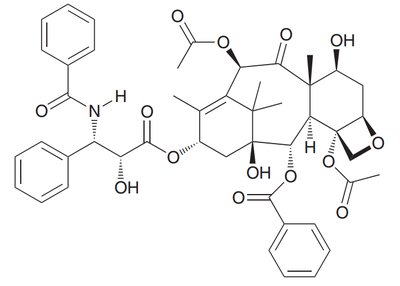
Q1. Taxol Stereochemistry and Structure Analysis
Background
Topic: Stereochemistry and Structural Analysis of Natural Products
This question tests your ability to identify chiral centers, count possible stereoisomers, recognize π bonds, and assign stereochemical configurations (R/S and E/Z) in a complex molecule like Taxol.
Key Terms and Formulas:
Chiral center: A carbon atom bonded to four different groups.
Stereoisomers: Molecules with the same connectivity but different spatial arrangements.
π bond: A bond formed by sideways overlap of p orbitals, typically found in double/triple bonds.
R/S configuration: Assigning absolute configuration using Cahn-Ingold-Prelog rules.
E/Z configuration: Assigning configuration to double bonds based on priority of substituents.
Formula for possible stereoisomers: where is the number of chiral centers.
Step-by-Step Guidance
Examine the Taxol structure and identify all carbon atoms that are bonded to four different groups to count the chiral centers.
Use the formula to determine the maximum number of possible stereoisomers, where is the number of chiral centers found.
Scan the structure for double bonds and count the number of π bonds present (each double bond contains one π bond).
Apply the Cahn-Ingold-Prelog rules to each chiral center to assign R or S configuration. Start by ranking the substituents by atomic number, then trace the path from highest to lowest priority.
For the double bond, assign E or Z configuration by comparing the priority of groups attached to each carbon of the double bond.
Try solving on your own before revealing the answer!
Final Answers:
1a. 11 chiral centers.
1b. 2048 possible stereoisomers.
1c. 16 π bonds.
1d. See image_12 for R/S configuration assignments.
1e. E configuration around the double bond.
Q2. Nomenclature of Organic Compounds
Background
Topic: IUPAC Nomenclature
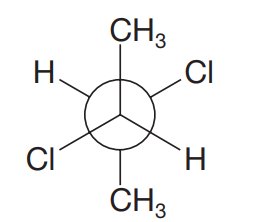
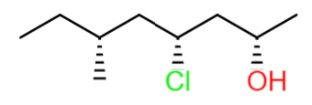
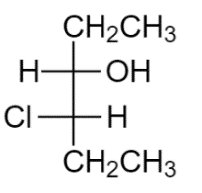
This question tests your ability to name organic compounds using IUPAC rules, including stereochemistry (R/S), functional groups, and substituents.
Key Terms and Formulas:
IUPAC nomenclature: Systematic method for naming organic compounds.
R/S configuration: Indicates absolute configuration at chiral centers.
Functional groups: Alcohol (-OH), halide (Cl), etc.
Step-by-Step Guidance
Identify the longest carbon chain in each compound and number it to give the lowest possible numbers to substituents.
Locate and name all substituents (e.g., chloro, methyl, hydroxy) and assign their positions.
Determine the configuration (R or S) at each chiral center using Cahn-Ingold-Prelog rules.
Combine the information to write the full IUPAC name, including stereochemistry.
Try solving on your own before revealing the answer!
Final Answers:
2a. (2R,3S)-2,3-dichlorobutane
2b. (2S,4R,6R)-4-chloro-6-methyl-2-octanol
2c. (3S,4S)-4-chloro-3-hexanol
Q3. Drawing the Enantiomer of a Compound
Background
Topic: Stereochemistry – Enantiomers
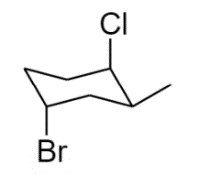
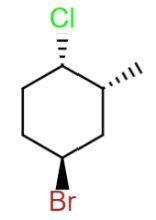
This question tests your ability to draw the enantiomer of a given compound, specifically when a substituent (bromine) is on a dashed wedge.
Key Terms and Formulas:
Enantiomer: Non-superimposable mirror image of a chiral molecule.
Dashed wedge: Indicates a group going away from the viewer.
Solid wedge: Indicates a group coming toward the viewer.
Step-by-Step Guidance
Identify the chiral center(s) in the compound.
Draw the mirror image of the compound, switching the positions of all groups attached to the chiral center(s).
Ensure that the dashed wedge becomes a solid wedge in the enantiomer, and vice versa.
Try solving on your own before revealing the answer!
Final Answer:
Q4. Optical Activity and Enantiomeric Excess
Background
Topic: Optical Activity and Enantiomeric Excess
This question tests your understanding of specific rotation, enantiomeric excess (% ee), and the calculation of enantiomer composition in a mixture.
Key Terms and Formulas:
Specific rotation (): The observed rotation divided by concentration and path length.
Enantiomeric excess (% ee):
Mixture composition:
Step-by-Step Guidance
Recall that enantiomers have equal and opposite specific rotations.
Calculate the specific rotation of the R enantiomer, knowing the S enantiomer's value and the sign convention.
Use the observed rotation and the specific rotation of the pure enantiomer to calculate % ee.
Apply the formula for mixture composition to find the percentage of the S enantiomer.
Try solving on your own before revealing the answer!
Final Answers:
4a. -60 (specific rotation of R enantiomer)
4b. 90% ee
4c. 5% S enantiomer
Q5. Identifying Relationships Between Compounds
Background
Topic: Isomerism – Constitutional Isomers, Enantiomers, Diastereomers
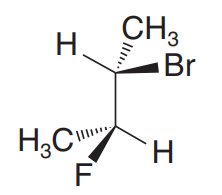
This question tests your ability to distinguish between constitutional isomers, enantiomers, and diastereomers based on structural and stereochemical differences.
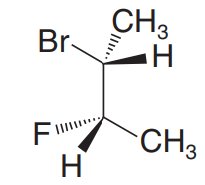
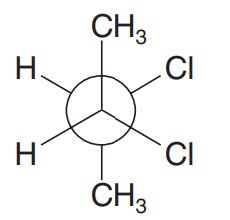
Key Terms and Formulas:
Constitutional isomers: Same molecular formula, different connectivity.
Enantiomers: Non-superimposable mirror images.
Diastereomers: Stereoisomers that are not mirror images.
Step-by-Step Guidance
Compare the connectivity of atoms in each pair to check for constitutional isomerism.
Check if the compounds are mirror images of each other (enantiomers).
If they are stereoisomers but not mirror images, they are diastereomers.
Try solving on your own before revealing the answer!
Final Answers:
5a. Diastereomers
5b. Diastereomers
5c. Enantiomers
