 Back
BackOrganometallic Compounds: Structure, Preparation, and Reactions
Study Guide - Smart Notes
 Tailored notes based on your materials, expanded with key definitions, examples, and context.
Organometallic Compounds
Introduction to Organometallic Compounds
Organometallic compounds are molecules that contain a direct bond between a carbon atom and a metal. These compounds are essential in organic synthesis due to their unique reactivity, especially as nucleophiles in carbon–carbon bond-forming reactions. The most commonly studied organometallic reagents in undergraduate organic chemistry are organomagnesium (Grignard reagents), organolithium, and organocopper compounds.
Organomagnesium compounds are known as Grignard reagents.
Organolithium reagents are highly reactive and serve as strong bases and nucleophiles.
Organocopper reagents (Gilman reagents) are used for coupling reactions.
Preparation of Organometallic Reagents
Grignard Reagents (Organomagnesium Compounds)
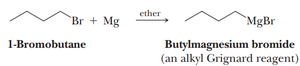
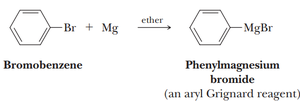
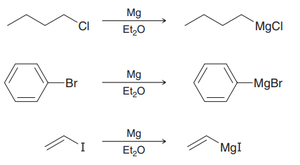
Grignard reagents are prepared by the reaction of an alkyl, aryl, or vinyl halide with magnesium metal in an ether solvent (commonly diethyl ether or tetrahydrofuran, THF). The reaction is exothermic and must be carefully controlled to maintain a gentle reflux.
General Reaction:
Reactivity order of halides: Iodides > Bromides > Chlorides
Grignard reagents are named after Victor Grignard, who discovered them.
Organolithium Reagents
Organolithium compounds are prepared by treating an organohalide with two equivalents of lithium metal. These reagents are even more reactive than Grignard reagents and must be handled under an inert atmosphere due to their sensitivity to moisture and oxygen.
General Reaction:
Organolithium reagents are powerful nucleophiles and bases.
Structure and Solvation
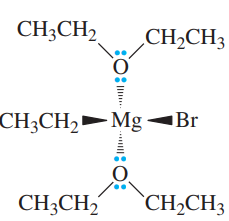
Grignard reagents exist as coordination complexes in solution, with magnesium acting as a Lewis acid and the ether solvent as a Lewis base. This solvation is crucial for their stability and reactivity.
Bond Character and Reactivity
Bond Polarity and Ionic Character
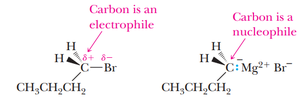
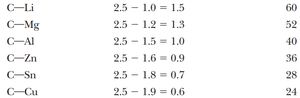
The carbon–metal bond in organometallic compounds is polar covalent, with the carbon atom bearing a partial negative charge and the metal a partial positive charge. The percent ionic character can be estimated from the electronegativity difference between carbon and the metal.
Bond | EN Difference | % Ionic Character |
|---|---|---|
C–Li | 2.5 – 1.0 = 1.5 | 60 |
C–Mg | 2.5 – 1.2 = 1.3 | 52 |
C–Al | 2.5 – 1.5 = 1.0 | 40 |
C–Zn | 2.5 – 1.6 = 0.9 | 36 |
C–Sn | 2.5 – 1.8 = 0.7 | 28 |
C–Cu | 2.5 – 1.9 = 0.6 | 24 |
Solubility and Aggregation
Organolithium reagents are soluble in nonpolar solvents due to their tendency to aggregate, presenting a nonpolar surface to the solvent. This property distinguishes them from Grignard reagents, which require ether solvents for stability.
Reactivity of Organometallic Reagents
Reaction with Proton Acids
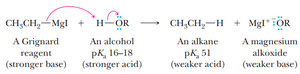
Both Grignard and organolithium reagents are strong bases and react rapidly with any proton donor stronger than the alkane from which they are derived. This includes water, alcohols, and other functional groups with acidic protons.
General Reaction:
These reagents must be handled under anhydrous conditions.

Functional Group Compatibility
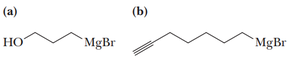
Grignard and organolithium reagents will react with any functional group containing a weakly acidic proton (e.g., OH, NH, SH, terminal alkynes, COOH). Therefore, such groups must be absent from the starting organohalide.
Reactions with Electrophiles
Reactions with Carbonyl Compounds
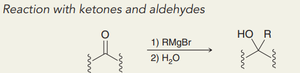
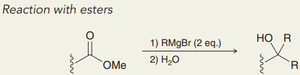
Grignard reagents add to carbonyl compounds (aldehydes, ketones, esters) to form alcohols after hydrolysis. This is a key method for forming new carbon–carbon bonds in organic synthesis.
With Aldehydes/Ketones:
With Esters: Two equivalents of Grignard reagent are required to produce a tertiary alcohol.
Reactions with Epoxides
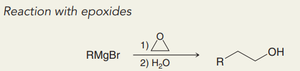
Grignard reagents open epoxides to give primary alcohols after hydrolysis, extending the carbon chain by two carbons.
Organocopper and Organozinc Reagents
Lithium Dialkyl Cuprates (Gilman Reagents)
Gilman reagents (R2CuLi) are prepared by treating an organolithium compound with copper(I) halide. They are used in coupling reactions with organohalides (Corey–Posner/Whitesides–House reaction) to form new C–C bonds, especially with primary alkyl halides.
General Reaction:
The reaction is stereospecific and tolerates various functional groups.
Organozinc Compounds and the Simmons–Smith Reaction
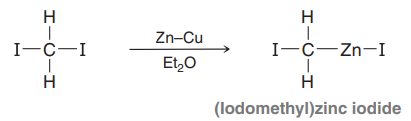
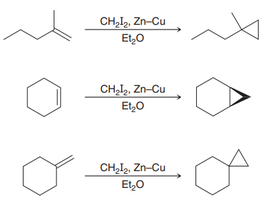
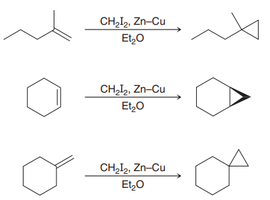
Organozinc compounds, such as (iodomethyl)zinc iodide, are used in the Simmons–Smith reaction to convert alkenes into cyclopropanes. The reaction is stereospecific and proceeds via a concerted mechanism.
Palladium-Catalyzed Coupling Reactions
Stille Coupling
The Stille coupling is a palladium-catalyzed reaction between an organostannane and an organic halide or triflate to form a new C–C bond. The reaction proceeds via oxidative addition, transmetallation, and reductive elimination steps.
Catalyst: Pd(PPh3)4 (palladium(0) complex)
Coupling partners: R (from organostannane), R' (from organic halide/triflate)
Suzuki Coupling
The Suzuki coupling is similar to the Stille coupling but uses an organoboron compound instead of an organotin. It is widely used due to the low toxicity and cost of boron reagents. The reaction is stereospecific and useful for forming bonds between sp2 and sp3 centers.



Advantages: Mild conditions, low toxicity, easy removal of by-products.
Disadvantage: Requires basic conditions.
Heck Reaction
The Heck reaction couples an aryl, vinyl, or benzyl halide with an alkene in the presence of a palladium catalyst. The reaction is stereospecific and forms a new C–C bond between two sp2-hybridized centers.
General Reaction:
The reaction proceeds via syn addition and syn reductive elimination.
Summary Table: Key Organometallic Reagents
Reagent | Preparation | Key Reactions | Notes |
|---|---|---|---|
Grignard (RMgX) | R–X + Mg (ether) | Addition to C=O, epoxides, esters | Strong base, nucleophile |
Organolithium (RLi) | R–X + 2Li | Similar to Grignard, stronger base | Very reactive, handle under inert atmosphere |
Gilman (R2CuLi) | R–Li + CuX | Coupling with R'–X | Milder, stereospecific |
Organozinc (RZnX) | R–X + Zn | Simmons–Smith cyclopropanation | Mild, stereospecific |
Organoboron (RB(OR')2) | Hydroboration | Suzuki coupling | Low toxicity, mild |
Additional info: The mechanisms of palladium-catalyzed couplings (Stille, Suzuki, Heck) involve oxidative addition, transmetallation, and reductive elimination steps. These reactions are foundational in modern organic synthesis for constructing complex molecules, including pharmaceuticals and natural products.
