 Back
BackRadical Halogenation of Alkanes: Mechanism and Synthetic Importance
Study Guide - Smart Notes
 Tailored notes based on your materials, expanded with key definitions, examples, and context.
Radical Halogenation of Alkanes
Introduction to Alkane Reactivity
Alkanes are saturated hydrocarbons that serve as the backbone of many organic molecules. Despite their abundance, especially as products of petroleum refining, they are generally unreactive due to the strength and nonpolarity of their C–H and C–C bonds. The primary reaction that allows for their transformation into more useful compounds is free radical halogenation, which introduces a functional group and opens the door to further synthetic transformations.
Alkanes: Saturated hydrocarbons with only single bonds (C–C and C–H).
Unreactivity: Alkanes are largely inert under standard conditions.
Gateway Reaction: Radical halogenation is the main method to functionalize alkanes, making them reactive intermediates for further synthesis.
The Radical Chain Reaction Mechanism
Overview of the Radical Chain Process
Alkanes react with diatomic halogens (such as Cl2 or Br2) in the presence of heat, light, or a radical initiator. This process follows a chain mechanism with three main steps: initiation, propagation, and termination.
Initiation: Generation of halogen radicals by homolytic cleavage of the diatomic halogen molecule.
Propagation: Radicals react with alkanes to form alkyl radicals, which then react with more halogen molecules to produce alkyl halides and regenerate halogen radicals.
Termination: Two radicals combine to form a stable molecule, ending the chain reaction.
Stepwise Mechanism
Initiation:
Halogen molecule absorbs energy (heat or light) and splits into two halogen radicals.
Equation:
Propagation:
Halogen radical abstracts a hydrogen atom from the alkane, forming HX and an alkyl radical.
Alkyl radical reacts with another halogen molecule, forming the alkyl halide and regenerating a halogen radical.
Equations:
Termination:
Two radicals combine to form a stable molecule, removing radicals from the system.
Possible combinations: , ,
Applications and Synthetic Importance
Functionalization and Further Transformations
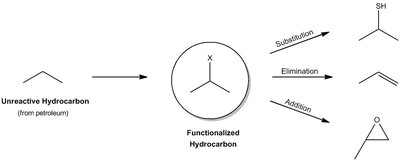
Radical halogenation transforms unreactive alkanes into alkyl halides, which are versatile intermediates in organic synthesis. These functionalized hydrocarbons can undergo a variety of reactions, including substitution, elimination, and addition, to yield a wide range of products such as thiols, alkenes, and epoxides.
Substitution: Alkyl halides can be converted to other functional groups (e.g., thiols, alcohols) via nucleophilic substitution.
Elimination: Alkyl halides can undergo elimination to form alkenes.
Addition: Alkenes can be further transformed, for example, to epoxides via oxidation.
Example: Chlorination of propane yields 1-chloropropane and 2-chloropropane, with the major product determined by the stability of the intermediate radical.
Summary Table: Radical Halogenation Steps
Step | Description | Example Equation |
|---|---|---|
Initiation | Formation of halogen radicals | |
Propagation | Radical chain continues, forming alkyl halide |
|
Termination | Radicals combine to end the chain |
Additional info: The selectivity of halogenation (e.g., chlorination vs. bromination) depends on the reactivity of the halogen and the stability of the intermediate radical. Bromination is more selective for more substituted (and thus more stable) radicals, while chlorination is less selective but faster.
