 Back
BackReactions and Properties of Carboxylic Acids and Their Derivatives
Study Guide - Smart Notes
 Tailored notes based on your materials, expanded with key definitions, examples, and context.
Carboxylic Acids and Their Derivatives
Overview of Carboxylic Acid Derivatives
Carboxylic acids and their derivatives are a fundamental class of organic compounds characterized by the presence of a carbonyl group (C=O) bonded to a heteroatom or group that can be replaced by a nucleophile. These derivatives include esters, acyl chlorides, amides, and others, each with distinct reactivity and physical properties.
Carboxylic acids: RCOOH
Esters: RCOOR'
Acyl chlorides: RCOCl
Amides: RCONH2, RCONHR', RCONR'2

Relative Reactivity of Carboxylic Acid Derivatives
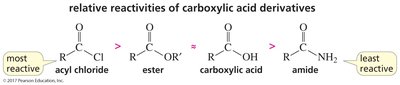
The reactivity of carboxylic acid derivatives toward nucleophilic substitution depends on the nature of the leaving group attached to the carbonyl carbon. The order of reactivity is:
Acyl chlorides (most reactive)
Esters
Carboxylic acids
Amides (least reactive)
Cyclic Carboxylic Acid Derivatives: Lactones and Lactams
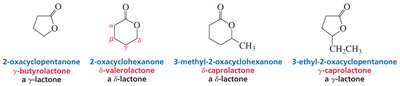
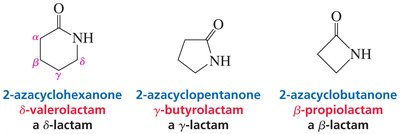
Cyclic esters are called lactones, and cyclic amides are called lactams. The size of the ring is indicated by Greek letters (β, γ, δ, etc.), which correspond to the position of the heteroatom relative to the carbonyl group.
Lactones: Cyclic esters, e.g., γ-butyrolactone, δ-valerolactone
Lactams: Cyclic amides, e.g., β-propiolactam, γ-butyrolactam, δ-valerolactam
The Carboxyl Group
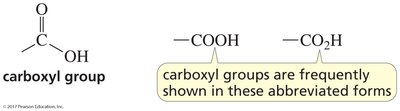
The carboxyl group is the functional group of carboxylic acids, typically represented as –COOH or –CO2H. It consists of a carbonyl group bonded to a hydroxyl group.
Structure and Bonding
Resonance in Carboxylic Acid Derivatives
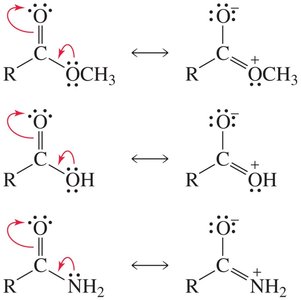
Esters, carboxylic acids, and amides exhibit resonance, which stabilizes the molecule by delocalizing electrons between the carbonyl oxygen and the heteroatom (O or N). This resonance affects their reactivity and physical properties.
Physical Properties
Boiling Points and Intermolecular Forces
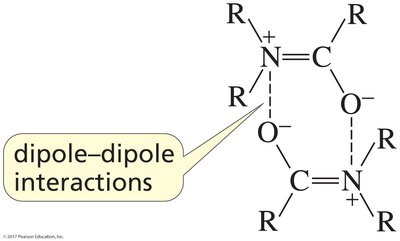
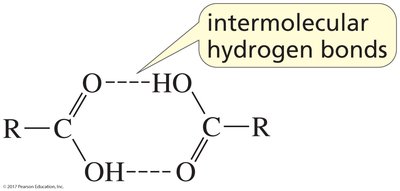
The boiling points of carboxylic acids and their derivatives are influenced by their ability to form hydrogen bonds and dipole-dipole interactions. Amides and carboxylic acids have higher boiling points due to strong hydrogen bonding, while esters and acyl chlorides have lower boiling points.
Amides > Carboxylic acids > Esters ≈ Acyl chlorides ≈ Ketones ≈ Aldehydes > Ethers

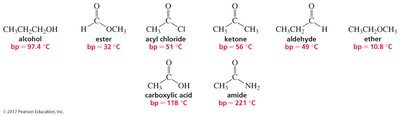
Amides have the highest boiling points due to extensive hydrogen bonding, while esters and acyl chlorides have lower boiling points due to weaker dipole-dipole interactions.
Reactivity and Mechanisms
Electrophilicity of the Carbonyl Carbon
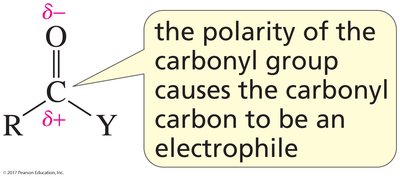
The carbonyl carbon in carboxylic acid derivatives is electrophilic due to the polarization of the C=O bond, making it susceptible to nucleophilic attack.
Nucleophilic Acyl Substitution Mechanism
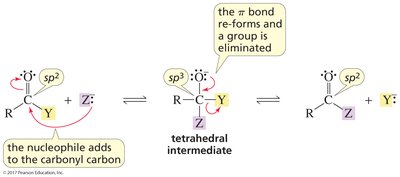
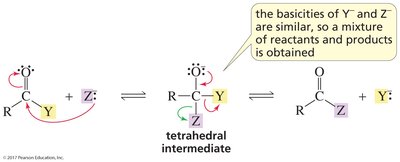
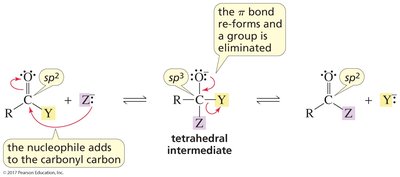
Nucleophilic acyl substitution involves the addition of a nucleophile to the carbonyl carbon, forming a tetrahedral intermediate, followed by elimination of the leaving group. The nature of the leaving group determines the reaction's outcome.
Basicity of Leaving Groups
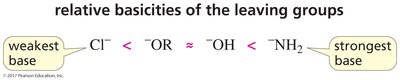
The leaving group's basicity affects the reactivity of carboxylic acid derivatives. The weaker the base, the better the leaving group. The order is:
Cl− (weakest base, best leaving group)
RO− ≈ HO−
NH2− (strongest base, poorest leaving group)
Reaction Pathways Based on Nucleophile Strength
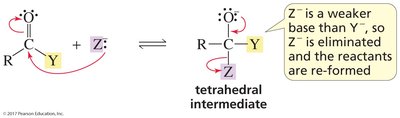
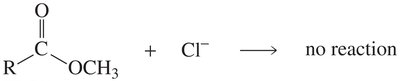
If the incoming nucleophile is a weaker base than the leaving group, the reaction is reversible and the reactants are reformed. If the nucleophile is a stronger base, the product is formed. If both have similar basicity, a mixture results.
Comparison with SN2 Reactions
When a nucleophile attacks an alkyl halide, the sigma bond breaks (SN2 mechanism). When a nucleophile attacks a carbonyl compound, the pi bond breaks, forming a tetrahedral intermediate.

Reaction Coordinate Diagrams
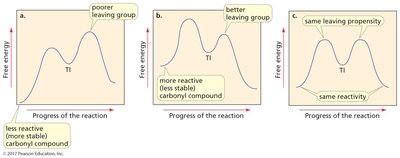
The energy profile of nucleophilic acyl substitution depends on the stability of the leaving group. Better leaving groups lower the activation energy and increase reactivity.
Summary Table: Carboxylic Acid Derivatives
Derivative | General Formula | Reactivity | Boiling Point | Key Reaction |
|---|---|---|---|---|
Acyl chloride | RCOCl | Most reactive | Low | Hydrolysis, alcoholysis, aminolysis |
Ester | RCOOR' | Moderate | Low | Hydrolysis, transesterification |
Carboxylic acid | RCOOH | Moderate | High | Esterification, amidation |
Amide | RCONH2 | Least reactive | Highest | Hydrolysis (acid/base catalyzed) |
Additional info: The above table summarizes the main properties and reactivity trends of carboxylic acid derivatives, which are central to understanding their behavior in organic synthesis.
