 Back
BackReactions at the α-Carbon of Carbonyl Compounds
Study Guide - Smart Notes
 Tailored notes based on your materials, expanded with key definitions, examples, and context.
Reactions at the α-Carbon of Carbonyl Compounds
Acidity of the α-Hydrogen
The α-carbon in carbonyl compounds is the carbon atom directly adjacent to the carbonyl group. Hydrogens attached to this carbon are known as α-hydrogens. These hydrogens are significantly more acidic than those in alkanes due to the resonance stabilization of the resulting conjugate base (enolate ion) by the carbonyl group.
pKa Values: In aldehydes and ketones, the pKa of the α-hydrogen is typically 16–20, compared to about 60 for ethane.
Esters: The α-hydrogens of esters are less acidic (pKa ≈ 25) because the resonance stabilization is less effective.
Enhanced Acidity: When the α-hydrogen is flanked by two carbonyl groups (as in β-diketones or β-keto esters), its acidity increases dramatically (pKa ≈ 9–11).
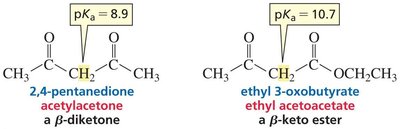
Example: 2,4-pentanedione (acac, acetylacetone) has a central α-hydrogen with a pKa of 8.9, while ethyl acetoacetate (a β-keto ester) has a pKa of 10.7.
Keto-Enol Tautomerism
Keto-enol tautomerism is an equilibrium between two isomers (tautomers) that differ in the position of a proton and a double bond. The keto form contains a carbonyl group (C=O), while the enol form contains an alkene (C=C) and an alcohol (OH) group.
Isomer Type: Keto and enol tautomers are constitutional isomers (they differ in connectivity).
Stability: The keto form is usually much more stable due to the strength of the C=O bond compared to the C=C bond.
Predominance: In most simple ketones and aldehydes, the equilibrium lies heavily toward the keto form.
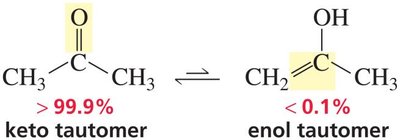
Example: For acetone, more than 99.9% exists as the keto tautomer, with less than 0.1% as the enol.
However, certain structural features (such as conjugation or intramolecular hydrogen bonding) can stabilize the enol form, making it more prevalent in some compounds.
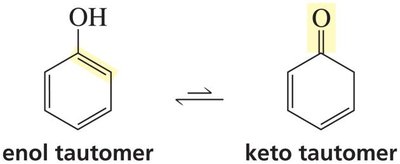
Example: In phenol, the enol form is stabilized by aromaticity, making it the predominant tautomer.
Mechanism of Tautomerism
The interconversion between keto and enol forms (tautomerism) can be catalyzed by either acid or base. The mechanism involves the movement of a proton and the shifting of a double bond.
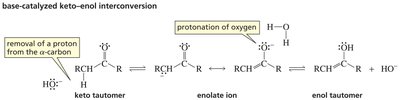
Base-Catalyzed Tautomerism
The base removes an α-hydrogen, forming an enolate ion.
Protonation of the enolate ion at the oxygen yields the enol tautomer.
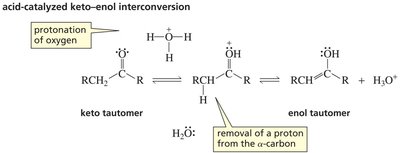
Acid-Catalyzed Tautomerism
The carbonyl oxygen is first protonated, increasing the acidity of the α-hydrogen.
Removal of the α-hydrogen by water leads to the enol form.
The Aldol Reaction
The aldol reaction is a fundamental carbon–carbon bond-forming reaction in organic chemistry. It involves the reaction of two aldehydes or ketones (at least one with α-hydrogens) under acidic or basic conditions to form a β-hydroxy aldehyde or ketone (an "aldol").
Mechanism: The reaction proceeds via enol or enolate formation, nucleophilic attack on another carbonyl compound, and protonation.
Product: The product contains both an alcohol (–OH) and a carbonyl group, specifically at the β-position relative to the carbonyl.
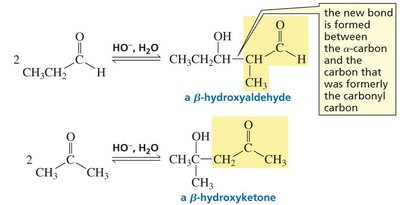
Example: Two molecules of acetaldehyde react to form 3-hydroxybutanal (a β-hydroxyaldehyde).
Mechanism of the Aldol Reaction (Basic Conditions)
Enolization: Formation of the enolate ion from the α-hydrogen.
Nucleophilic Attack: The enolate attacks the carbonyl carbon of another molecule.
Protonation: The alkoxide intermediate is protonated to yield the β-hydroxy product.
Biosynthesis of Fructose: Biological Aldol Reaction
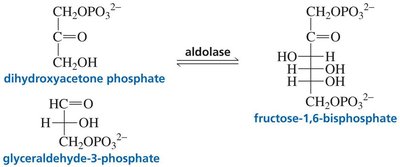
In biological systems, the enzyme aldolase catalyzes an aldol reaction during the biosynthesis of fructose. This is an example of a crossed aldol reaction (between two different carbonyl compounds): dihydroxyacetone phosphate and glyceraldehyde-3-phosphate combine to form fructose-1,6-bisphosphate.
Nucleophile: Dihydroxyacetone phosphate acts as the nucleophile.
Electrophile: Glyceraldehyde-3-phosphate acts as the electrophile.
New Bond: The new C–C bond forms between the α-carbon of the nucleophile and the carbonyl carbon of the electrophile.
Additional info: The aldol reaction is a key step in both laboratory organic synthesis and metabolic pathways, illustrating the importance of α-carbon reactivity in carbonyl chemistry.
