 Back
BackReactions of Aldehydes, Ketones, and Carboxylic Acid Derivatives
Study Guide - Smart Notes
 Tailored notes based on your materials, expanded with key definitions, examples, and context.
Reactions of Aldehydes and Ketones
Overview of Carbonyl Compounds
Aldehydes, ketones, and carboxylic acid derivatives are central to organic synthesis due to their reactivity and versatility. Their chemistry is governed by the electrophilic nature of the carbonyl carbon, which is susceptible to nucleophilic attack.
Classification of Carbonyl Compounds
Class I Carbonyl Compounds
Class I carbonyl compounds contain a group that can be replaced by a nucleophile. These include:
Carboxylic acids (RCOOH)
Esters (RCOOR')
Anhydrides (RCO)2O
Acyl chlorides (RCOCl)
Amides (RCONH2, RCONHR', RCONR'2)
These compounds undergo nucleophilic acyl substitution reactions.

Class II Carbonyl Compounds
Class II carbonyl compounds do not have a good leaving group attached to the carbonyl carbon. The main examples are:
Aldehydes (RCHO)
Ketones (RCOR')
These compounds typically undergo nucleophilic addition reactions rather than substitution.

Relative Reactivity of Carbonyl Compounds
Reactivity Order
The reactivity of carbonyl compounds towards nucleophilic addition or substitution depends on the nature of the substituents and the ability of the leaving group. The general order of reactivity is:
Most Reactive | → | Least Reactive |
|---|---|---|
Acyl halide | → | Acid anhydride |
Acid anhydride | → | Aldehyde |
Aldehyde | → | Ketone |
Ketone | → | Ester |
Ester | → | Carboxylic acid |
Carboxylic acid | → | Amide |
Amide | → | Carboxylate ion |

Key Point: The more reactive the compound, the easier it is for a nucleophile to attack the carbonyl carbon.
Nucleophilic Addition to Carbonyls
General Mechanism
Nucleophilic addition is favored when the nucleophile is a strong base, such as an alkyl anion (R-) or hydride (H-). The nucleophile attacks the electrophilic carbonyl carbon, forming a tetrahedral intermediate.
Step 1: Nucleophile attacks the carbonyl carbon.
Step 2: Protonation of the oxygen atom yields the alcohol product.
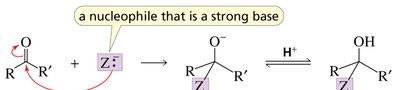
Note: The reaction is generally irreversible if the nucleophile is a strong base, as the leaving group is too basic to be eliminated.

Grignard Reagents and Esters
Reactions with Esters
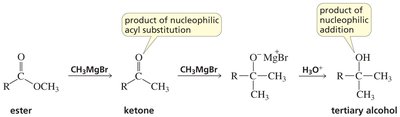
Grignard reagents (RMgX) react with esters via nucleophilic acyl substitution to produce a ketone, which then undergoes nucleophilic addition to yield a tertiary alcohol. Two equivalents of Grignard reagent are required for complete reaction.
Step 1: Nucleophilic acyl substitution forms a ketone intermediate.
Step 2: Nucleophilic addition to the ketone forms a tertiary alcohol.
Utility of Grignard Reagents
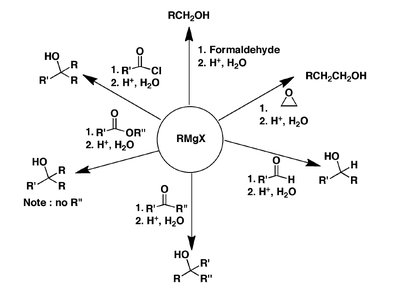
Grignard reagents are versatile nucleophiles that can react with a variety of carbonyl compounds to form alcohols of different types, depending on the starting material.
Reduction of Carbonyl Compounds
LiAlH4 vs NaBH4
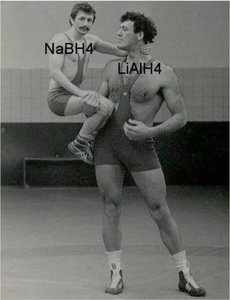
Two common hydride reducing agents are lithium aluminum hydride (LiAlH4) and sodium borohydride (NaBH4). LiAlH4 is a much stronger reducing agent and can reduce esters, carboxylic acids, and amides, while NaBH4 is milder and typically reduces only aldehydes and ketones.
LiAlH4: Strong, reduces most carbonyls including esters and acids.
NaBH4: Milder, reduces aldehydes and ketones.
Reduction of Carboxylic Acids and Amides
Carboxylic acids: Reduced by hydride to primary alcohols with the same number of carbons.
Amides: Unsubstituted amides yield primary amines; N-substituted amides yield secondary or tertiary amines.
Note: The mechanism for reduction of N-substituted amides is not required at this level.
Chemoselectivity in Organic Reactions
Definition and Examples
Chemoselectivity refers to the preferential reaction of a reagent with one functional group in the presence of others. For example, catalytic hydrogenation with Lindlar's catalyst selectively reduces alkynes to cis-alkenes, while other reagents may reduce multiple functional groups.
Nucleophilic Addition-Elimination Mechanism
When the nucleophile is oxygen or nitrogen and acid is present, nucleophilic addition can be followed by elimination, leading to imine or oxime formation. The rate of imine formation is pH-dependent.
Imine formation: Reaction of aldehyde/ketone with a primary amine.
Oxime formation: Reaction with hydroxylamine.
Example: Formation of oxime from aldehyde and hydroxylamine, with water as a byproduct.
Acetal Formation and Protecting Groups
Acetal Formation Mechanism
Acetals are formed by the reaction of aldehydes or ketones with alcohols in the presence of acid. Acetals are stable to base and serve as protecting groups for carbonyls during multi-step synthesis.
Protecting group: A group introduced to protect a functional group from unwanted reactions during a synthetic sequence.
Example: Selective protection of an aldehyde in the presence of a ketone.
Baeyer-Villiger Oxidation
The Baeyer-Villiger oxidation converts ketones to esters or cyclic ketones to lactones using peroxy acids. The migration tendency of groups during the reaction determines the product.
Wittig Reaction
The Wittig reaction is important for the synthesis of alkenes from aldehydes or ketones using phosphonium ylides. It allows for the formation of carbon-carbon double bonds with control over stereochemistry.
Kinetic vs Thermodynamic Control
Reactions can be controlled to favor either the kinetic (faster-forming, less stable) or thermodynamic (slower-forming, more stable) product by adjusting reaction conditions such as temperature and base strength.
Kinetic control: Low temperature, strong, bulky base favors the less substituted, faster-forming product.
Thermodynamic control: Higher temperature, weaker base favors the more substituted, more stable product.
