 Back
BackReactions of Alkenes: Mechanisms, Regioselectivity, and Stereochemistry
Study Guide - Smart Notes
 Tailored notes based on your materials, expanded with key definitions, examples, and context.
Reactions of Alkenes and Alkynes
A. Stability of Carbocations
The addition of hydrogen halides (such as HBr, HCl, and HI) to alkenes proceeds through the formation of carbocation intermediates. The stability of these carbocations plays a crucial role in determining the major product of the reaction.
Carbocation Formation: When a hydrogen halide adds to an alkene, the π bond attacks the proton (H+), leading to the formation of a carbocation intermediate.
Regioisomers: If the alkene carbons have different substituents, two constitutional isomers (regioisomers) can form. The reaction is regioselective if one isomer predominates.
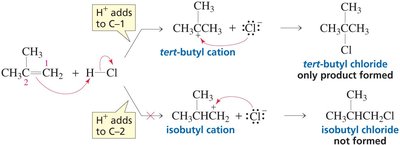
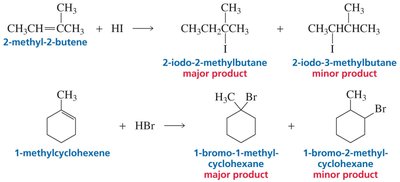
Markovnikov's Rule: The major product is formed by addition of the nucleophile (e.g., Cl-) to the carbon that forms the most stable carbocation. This is a modern restatement of Markovnikov’s Rule.

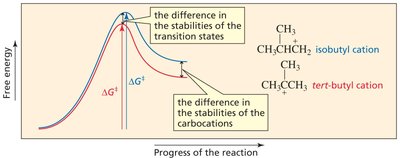
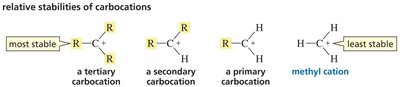
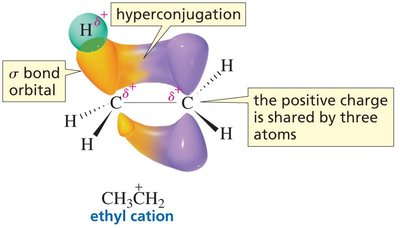
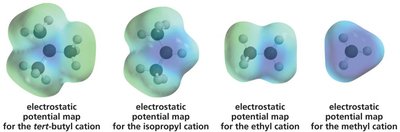
Carbocation Stability: Tertiary carbocations are more stable than secondary, which are more stable than primary, due to alkyl group electron-donating effects and hyperconjugation.
Hyperconjugation: Alkyl groups stabilize carbocations by delocalizing the positive charge through hyperconjugation, where adjacent σ bonds donate electron density to the empty p orbital of the carbocation.
Regioselectivity Example: In the addition of HI to 2-methyl-2-butene, the major product results from the more stable carbocation intermediate.
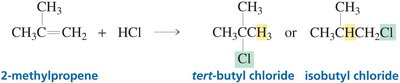
Example: The addition of HCl to 2-methylpropene yields tert-butyl chloride as the major product due to the formation of a more stable tertiary carbocation.
B. Carbocation Rearrangements
Carbocation intermediates can undergo rearrangements to form more stable carbocations, affecting the final product distribution.
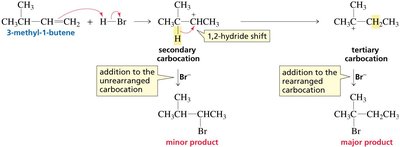
1,2-Hydride Shift: A hydride (H-) migrates from an adjacent carbon to the carbocation center, converting a less stable carbocation into a more stable one.

1,2-Methyl Shift: A methyl group migrates from an adjacent carbon to the carbocation center, again increasing stability.
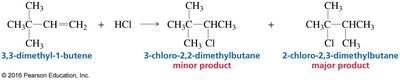
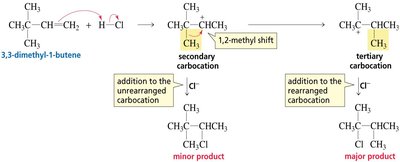
Example: In the addition of HBr to 3-methyl-1-butene, a hydride shift leads to a tertiary carbocation, resulting in the major product.
C. Acid-Catalyzed Addition of Water to Alkenes
The addition of water to alkenes (hydration) is similar to hydrogen halide addition but requires an acid catalyst, typically H2SO4, to activate water as an electrophile.
Mechanism: The alkene is protonated to form a carbocation, which is then attacked by water. The resulting oxonium ion is deprotonated to yield the alcohol and regenerate the acid catalyst.
Regioselectivity: The proton adds to the carbon with more hydrogens, forming the more stable carbocation intermediate.
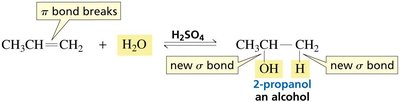

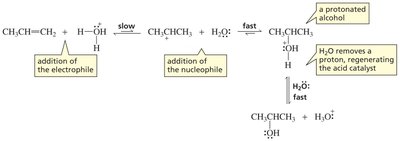
Example: Hydration of propene with H2SO4 yields 2-propanol as the major product.
D. Reactions Producing Stereoisomers
When addition reactions create new asymmetric centers, mixtures of stereoisomers (enantiomers or diastereomers) can result. The stereochemistry of the product depends on the mechanism and the symmetry of the intermediate.
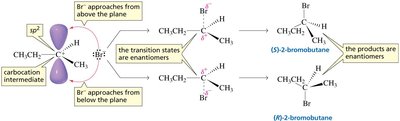
Chiral Centers: If a carbocation intermediate is planar, nucleophilic attack can occur from either side, leading to racemic mixtures if a new chiral center is formed.
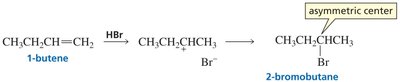
Example: Addition of HBr to 1-butene forms 2-bromobutane, which has a new asymmetric center and can exist as two enantiomers.
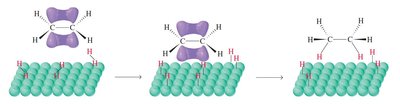
Catalytic Hydrogenation: The addition of H2 to alkenes over a metal catalyst (e.g., Pt) is a syn addition, leading to specific stereochemical outcomes depending on the substrate.
E. Importance of Chirality in Biological Systems
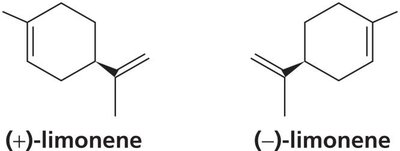
Chirality is fundamental in biological chemistry. Enantiomers can have drastically different biological activities because biological macromolecules (proteins, DNA, carbohydrates) are chiral and can distinguish between enantiomers.
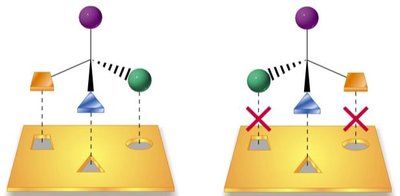
Receptor Binding: Only one enantiomer may fit a specific receptor, leading to selective biological responses.
Enzyme Specificity: Enzymes, which are chiral, typically catalyze reactions for only one enantiomer of a substrate, producing only one stereoisomer as product.
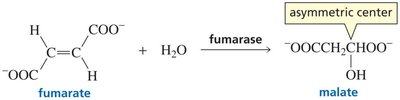
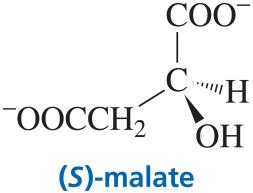
Example: The enzyme fumarase catalyzes the addition of water to fumarate, producing only (S)-malate, demonstrating the stereospecificity of enzymatic reactions.
