 Back
Backch 8 Reactions of Alkenes: Mechanisms, Stereochemistry, and Applications
Study Guide - Smart Notes
 Tailored notes based on your materials, expanded with key definitions, examples, and context.
Reactions of Alkenes
Introduction to Alkene Reactivity
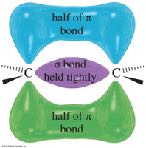
Alkenes are hydrocarbons containing at least one carbon–carbon double bond. The double bond consists of a sigma (σ) bond and a pi (π) bond. The π electrons are more loosely held and are thus more reactive, making alkenes susceptible to a variety of addition reactions. Most reactions of alkenes involve the transformation of the π bond into new σ bonds, often through electrophilic addition mechanisms.
General Mechanism of Electrophilic Addition
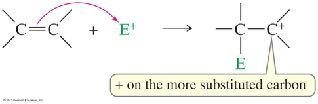
Electrophilic addition is the most common reaction type for alkenes. The mechanism typically involves two steps:
Step 1: The π electrons of the alkene attack an electrophile, forming a carbocation intermediate.
Step 2: A nucleophile attacks the carbocation, resulting in the addition product.
Types of Additions to Alkenes
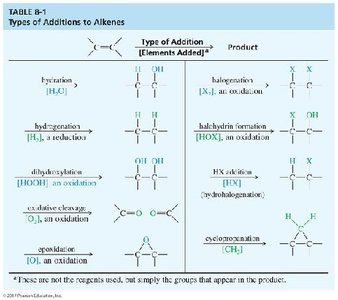
Alkenes undergo a variety of addition reactions, each with characteristic reagents and products. The table below summarizes the main types:
Type of Addition | Elements Added | Product |
|---|---|---|
Hydration | H2O | Alcohol |
Hydrohalogenation | HX | Alkyl halide |
Halogenation | X2 | Vicinal dihalide |
Halohydrin formation | HOX | Halohydrin |
Dihydroxylation | HOH (oxidation) | Glycol (diol) |
Epoxidation | O (oxidation) | Epoxide |
Hydroboration | BH3 (oxidation) | Alcohol (anti-Markovnikov) |
Cyclopropanation | CH2 | Cyclopropane |
Electrophilic Addition of Hydrogen Halides (HX)
Mechanism and Markovnikov's Rule
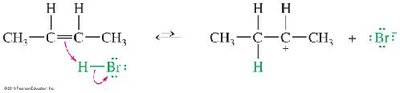
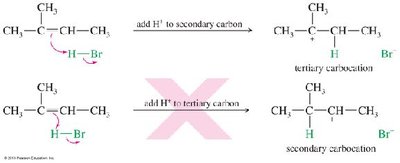
When alkenes react with hydrogen halides (HBr, HCl, HI), the addition follows Markovnikov's rule: the proton (H+) adds to the carbon with more hydrogens, and the halide (X−) adds to the more substituted carbon, forming the most stable carbocation intermediate.
Step 1: Protonation of the double bond forms the most stable carbocation.
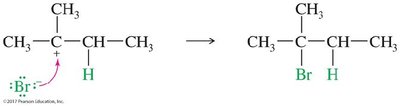
Step 2: Halide ion attacks the carbocation to form the alkyl halide.
Reaction-Energy Diagram
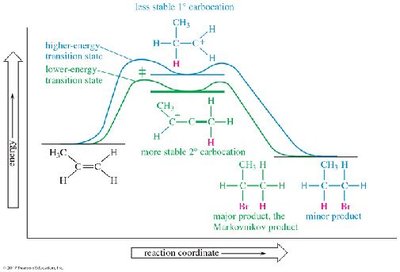
The rate-determining step is the formation of the carbocation intermediate. The more stable the carbocation, the lower the activation energy and the faster the reaction.
Anti-Markovnikov Addition: The Peroxide Effect
Free Radical Addition of HBr
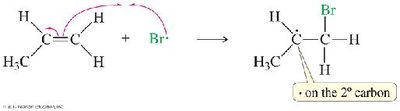
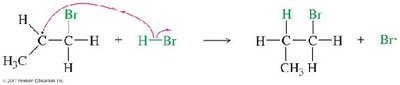
In the presence of peroxides, HBr adds to alkenes via a free radical mechanism, resulting in anti-Markovnikov addition (the bromine adds to the less substituted carbon). This effect is unique to HBr due to the energetics of the radical steps.
Hydration of Alkenes
Acid-Catalyzed Hydration
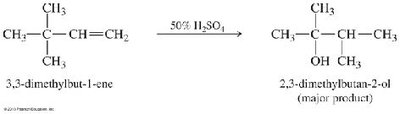
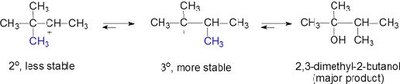
Water can be added to alkenes in the presence of acid (H2SO4 or H3PO4), following Markovnikov's rule. The mechanism involves carbocation formation, nucleophilic attack by water, and deprotonation to yield an alcohol.
Oxymercuration–Demercuration
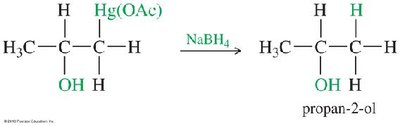
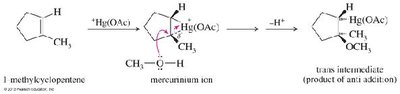
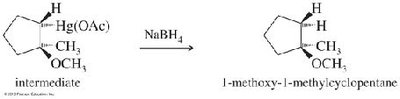
This method hydrates alkenes under milder conditions and avoids carbocation rearrangements. Mercury(II) acetate adds to the alkene, forming a mercurinium ion intermediate, which is then attacked by water. Sodium borohydride (NaBH4) reduces the intermediate, yielding a Markovnikov alcohol.

Alkoxymercuration–Demercuration
If an alcohol (ROH) is used instead of water, an ether is formed via the same mechanism.
Hydroboration–Oxidation
Anti-Markovnikov Hydration
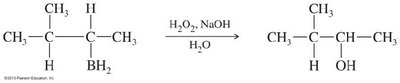
Diborane (B2H6) or borane–THF adds to alkenes in a concerted, syn addition, with boron attaching to the less substituted carbon. Oxidation with hydrogen peroxide in base replaces boron with a hydroxyl group, yielding an anti-Markovnikov alcohol.

Halogenation and Halohydrin Formation
Addition of Halogens (Cl2, Br2)
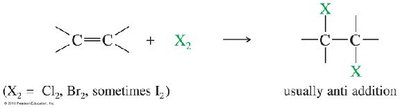
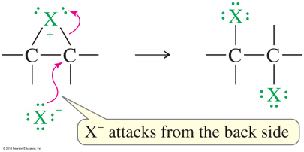
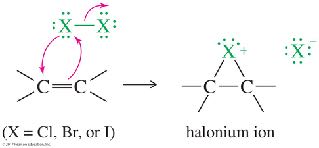
Halogens add to alkenes to form vicinal dihalides via an anti addition mechanism. The reaction proceeds through a three-membered halonium ion intermediate, which is attacked from the opposite side by the halide ion.
Halohydrin Formation
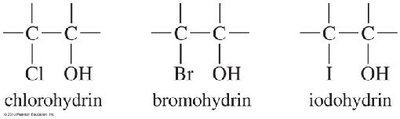
When halogenation occurs in the presence of water, a halohydrin is formed. Water acts as the nucleophile, attacking the more substituted carbon of the halonium ion, resulting in anti addition and Markovnikov orientation.
Catalytic Hydrogenation
Syn Addition of Hydrogen
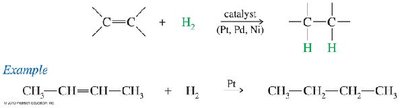
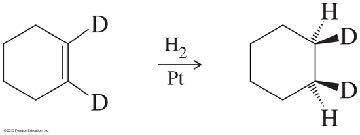
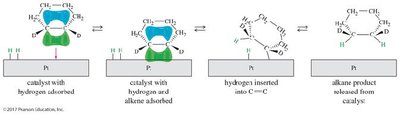
Hydrogen gas (H2) adds across the double bond in the presence of a metal catalyst (Pt, Pd, Ni), resulting in syn addition. Both hydrogens add to the same face of the alkene, yielding an alkane.
Wilkinson's Catalyst
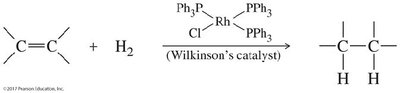
Wilkinson's catalyst is a homogeneous catalyst that also facilitates the hydrogenation of alkenes under mild conditions.
Cyclopropanation of Alkenes
Formation of Cyclopropanes
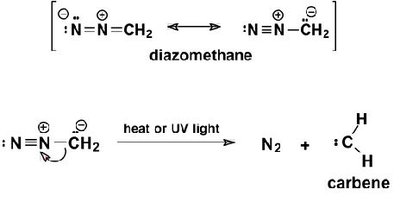
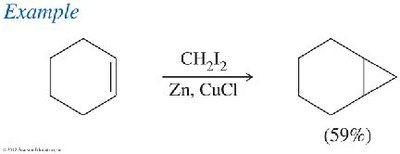
Alkenes can be converted to cyclopropanes by the addition of a carbene or carbenoid. Common methods include the use of diazomethane, the Simmons–Smith reaction, and alpha elimination of haloforms.
Epoxidation and Dihydroxylation
Epoxidation
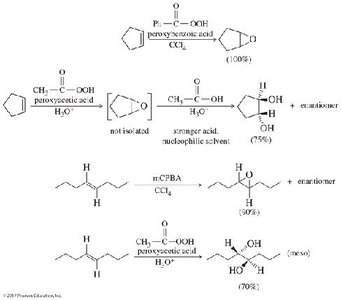
Alkenes react with peroxyacids (e.g., MCPBA) to form epoxides (oxiranes) in a single step. The reaction is stereospecific and retains the stereochemistry of the alkene.
Anti Dihydroxylation
Epoxides can be opened by acid-catalyzed hydrolysis to yield anti-1,2-diols (glycols).
Syn Dihydroxylation
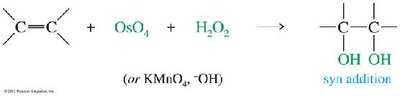
Osmium tetroxide (OsO4) or cold, dilute potassium permanganate (KMnO4) adds two hydroxyl groups to the same side of the double bond, forming a syn-1,2-diol.
Oxidative Cleavage of Alkenes
Ozonolysis
Ozone (O3) cleaves alkenes to form aldehydes and ketones. The reaction proceeds via a molozonide and ozonide intermediate, which is reduced by zinc or dimethyl sulfide.


Polymerization and Olefin Metathesis
Polymerization of Alkenes
Alkenes can undergo chain-growth polymerization via cationic, free-radical, or anionic mechanisms to form polymers. The process is terminated by abstraction of a proton, forming a new alkene end group.
Olefin Metathesis
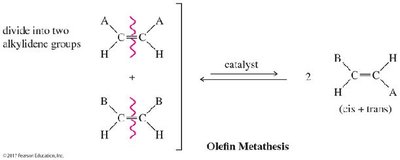
Olefin metathesis is a reaction in which alkylidene groups are exchanged between alkenes, catalyzed by metal-alkylidene complexes. This reaction is important in synthetic organic chemistry and industrial processes.
Additional info: This guide covers the main reactions of alkenes, including mechanisms, stereochemistry, and synthetic applications, as outlined in a typical college-level organic chemistry course.
