 Back
BackReactions of Benzene and Substituted Benzenes: Electrophilic Aromatic Substitution and Substituent Effects
Study Guide - Smart Notes
 Tailored notes based on your materials, expanded with key definitions, examples, and context.
Reactions of Benzene and Substituted Benzenes
Introduction to Electrophilic Aromatic Substitution (EAS)
Benzene and its derivatives undergo a characteristic class of reactions known as electrophilic aromatic substitution (EAS). In these reactions, an electrophile replaces a hydrogen atom on the aromatic ring, preserving aromaticity. The reactivity and orientation of substitution are strongly influenced by substituents already present on the ring.
Electrophilic Aromatic Substitution: Key Reactions
Halogenation, Nitration, and Sulfonation
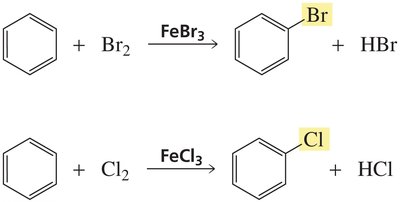
Halogenation: Benzene reacts with halogens (Br2, Cl2) in the presence of a Lewis acid catalyst (FeBr3 or FeCl3) to yield aryl halides.
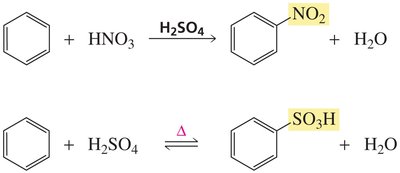
Nitration: Benzene reacts with concentrated HNO3 and H2SO4 to form nitrobenzene.
Sulfonation: Benzene reacts with fuming H2SO4 (or SO3 in H2SO4) to yield benzenesulfonic acid. The reaction is reversible with heat and dilute acid.
Friedel–Crafts Alkylation and Acylation
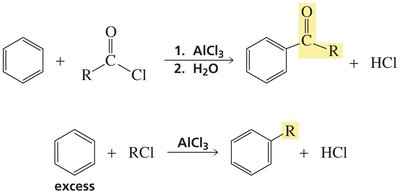
Friedel–Crafts Alkylation: Benzene reacts with alkyl halides (RCl) in the presence of AlCl3 to form alkylbenzenes.
Friedel–Crafts Acylation: Benzene reacts with acyl chlorides (RCOCl) and AlCl3, followed by hydrolysis, to yield aryl ketones.
Reactions at the Benzylic Position
Benzylic Bromination, Oxidation, and Reduction
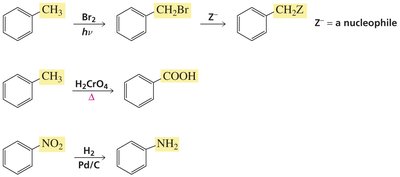
Benzylic Bromination: Alkylbenzenes undergo selective bromination at the benzylic position with Br2 and light (hv), forming benzyl bromides, which can be further substituted by nucleophiles.
Benzylic Oxidation: Alkyl side chains on benzene rings are oxidized to benzoic acid derivatives using strong oxidants (e.g., H2CrO4), but only if there is at least one benzylic hydrogen.
Nitro Group Reduction: Nitrobenzenes can be reduced to anilines (amino groups) using catalytic hydrogenation (H2, Pd/C).
Regioselectivity in Disubstitution: Ortho, Meta, and Para Isomers
Isomer Formation in EAS
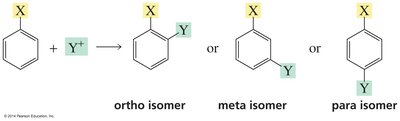
When a substituted benzene undergoes EAS, the incoming group can add to the ortho, meta, or para positions relative to the existing substituent. The distribution of products depends on the nature of the substituent already present on the ring.
Ortho Isomer: New group attaches adjacent to the substituent.
Meta Isomer: New group attaches one carbon away from the substituent.
Para Isomer: New group attaches opposite the substituent.
Substituent Effects: Activating and Deactivating Groups
Directing Effects and Product Distribution
Substituents on the benzene ring influence both the rate of EAS and the position where new substituents are introduced:
Activating Groups: Donate electron density to the ring (e.g., alkyl, -OH, -NH2), increase reactivity, and direct new groups to the ortho and para positions.
Deactivating Groups: Withdraw electron density (e.g., -NO2, -COOH), decrease reactivity, and direct new groups to the meta position.
Halogens: Are weakly deactivating but direct ortho/para due to resonance effects.
Examples of Regioselectivity
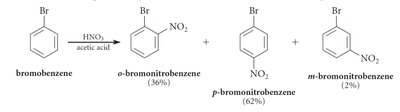
Bromination of Bromobenzene: Yields mainly ortho and para products due to the activating and ortho/para-directing effect of Br.
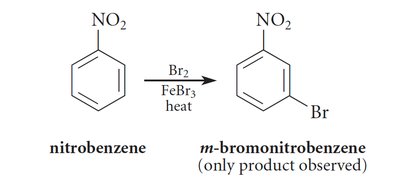
Bromination of Nitrobenzene: Yields only the meta product due to the strong deactivating and meta-directing effect of NO2.
Summary Table: Substituent Effects on EAS
Substituent Type | Examples | Effect on Reactivity | Directing Effect |
|---|---|---|---|
Strongly Activating | -OH, -NH2 | Increase | Ortho/Para |
Moderately Activating | -OCH3, -NHR | Increase | Ortho/Para |
Weakly Activating | -R (alkyl) | Increase | Ortho/Para |
Weakly Deactivating | -F, -Cl, -Br, -I | Decrease | Ortho/Para |
Moderately Deactivating | -COOH, -COOR, -CHO | Decrease | Meta |
Strongly Deactivating | -NO2, -CF3, -SO3H | Decrease | Meta |
Key Mechanistic Steps in EAS
General Mechanism
Step 1: Generation of the electrophile (e.g., Br+, NO2+).
Step 2: Electrophilic attack on the aromatic ring, forming a resonance-stabilized carbocation intermediate (arenium ion).
Step 3: Deprotonation to restore aromaticity, yielding the substituted benzene.
Example: In bromination, FeBr3 activates Br2 to generate Br+, which attacks the ring.
Applications and Importance
EAS reactions are fundamental for the synthesis of aromatic compounds in pharmaceuticals, dyes, and polymers.
Understanding substituent effects is crucial for designing multi-step syntheses and predicting product distributions.
