 Back
BackReactions of Carboxylic Acids and Their Derivatives: Structure, Reactivity, and Mechanisms
Study Guide - Smart Notes
 Tailored notes based on your materials, expanded with key definitions, examples, and context.
Reactions of Carboxylic Acids and Their Derivatives
Introduction to Carboxylic Acid Derivatives
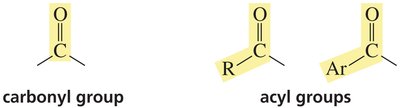
Carboxylic acids and their derivatives are a central class of organic compounds, characterized by the presence of a carbonyl group (C=O) bonded to a heteroatom or another group. Their reactivity is largely determined by the nature of the group attached to the carbonyl carbon. Understanding their structure, classification, and mechanisms of reaction is essential for mastering organic synthesis.
Classification of Carbonyl Compounds
Class I Carbonyl Compounds
Class I carbonyl compounds are those in which the group attached to the carbonyl carbon (Z) can be replaced by a nucleophile. These include carboxylic acids, esters, anhydrides, acyl chlorides, and amides.
Carboxylic Acid (RCOOH): Contains a hydroxyl group attached to the carbonyl carbon.
Ester (RCOOR'): Contains an alkoxy group (–OR') attached to the carbonyl carbon.
Anhydride (RCO)2O: Contains two acyl groups bonded to an oxygen atom.
Acyl Chloride (RCOCl): Contains a chlorine atom attached to the carbonyl carbon.
Amide (RCONH2, RCONHR', RCONR'2): Contains an amino group attached to the carbonyl carbon.
Class II Carbonyl Compounds
Class II carbonyl compounds are those in which the group attached to the carbonyl carbon cannot be easily replaced by a nucleophile. These include aldehydes and ketones, which are less reactive toward nucleophilic substitution compared to Class I derivatives.
Resonance and Reactivity of Carboxylic Acid Derivatives
Resonance Contribution
The resonance stabilization of carboxylic acid derivatives affects their reactivity. The ability of the substituent (Z) to donate or withdraw electrons influences the electron density on the carbonyl carbon, thus affecting its susceptibility to nucleophilic attack.
Amides: Nitrogen is less electronegative and can better accommodate positive charge, leading to significant resonance stabilization and lower reactivity.
Esters and Anhydrides: Oxygen is more electronegative than nitrogen, resulting in less resonance stabilization compared to amides.
Acyl Chlorides: Halides are poor bases and do not share electrons well, resulting in minimal resonance stabilization and high reactivity.
Key Point: The more stabilized the carbonyl group by resonance, the less reactive the compound is toward nucleophilic acyl substitution.
Relative Reactivity of Carboxylic Acid Derivatives
Order of Reactivity
The reactivity of carboxylic acid derivatives toward nucleophilic acyl substitution decreases in the following order:
Acyl Chloride > Anhydride > Ester ≈ Carboxylic Acid > Amide
This order is determined by the basicity of the leaving group and the resonance stabilization of the derivative.
Table: pKa Values of Conjugate Acids of Leaving Groups
Carbonyl Compound | Leaving Group | Conjugate Acid of Leaving Group | pKa |
|---|---|---|---|
Acyl Chloride | Cl- | HCl | -7 |
Anhydride | RCOO- | RCOOH | ~3-5 |
Ester | RO- | ROH | ~15-16 |
Carboxylic Acid | HO- | H2O | 15.7 |
Amide | NH2- | NH3 | 36 |
Key Point: A carboxylic acid derivative can be converted into a less reactive derivative in a nucleophilic acyl substitution reaction, but not to one that is more reactive.
Mechanisms of Nucleophilic Acyl Substitution
General Mechanism
Nucleophilic acyl substitution involves the attack of a nucleophile on the carbonyl carbon, followed by the elimination of the leaving group. The mechanism proceeds through a tetrahedral intermediate.
Mechanism of Ester Hydrolysis and Transesterification
Ester hydrolysis can be acid- or base-catalyzed. In both cases, the nucleophile (water or alcohol) attacks the carbonyl carbon, forming a tetrahedral intermediate, which then collapses to expel the leaving group and form the product.
Acid-catalyzed hydrolysis: Proceeds via protonation of the carbonyl oxygen, increasing electrophilicity.
Base-catalyzed hydrolysis (saponification): Involves direct attack by hydroxide ion.
Favoring Product Formation
Ester Hydrolysis: Use excess water or remove alcohol by distillation to drive the reaction toward carboxylic acid formation (Le Châtelier’s principle).
Esterification: Use excess alcohol or remove water to favor ester formation.
Saponification
Saponification is the base-catalyzed hydrolysis of esters (usually fats) to produce glycerol and soap (salts of fatty acids).
Equation:
Reactivity of Amides
Amides Are Very Unreactive
Due to strong resonance stabilization, amides are the least reactive of the common carboxylic acid derivatives. Their hydrolysis requires harsh conditions (strong acid or base, heat).
Acid-Catalyzed Amide Hydrolysis and Alcoholysis
Amides can be hydrolyzed to carboxylic acids or converted to esters (alcoholysis) under acidic conditions, but these reactions are slow and require strong acid and heat.
Synthesis and Transformations Involving Carboxylic Acid Derivatives
Synthesis of Primary Amines
Primary amines can be synthesized from alkyl halides via nucleophilic substitution with ammonia, or from nitriles by reduction.
Nitriles in Synthesis
Nitriles are versatile intermediates in organic synthesis. They can be converted to carboxylic acids, amines, aldehydes, ketones, and amidines through various reactions.
Dicarboxylic Acids
Dicarboxylic acids contain two carboxylic acid groups and are important in polymer chemistry and biochemistry. Their reactivity and properties are influenced by the distance between the two acid groups.
Summary Table: Reactivity and Transformations of Carboxylic Acid Derivatives
Derivative | General Formula | Relative Reactivity | Common Transformations |
|---|---|---|---|
Acyl Chloride | RCOCl | Most reactive | Hydrolysis, alcoholysis, aminolysis |
Anhydride | (RCO)2O | High | Hydrolysis, alcoholysis, aminolysis |
Ester | RCOOR' | Moderate | Hydrolysis, transesterification |
Carboxylic Acid | RCOOH | Low | Esterification, amidation |
Amide | RCONH2 | Least reactive | Hydrolysis (harsh conditions) |
