 Back
BackRedox Reactions and Organometallic Chemistry: Alcohols, Carbonyls, and Synthesis
Study Guide - Smart Notes
 Tailored notes based on your materials, expanded with key definitions, examples, and context.
Oxidation and Reduction of Alcohols and Carbonyl Compounds
Oxidation of Alcohols
Oxidation of alcohols is a fundamental transformation in organic chemistry, converting alcohols into carbonyl compounds such as aldehydes, ketones, and carboxylic acids. The extent of oxidation depends on the type of alcohol:
Primary Alcohols: Can be oxidized to aldehydes and further to carboxylic acids.
Secondary Alcohols: Oxidized to ketones.
Tertiary Alcohols: Generally resistant to oxidation due to the absence of hydrogen atoms on the carbon bearing the hydroxyl group.
Oxidation involves increasing the number of bonds to oxygen and decreasing the oxidation number of the carbon atom.
Reduction of Carbonyl Compounds
Reduction is the reverse process, converting carbonyl compounds (aldehydes, ketones, carboxylic acids, esters) back to alcohols. This is achieved using reducing agents:
LiAlH4 (Lithium Aluminum Hydride): Strong reducing agent, reduces carboxylic acids and esters.
NaBH4 (Sodium Borohydride): Milder, reduces aldehydes and ketones but not carboxylic acids or esters.
Reduction increases the number of bonds to hydrogen and decreases the oxidation number of the carbon atom.
Structure and Reactivity of Carbonyl Compounds
Trigonal Planar Geometry and Hybridization
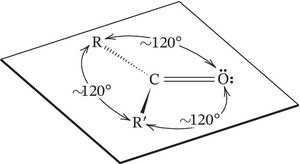
Carbonyl compounds feature a central carbon atom that is sp2 hybridized, resulting in a trigonal planar geometry with bond angles of approximately 120°.
Key Point: The carbonyl carbon is electrophilic due to polarization of the C=O bond.
Polarity of Carbonyl Groups
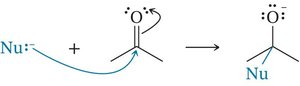
The carbonyl group is highly polarized, with the oxygen atom being more electronegative and attracting electron density. This makes the carbonyl carbon susceptible to nucleophilic attack.
Redox Chemistry: Mechanisms and Agents
Oxidation Mechanisms
Oxidation of alcohols typically proceeds via elimination mechanisms, often requiring the presence of hydrogen atoms on the carbon. Common oxidizing agents include:
Chromic Acid (H2CrO4): Strong oxidant, used for primary and secondary alcohols.
PCC (Pyridinium Chlorochromate): Milder, prevents overoxidation.
Swern Oxidation: Uses DMSO and oxalyl chloride, suitable for sensitive substrates.
Permanganate (KMnO4): Strong oxidant, complex mechanism.
Reduction Mechanisms
Reduction of carbonyl compounds involves hydride transfer from reducing agents. The mechanism varies depending on the substrate and reagent.
LiAlH4: Reduces carboxylic acids, esters, and alkyl halides.
NaBH4: Reduces aldehydes and ketones.
Organometallic Reagents in Synthesis
Formation and Properties of Organometallic Reagents
Organometallic reagents such as Grignard reagents (RMgX) and alkyl lithium compounds (RLi) are essential for carbon-carbon bond formation. They are strong bases and nucleophiles, reacting violently with acidic hydrogens.
Grignard Reagents: Formed by reacting alkyl halides with magnesium in ether solvents.
Alkyl Lithium Reagents: More reactive and pyrophoric than Grignard reagents.
Mechanism of Grignard Addition to Carbonyls
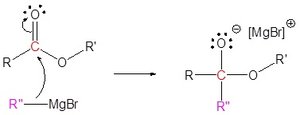
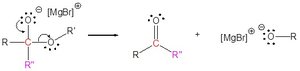
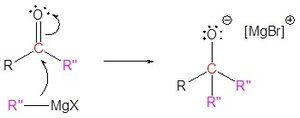
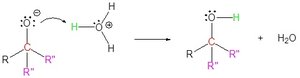
Grignard reagents add to carbonyl compounds, forming alcohols after hydrolysis. The mechanism involves nucleophilic attack on the carbonyl carbon, followed by protonation.
Regiochemistry of Epoxide Attack
Grignard reagents can also open epoxide rings, with regiochemistry determined by the base-catalyzed mechanism.
Alcohol Synthesis from Esters
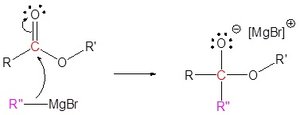
Esters can be converted to alcohols using excess Grignard reagent, resulting in tertiary alcohols similar to those formed from ketones.
Summary Tables
Oxidation and Reduction Summary
Alcohol Type | Oxidation Product | Reduction Product |
|---|---|---|
Primary | Aldehyde → Carboxylic Acid | Alcohol |
Secondary | Ketone | Alcohol |
Tertiary | No Reaction | Alcohol |
Organometallic Addition Summary
Reagent | Target | Product |
|---|---|---|
Grignard (RMgX) | Aldehyde | Secondary Alcohol |
Grignard (RMgX) | Ketone | Tertiary Alcohol |
Grignard (RMgX) | Ester | Tertiary Alcohol |
Alkyl Lithium (RLi) | Carbonyl | Alcohol |
Applications and Synthesis Planning
Retrosynthetic Analysis
Retrosynthetic analysis is used to plan multistep syntheses, breaking down target molecules into simpler precursors. Organometallic reagents are key tools for constructing complex alcohols and carbonyl derivatives.
Example: Synthesis of tertiary alcohols from esters using Grignard reagents.
Protecting Groups
Alcohols may need to be protected during synthesis to prevent unwanted reactions. Common protecting groups include silyl ethers and acetals.
Key Point: Protection and deprotection steps are crucial for successful multistep syntheses.
Conclusion
Understanding the mechanisms and applications of oxidation, reduction, and organometallic chemistry is essential for mastering organic synthesis. These reactions enable the transformation of simple molecules into complex structures, forming the foundation of modern organic chemistry.
