 Back
BackSolid, Liquids, and Interfaces: Electric Fields and Electron Transfer at Interfaces
Study Guide - Smart Notes
 Tailored notes based on your materials, expanded with key definitions, examples, and context.
Solid, Liquids, and Interfaces
Introduction to Interfaces
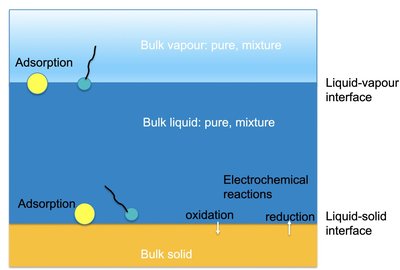
Interfaces between solids, liquids, and vapors are fundamental in physical chemistry and electrochemistry. These interfaces are sites for unique phenomena such as adsorption, double layer formation, and electron transfer reactions. Understanding the behavior of electric fields and potentials at these interfaces is crucial for interpreting and designing electrochemical systems.
Electric Fields at Interfaces
Definition of Potential and Electron Energy
Electrostatic potential is defined as the work required to move a positive test charge from infinity to a specific point. In electrochemistry, this potential is crucial for understanding how charges interact at interfaces. Because the definition uses a positive test charge, the direction of potential and electron energy are opposite:
High potential (more positive): Repels positive charges, attracts electrons (lower electron energy).
Low potential (more negative): Attracts positive charges, repels electrons (higher electron energy).
Capacitance at Interfaces
When ions accumulate near a surface, they create a double layer that acts like a capacitor. The capacitance per unit area is given by:
= relative permittivity (dielectric constant)
= vacuum permittivity
= area
= separation distance
The charge stored is , where is the potential difference.
Examples of Capacitance in Materials
Different materials have varying dielectric constants and strengths, affecting their capacitance and the maximum electric field they can sustain before breakdown. For example, water has a high dielectric constant (), leading to high capacitance at interfaces.
Double Layer and Debye Length
The double layer at an interface consists of a layer of adsorbed ions and a diffuse layer of counterions. The characteristic thickness of the diffuse layer is the Debye length ():
= gas constant
= temperature
= Faraday's constant
= ionic strength
= density
Every Debye length, the potential drops by a factor of .
Theory of Double Layer Structure
The double layer is often described by the Helmholtz model (compact layer) and the Gouy-Chapman model (diffuse layer). The total interfacial capacitance is a series combination of these layers. The point of zero charge (PZC) is the potential at which the net surface charge is zero.
Adsorption and Electrosorption at Interfaces
Adsorption Phenomena
Adsorption refers to the accumulation of molecules or ions at the interface. The strength of adsorption depends on the nature of the adsorbate and the surface, ranging from weak physisorption to strong chemisorption. The electrosorption isotherm describes the equilibrium coverage () as a function of potential and concentration:
For electrosorption:
Where and are the potentials of the metal and solution, respectively.
Interfacial Length Scales
Comparison of Layers at the Interface
Several distinct regions exist at the solid-liquid interface, each with characteristic thickness:
Inner Helmholtz layer: 0.2–0.4 nm (specifically adsorbed ions)
Outer Helmholtz layer: 0.5–1 nm (solvated ions)
Diffuse layer: 0.5–10 nm (counterions distributed by thermal motion)
Diffusion layer: 5–100 μm (concentration gradients)
Hydrodynamic layer: 150–1000 μm (affected by fluid flow)
Electron Transfer at the Solid-Liquid Interface
Conditions for Electron Transfer
Electron transfer at the interface depends on the relative energies of electronic states in the metal and solution. Spontaneous electron transfer occurs if an electron can lower its energy by moving from the metal to a molecular orbital of an ion in solution (reduction), or vice versa (oxidation).
Reduction: Electron moves from metal to solution species.
Oxidation: Electron moves from solution species to metal.
Electron transfer is typically very fast and occurs via quantum tunneling. After transfer, the solvation sphere of the ion readjusts.
Electrochemical Potential
The electrochemical potential combines the chemical potential and the effect of the electric field:
= solution potential
= metal potential
Thermodynamics of Electron Transfer
For a general redox reaction at the interface:
The cell potential is given by:
The Gibbs free energy change is:
Electrochemical Cells
In a full electrochemical cell, the overall cell potential () is the difference between the half-cell potentials. For example:
, V
and , V
Summary
Electric fields at interfaces are governed by the formation of double layers and the properties of the materials involved.
Capacitance at interfaces is determined by dielectric properties and separation distance.
Electron transfer at interfaces is central to electrochemistry and depends on the alignment of electronic states and potentials.
Thermodynamics and kinetics of these processes are described by electrochemical potentials and cell voltages.
