 Back
BackStep-by-Step Guidance for Organic Chemistry Aromatic Compounds and Reactions
Study Guide - Smart Notes
 Tailored notes based on your materials, expanded with key definitions, examples, and context.
Q1. What is the major organic product obtained from the following reaction?
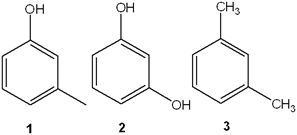
Background
Topic: Electrophilic Aromatic Substitution (Nitration)
This question tests your understanding of the nitration of aromatic compounds, specifically how substituents on the benzene ring influence the position of incoming groups.
Key Terms and Formulas
Electrophilic Aromatic Substitution (EAS): A reaction where an electrophile replaces a hydrogen atom on an aromatic ring.
Nitration: Introduction of a nitro group () to the aromatic ring using and .
Ortho/Para Directing Groups: Groups like methyl () direct incoming substituents to the ortho and para positions.
Step-by-Step Guidance
Identify the starting material: The aromatic ring has two methyl groups (xylene).
Determine the effect of methyl groups: Methyl groups are activating and ortho/para directing.
Predict the position for nitration: The nitro group will be introduced at a position ortho or para to one or both methyl groups, considering steric hindrance and available positions.
Draw the possible products and match them to the answer choices.
Try solving on your own before revealing the answer!
Final Answer: 1
The major product is the nitro group at the para position relative to one methyl group, which is the least hindered and most favored by the directing effects.
Q2. What is the major organic product obtained from the following reaction?
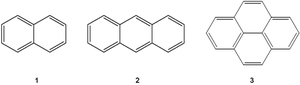
Background
Topic: Friedel-Crafts Alkylation
This question tests your understanding of the Friedel-Crafts alkylation reaction, where an alkyl group is introduced to an aromatic ring using an alkyl halide and a Lewis acid catalyst.
Key Terms and Formulas
Friedel-Crafts Alkylation: Reaction of an aromatic ring with an alkyl halide in the presence of AlCl3.
Carbocation Rearrangement: The alkyl group may rearrange to form a more stable carbocation before attaching to the ring.
Ortho/Para Directing Groups: Methyl group directs the incoming alkyl group to ortho and para positions.
Step-by-Step Guidance
Identify the starting material: The aromatic ring has a methyl group (toluene).
Recognize the alkylating agent: tert-butyl chloride () and AlCl3.
Predict the position for alkylation: The tert-butyl group will attach to the ortho or para position relative to the methyl group.
Draw the possible products and match them to the answer choices.
Try solving on your own before revealing the answer!
Final Answer: 2
The major product is the para-substituted tert-butyl group relative to the methyl group, due to steric hindrance at the ortho position.
Q3. What is the major organic product obtained from the following reaction?
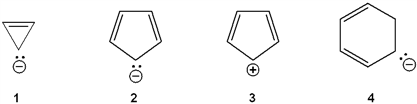
Background
Topic: Friedel-Crafts Alkylation (with possible carbocation rearrangement)
This question tests your understanding of Friedel-Crafts alkylation and the possibility of carbocation rearrangement during the reaction.
Key Terms and Formulas
Friedel-Crafts Alkylation: Introduction of an alkyl group to an aromatic ring using an alkyl halide and AlCl3.
Carbocation Rearrangement: The propyl group may rearrange to form a more stable carbocation before attaching to the ring.
Ortho/Para Directing Groups: Methyl group directs the incoming alkyl group to ortho and para positions.
Step-by-Step Guidance
Identify the starting material: The aromatic ring has a methyl group (toluene).
Recognize the alkylating agent: propyl chloride and AlCl3.
Consider possible carbocation rearrangement: The propyl group may rearrange to a more stable isopropyl carbocation.
Predict the position for alkylation: The alkyl group will attach to the ortho or para position relative to the methyl group.
Try solving on your own before revealing the answer!
Final Answer: 3
The major product is the para-substituted isopropyl group relative to the methyl group, due to carbocation rearrangement and steric hindrance.
Q4. What is the major organic product obtained from the following reaction?
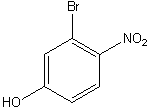
Background
Topic: Friedel-Crafts Acylation followed by Clemmensen Reduction
This question tests your understanding of a two-step sequence: Friedel-Crafts acylation (introduction of an acyl group) followed by Clemmensen reduction (reduction of the carbonyl group to a methylene group).
Key Terms and Formulas
Friedel-Crafts Acylation: Introduction of an acyl group to an aromatic ring using an acid chloride and AlCl3.
Clemmensen Reduction: Reduction of a carbonyl group to a methylene group using Zn(Hg) and HCl.
Ortho/Para Directing Groups: Methyl group directs the incoming acyl group to ortho and para positions.
Step-by-Step Guidance
Identify the starting material: The aromatic ring has a methyl group (toluene).
Recognize the acylating agent: acetyl chloride and AlCl3.
Predict the position for acylation: The acyl group will attach to the ortho or para position relative to the methyl group.
Apply Clemmensen reduction: The carbonyl group is reduced to a methylene group.
Try solving on your own before revealing the answer!
Final Answer: 1
The major product is the para-substituted propyl group relative to the methyl group, resulting from acylation and subsequent reduction.
