 Back
BackReactions of Non-Polar π-Systems - Module 2
Study Guide - Smart Notes
 Tailored notes based on your materials, expanded with key definitions, examples, and context.
Q1. Explain the reactivity of alkenes in the epoxidation reaction with m-CPBA, based on the observed rates for several alkenes.
Background
Topic: Epoxidation of Alkenes & Molecular Orbital Theory
This question tests your understanding of how alkene structure (substitution and conjugation) affects reactivity in electrophilic addition reactions, specifically epoxidation with m-CPBA. It also relates to molecular orbital theory and hyperconjugation effects.
Key Terms and Formulas:
Epoxidation: The addition of an oxygen atom across a double bond to form an epoxide.
m-CPBA: meta-Chloroperoxybenzoic acid, a common oxidizing agent for epoxidation.
π-bond: A bond formed by sideways overlap of p orbitals; acts as a nucleophile.
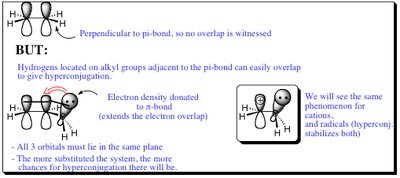
Hyperconjugation: Stabilization of the π-system by adjacent σ-bonds, increasing nucleophilicity and reactivity.
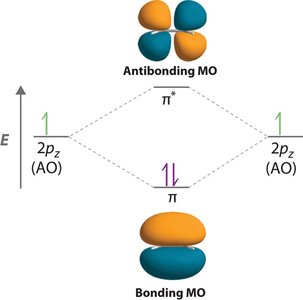
MO Theory: Molecular orbital theory explains the distribution of electrons in bonding and antibonding orbitals.
Step-by-Step Guidance
Examine the molecular orbital diagram for alkenes. The π-bond is the HOMO (highest occupied molecular orbital), and the π* is the LUMO (lowest unoccupied molecular orbital).
Consider how substitution affects the energy of the HOMO. More substituted alkenes have higher HOMO energy due to hyperconjugation, making them more nucleophilic and reactive toward electrophiles like m-CPBA.
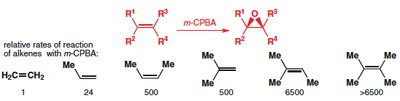
Analyze the rate data: Compare the rates of epoxidation for different alkenes. Notice that more substituted alkenes react faster, except when steric hindrance becomes significant.
Think about conjugation: Alkenes conjugated with other π-systems (like aromatic rings) are stabilized and may show altered reactivity. Consider how conjugation and hyperconjugation both affect the HOMO energy and accessibility.
Try solving on your own before revealing the answer!
Final Answer:
The reactivity of alkenes in epoxidation with m-CPBA increases with substitution due to hyperconjugation raising the HOMO energy, making the alkene more nucleophilic. The observed rates reflect this trend, with highly substituted alkenes reacting fastest unless steric hindrance slows the reaction. Conjugation with other π-systems also stabilizes the alkene and can affect reactivity.
