 Back
BackStepwise Synthesis of 1-Hexanol from Acetylene
Study Guide - Smart Notes
 Tailored notes based on your materials, expanded with key definitions, examples, and context.
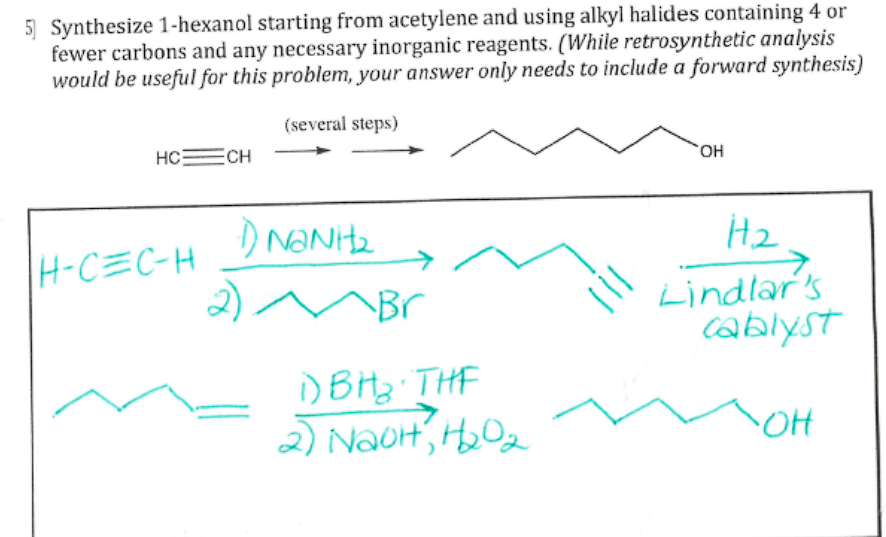
Q5. Synthesize 1-hexanol starting from acetylene and using alkyl halides containing 4 or fewer carbons and any necessary inorganic reagents.
Background
Topic: Multi-step Organic Synthesis (Alkyne Chemistry, Alkylation, Hydroboration-Oxidation)
This question tests your ability to design a forward synthesis for a target molecule (1-hexanol) starting from a simple alkyne (acetylene), using carbon chain extension and functional group transformations. You must use alkyl halides with four or fewer carbons and appropriate inorganic reagents.
Key Terms and Reactions:
Acetylene (ethyne): A two-carbon alkyne ().
Alkylation of terminal alkynes: Using strong base (e.g., ) to deprotonate acetylene, followed by reaction with an alkyl halide to extend the carbon chain.
Lindlar's catalyst: Used for partial hydrogenation of alkynes to cis-alkenes.
Hydroboration-oxidation: Converts alkenes to alcohols with anti-Markovnikov selectivity.
Key Formulas and Mechanisms:
(alkylation)
Step-by-Step Guidance
Start with acetylene (). Use sodium amide () to deprotonate the terminal alkyne, generating the acetylide ion ().
React the acetylide ion with an appropriate alkyl halide (e.g., ) to extend the carbon chain. This step forms a longer alkyne ().
Perform partial hydrogenation of the alkyne using Lindlar's catalyst and hydrogen () to convert the triple bond to a cis-alkene.
Apply hydroboration-oxidation ( in THF, followed by and ) to convert the alkene to the alcohol, specifically 1-hexanol.
Try solving on your own before revealing the answer!
Final Answer: Forward synthesis of 1-hexanol from acetylene
1. Deprotonate acetylene with NaNH2, then alkylate with butyl bromide to get 1-hexyne. 2. Hydrogenate with Lindlar's catalyst to get cis-hexene. 3. Hydroboration-oxidation (BH3/THF, H2O2/NaOH) yields 1-hexanol.
This sequence efficiently builds the six-carbon chain and installs the alcohol at the terminal position.
