 Back
BackStereochemistry and Isomerism: A Comprehensive Study Guide
Study Guide - Smart Notes
 Tailored notes based on your materials, expanded with key definitions, examples, and context.
Chapter 5: Isomerism and Stereochemistry
Introduction to Stereochemistry
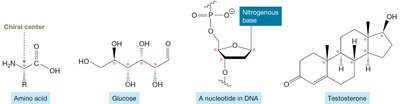
Stereochemistry is a fundamental aspect of organic chemistry, focusing on the spatial arrangement of atoms within molecules. It is especially critical in biological chemistry, as the body is a chiral environment, meaning many biomolecules and their interactions depend on their three-dimensional orientation.
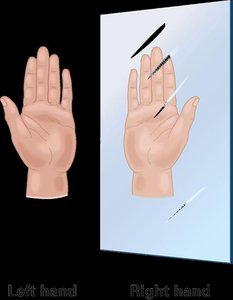
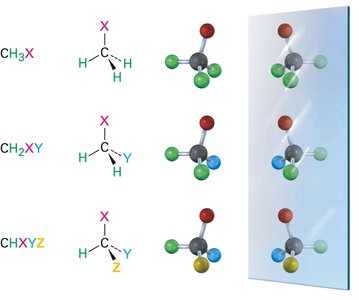
Chirality is the property of a molecule that makes it non-superimposable on its mirror image.
Stereoisomers are molecules with the same connectivity but different spatial arrangements.
Biological systems often distinguish between different stereoisomers, as seen in drug activity and olfactory responses.
Types of Isomers
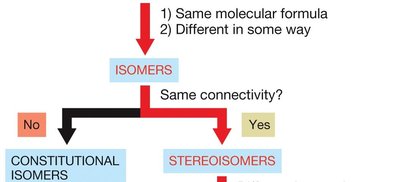
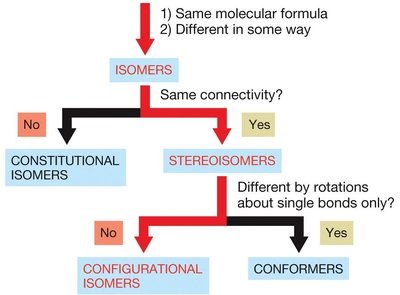
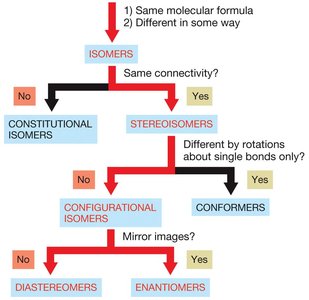
Isomers are compounds with the same molecular formula but differ in some way. The classification of isomers is essential for understanding molecular diversity.
Constitutional Isomers: Same formula, different connectivity.
Stereoisomers: Same connectivity, different spatial arrangement.
Conformers vs. Configurational Isomers
Conformers are isomers that differ by rotation around single bonds, while configurational isomers cannot be interconverted by such rotations.
Conformers: Same molecule, different positions due to bond rotation; same physical properties.
Configurational Isomers: Different compounds; can be separated and may have different physical properties.
Physical Properties of Isomers
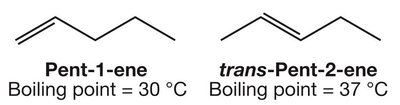
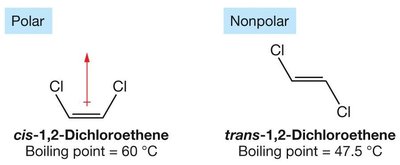
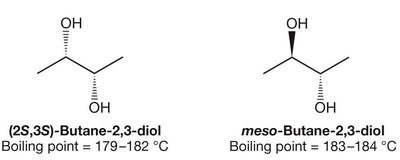
Isomers can exhibit different physical properties, such as boiling points, polarity, and optical activity, depending on their spatial arrangement.
Example: cis/trans isomers of alkenes and their boiling points.
Example: meso compounds vs. enantiomers in boiling points.
Configurational Isomers: Enantiomers and Diastereomers
Configurational isomers are divided into enantiomers and diastereomers based on their relationship to mirror images.
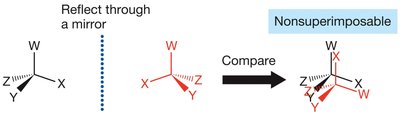
Enantiomers: Mirror images that are not superimposable.
Diastereomers: Not mirror images; differ at some but not all stereocenters.
Chiral Centers and Drawing Enantiomers
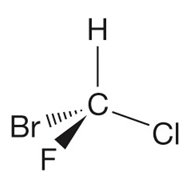
A chiral center is a tetrahedral atom (usually carbon) bonded to four different groups. Enantiomers can be drawn by reflecting the molecule or interchanging two groups.
Chiral center: Also called stereocenter, stereogenic center, or asymmetric atom.
Drawing enantiomers: Use dash/wedge notation to indicate spatial arrangement.
Chirality in Molecules
Chiral molecules are not identical to their mirror images and contain at least one chiral center. Achiral molecules have a plane of symmetry and are superimposable on their mirror images.
Chiral molecule: Has an enantiomer.
Achiral molecule: No enantiomer; has a plane of symmetry.
Naming Enantiomers: R/S System
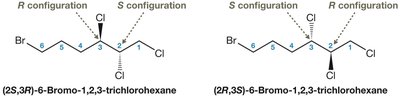
The Cahn-Ingold-Prelog rules are used to assign absolute configuration (R or S) to each chiral center in a molecule.
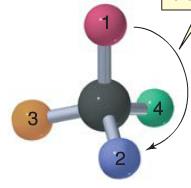
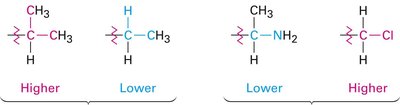
Assign priorities based on atomic number.
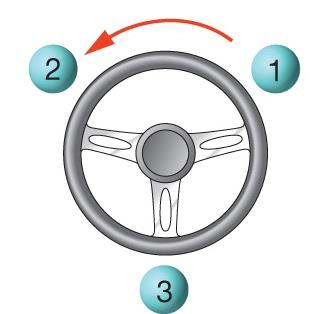
Orient the molecule so the lowest priority group is in the back.
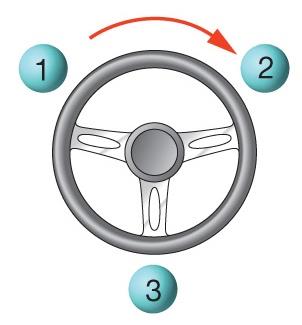
Clockwise arrangement: R (rectus, right); Counterclockwise: S (sinistra, left).
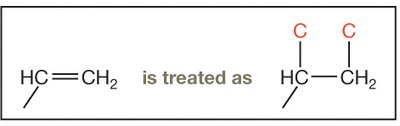
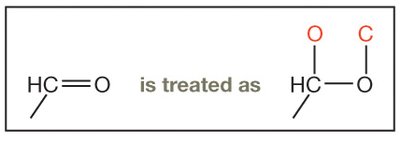
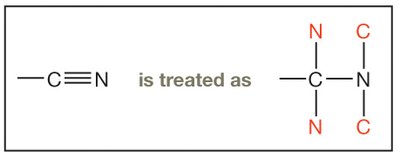
For ties, compare subsequent atoms; treat multiple bonds as equivalent to single bonds.
Isomers with Multiple Stereocenters
The number of possible stereoisomers increases with the number of chiral centers. For n chiral centers, a molecule can have up to 2n stereoisomers.
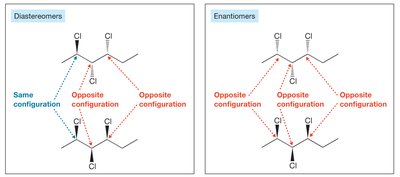
Enantiomers: Opposite configuration at all stereocenters.
Diastereomers: Opposite configuration at some, but not all, stereocenters.
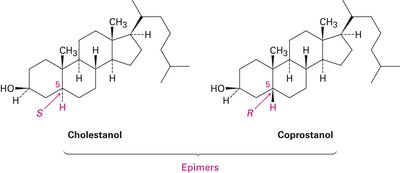
Epimers: Diastereomers that differ at only one stereocenter.
Alkene Diastereomers and E/Z Nomenclature
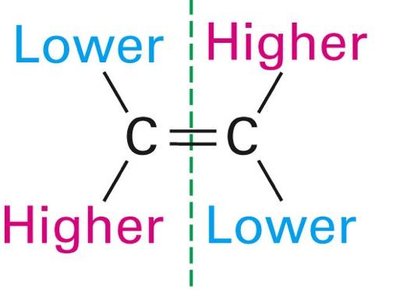
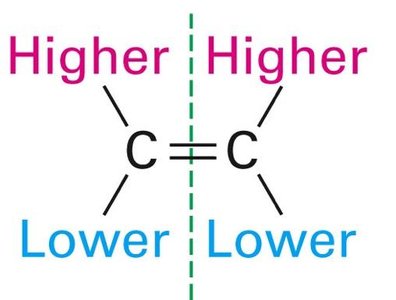
Alkenes can have diastereomers based on the arrangement of substituents around the double bond. The E/Z system is used for tri- and tetrasubstituted alkenes.
E (Entgegen): Highest priority groups on opposite sides.
Z (Zusammen): Highest priority groups on the same side.
Priorities are assigned using the same rules as for R/S.
Meso Compounds
Meso compounds contain chiral centers but are achiral due to a plane of symmetry. They are superimposable on their mirror images and do not exhibit optical activity.
Example: Tartaric acid has both enantiomers and a meso form.
Fischer Projections
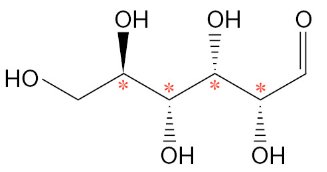
Fischer projections are a two-dimensional representation of chiral molecules, commonly used for sugars and amino acids. They simplify the identification of stereoisomers.
Horizontal lines represent bonds coming out of the plane.
Vertical lines represent bonds going behind the plane.
D and L Nomenclature
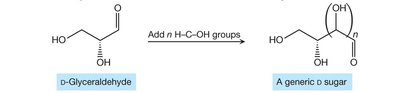
The D/L system is based on the optical rotation of glyceraldehyde and is used for sugars and amino acids. Most naturally occurring amino acids are L.
D and L are not related to R/S configuration.
Optical Activity and Racemic Mixtures
Chiral molecules are optically active and rotate plane-polarized light. Racemic mixtures contain equal amounts of enantiomers and do not rotate light.
Specific rotation: Characteristic property of an optically active compound.
Racemic mixture: 50:50 mixture of enantiomers; labeled (±).
Methods of resolution: fractional crystallization, chiral chromatography, chemical reactions.
Summary Table: Types of Isomers
Type | Definition | Example |
|---|---|---|
Constitutional Isomers | Same formula, different connectivity | Butane vs. isobutane |
Stereoisomers | Same connectivity, different spatial arrangement | Cis/trans alkenes |
Conformers | Isomers differing by rotation about single bonds | Axial/equatorial bromocyclohexane |
Configurational Isomers | Cannot be interconverted by bond rotation | Enantiomers, diastereomers |
Enantiomers | Mirror images, not superimposable | (R)- and (S)-lactic acid |
Diastereomers | Not mirror images, differ at some stereocenters | (2R,3R)- vs. (2R,3S)-butanediol |
Meso Compounds | Chiral centers, but achiral due to symmetry | Meso-tartaric acid |
Key Equations
Maximum number of stereoisomers: (where n = number of chiral centers)
Specific rotation: where = observed rotation, = path length (dm), = concentration (g/mL)
Additional info:
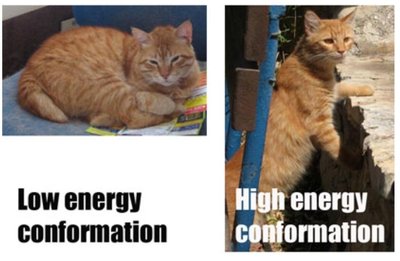
Some analogies and images (such as cats and hands) are used to reinforce concepts of chirality and conformations. These are pedagogical tools to help visualize molecular properties.
