 Back
BackStereoisomerism and Chirality: Structure, Classification, and Nomenclature
Study Guide - Smart Notes
 Tailored notes based on your materials, expanded with key definitions, examples, and context.
Stereoisomerism and Chirality
Chirality: The Handedness of Molecules
Chirality is a fundamental concept in organic chemistry, describing objects or molecules that are not superposable on their mirror images. The presence or absence of certain symmetry elements determines whether a molecule is chiral or achiral.
Chiral: Objects that cannot be superposed onto their mirror images.
Achiral: Objects that are superposable on their mirror images.
Plane of symmetry: An imaginary plane dividing a molecule such that one half is the reflection of the other.
Center of symmetry: A point within a molecule where identical components are equidistant and opposite along any axis passing through that point.
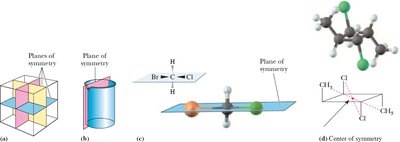
Example: A cube and a cylinder have planes of symmetry, while certain organic molecules lack these, making them chiral.
Stereoisomerism: Types and Definitions
Stereoisomers are compounds with the same molecular formula and atom connectivity but different spatial arrangements. They are classified as follows:
Constitutional isomers: Same formula, different connectivity.
Stereoisomers: Same formula and connectivity, different spatial orientation.
Configurational isomers: Isomers differing by the configuration of substituents on an atom; cannot be interconverted by rotation.
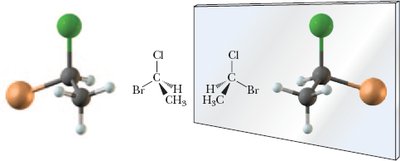
Example: A carbon atom bonded to four different groups (-Cl, -H, -CH3, -Br) is a chiral center.
Enantiomers and Diastereomers
Enantiomers are stereoisomers that are nonsuperposable mirror images of each other. Diastereomers are stereoisomers that are not mirror images.
Enantiomers: Always come in pairs; have identical physical and chemical properties in achiral environments.
Diastereomers: Can be chiral or achiral; arise when there are two or more stereocenters.
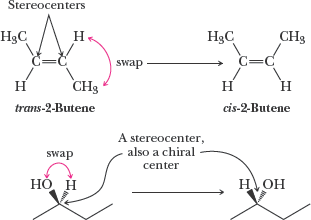
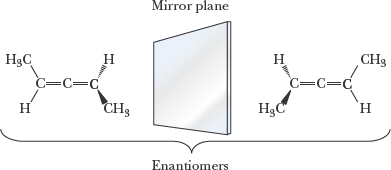
Example: Cis- and trans-2-butene are configurational isomers but not enantiomers; they are diastereomers.
Chiral Centers Beyond Carbon
Chiral centers are not limited to carbon atoms. Tetrahedral silicon, phosphorus, and germanium compounds can also exhibit chirality.
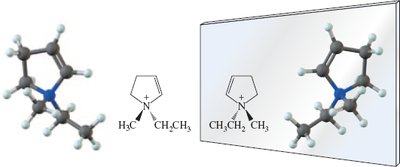
Example: A nitrogen atom in a tetrahedral environment can be a chiral center.
Conformational Isomers
Conformational isomers arise from rotation about single bonds. They interconvert rapidly and are not considered configurational isomers unless the barrier to rotation is high.
Gauche and anti forms: Different spatial arrangements in butane.
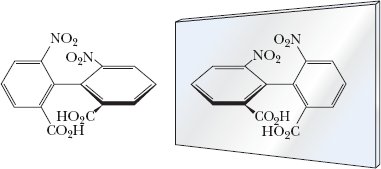
Atropisomers: Enantiomers lacking a chiral center, differing due to hindered rotation.
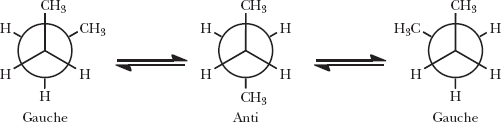
Example: The gauche forms of butane are enantiomers, but rapid interconversion makes the molecule achiral.
Naming Chiral Centers: The R, S System
Cahn-Ingold-Prelog (R, S) System
The R, S system is used to specify the absolute configuration of chiral centers. The arrangement is determined experimentally and follows a set of priority rules:
R: Clockwise order of priority.
S: Counterclockwise order of priority.
Priority Rules:
Assign priority based on atomic number of atoms bonded to the chiral center.
If priority cannot be assigned, examine the next set of atoms until a difference is found.
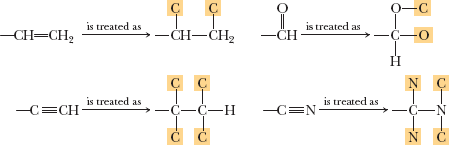
Atoms in double or triple bonds are treated as bonded to equivalent "phantom" atoms.
Priority is assigned at the first point of difference between groups.
Example: -CH2Cl has higher priority than -CH2CH2CH2CH3 due to the presence of Cl.
Molecules with Multiple Stereocenters
Calculating Stereoisomers
For molecules with n chiral centers, the maximum number of stereoisomers is given by .
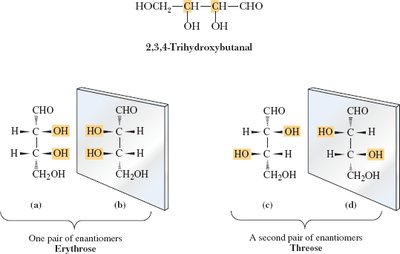
Example: 2,3,4-trihydroxybutanal has three chiral centers and can have up to eight stereoisomers.
Example: Erythrose and threose are pairs of enantiomers; other combinations are diastereomers.
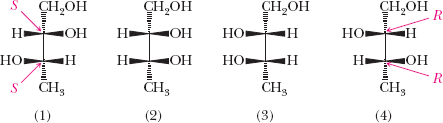
Stereoisomers of 1,2,3-Butanetriol
Each chiral center can be assigned an R or S configuration. Enantiomers are pairs with opposite configurations at all centers; diastereomers differ at one or more but not all centers.
Example: Assign IUPAC names and identify enantiomers and diastereomers among the four stereoisomers.
Meso Compounds
Definition and Properties
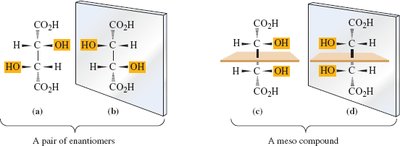
Meso compounds are achiral molecules with two or more chiral centers and internal symmetry. They reduce the number of possible stereoisomers.
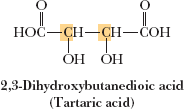
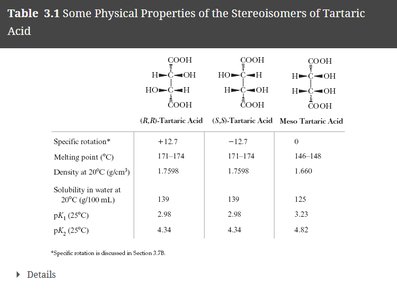
Example: Tartaric acid has three stereoisomers: a pair of enantiomers and a meso compound.
Physical and Chemical Properties: Enantiomers have identical properties in achiral environments.
Property | (R,R)-Tartaric Acid | (S,S)-Tartaric Acid | Meso Tartaric Acid |
|---|---|---|---|
Specific rotation | +12.7 | -12.7 | 0 |
Melting point (°C) | 171-174 | 171-174 | 146-148 |
Density at 20°C (g/cm³) | 1.7598 | 1.7598 | 1.660 |
Solubility in water at 20°C (g/100 mL) | 139 | 139 | 125 |
pKa1 (25°C) | 2.98 | 2.98 | 2.95 |
pKa2 (25°C) | 4.34 | 4.34 | 4.82 |
Fischer Projection Formulas
Representation and Use
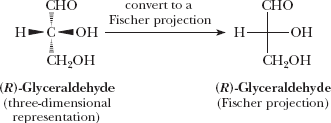
Fischer projections are two-dimensional representations of molecules, useful for visualizing stereochemistry. Groups on the right and left are in front, while those at the top and bottom are at the rear.
Example: Draw a Fischer projection of (2R,3R)-erythrose.
Cyclic Molecules with Two or More Chiral Centers
Disubstituted Cyclopentane Derivatives
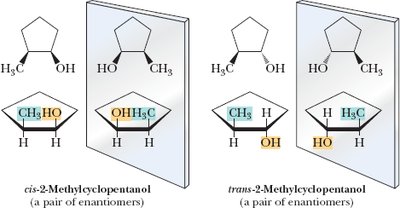
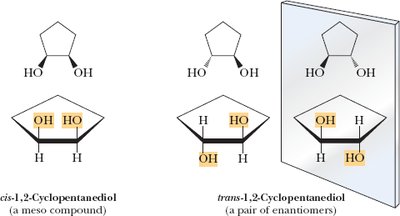
Derivatives of cyclopentane with two chiral centers can have up to four stereoisomers. Cis and trans isomers are chiral and exist as pairs of enantiomers; cis and trans are diastereomers.
Example: Cis-1,2-cyclopentanediol is a meso compound.
Disubstituted Cyclohexane Derivatives
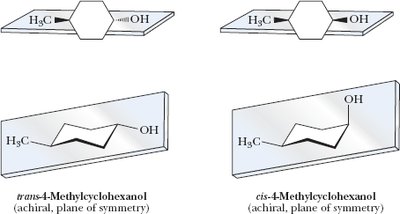
Chair conformations are the most stable forms of cyclohexane derivatives. Symmetry analysis is performed on flat structures. Some derivatives, like 4-methylcyclohexanol, are achiral due to a plane of symmetry.
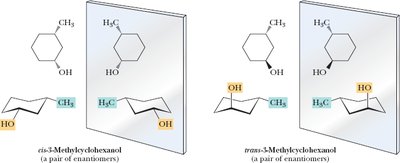
Example: 3-methylcyclohexanol has two chiral centers and four stereoisomers.
1,2-Cyclohexanediol Stereoisomers
Planar structures indicate three stereoisomers for 1,2-cyclohexanediol: a pair of enantiomers (trans) and a meso compound (cis).
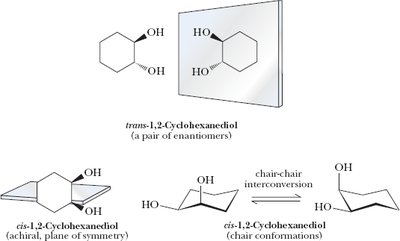
Example: Cis-1,2-cyclohexanediol interconverts rapidly between chair conformations, making it effectively a meso compound.
Summary Flowchart
Classification of Isomers
A flowchart can be used to classify isomers based on connectivity, symmetry, and stereochemistry.
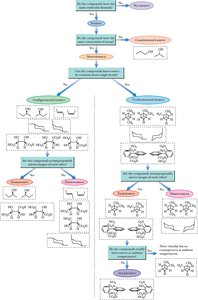
Example: Use the flowchart to determine whether a compound is a constitutional isomer, stereoisomer, enantiomer, diastereomer, or meso compound.
----------------------------------------
