 Back
BackSubstitution and Elimination Reactions of Alkyl Halides: SN1, SN2, E1, and E2 Mechanisms
Study Guide - Smart Notes
 Tailored notes based on your materials, expanded with key definitions, examples, and context.
Reactions of Alkyl Halides
Overview
Alkyl halides are organic compounds containing a halogen atom bonded to an sp3-hybridized carbon. They undergo substitution and elimination reactions, which are fundamental transformations in organic synthesis. The two main substitution mechanisms are SN1 (unimolecular nucleophilic substitution) and SN2 (bimolecular nucleophilic substitution), while elimination reactions include E1 and E2 mechanisms.
SN2 Reaction
Mechanism and Features
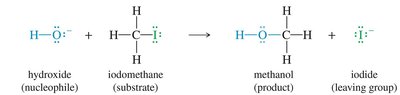
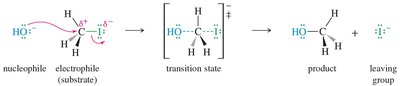
The SN2 reaction is a concerted, one-step process where the nucleophile attacks the electrophilic carbon from the opposite side of the leaving group, resulting in simultaneous bond formation and bond breaking. The reaction is second order overall, depending on both the alkyl halide and the nucleophile concentrations.
Mechanism: The nucleophile attacks the carbon bearing the leaving group, displacing the halide ion in a single step.
Rate Law:
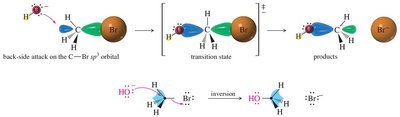
Stereochemistry: SN2 reactions result in inversion of configuration at the reaction center (Walden inversion).
Stereochemistry of SN2
Because the nucleophile attacks from the side opposite the leaving group, the configuration at the stereocenter is inverted. This is especially important in reactions involving chiral centers.

Uses for SN2 Reactions
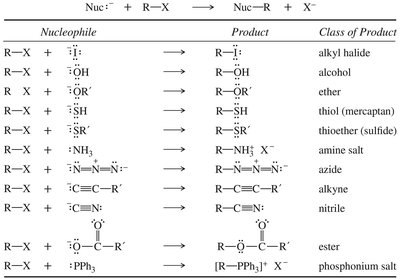
SN2 reactions are widely used to synthesize a variety of functional groups by replacing the halide with different nucleophiles.
Nucleophile | Product | Class of Product |
|---|---|---|
alkyl halide | ||
alcohol | ||
ether | ||
thiol (mercaptan) | ||
thioether (sulfide) | ||
amine salt | ||
azide | ||
alkyne | ||
nitrile | ||
ester | ||
phosphonium salt |
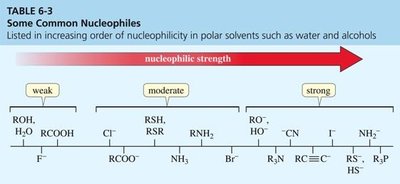
Nucleophilic Strength
The rate of SN2 reactions increases with nucleophilic strength. Strong bases are often strong nucleophiles, but not all strong nucleophiles are basic. Nucleophilicity trends depend on charge, electronegativity, and polarizability.
Basicity Versus Nucleophilicity
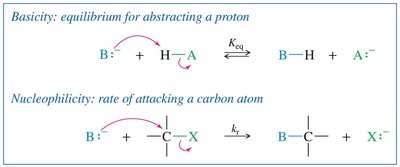
Basicity is a thermodynamic property, defined by the equilibrium constant for proton abstraction. Nucleophilicity is a kinetic property, defined by the rate at which a nucleophile attacks an electrophilic carbon.
Basicity:
Nucleophilicity:
Leaving Group Ability
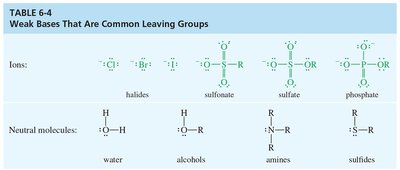
The best leaving groups are electron-withdrawing, stable after departure, and polarizable. Weak bases make good leaving groups.
Effect of Substituents on SN2 Rates
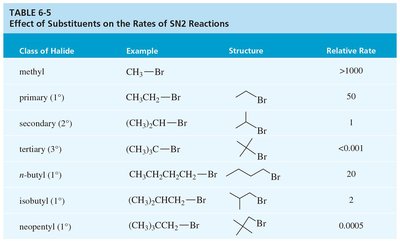
Steric hindrance greatly affects SN2 reactions. Methyl and primary halides react fastest, while tertiary halides are unreactive due to crowding at the reaction center.
Class of Halide | Example | Structure | Relative Rate |
|---|---|---|---|
methyl | CH3Br | — | >1000 |
primary (1°) | CH3CH2Br | — | 50 |
secondary (2°) | (CH3)2CHBr | — | 1 |
tertiary (3°) | (CH3)3CBr | — | <0.001 |
n-butyl (1°) | CH3CH2CH2CH2Br | — | 20 |
isobutyl (1°) | (CH3)2CHCH2Br | — | 2 |
neopentyl (1°) | (CH3)3CCH2Br | — | 0.0005 |
SN1 Reaction
Mechanism and Features
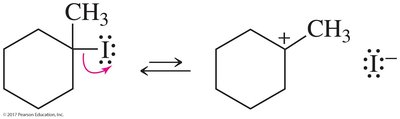
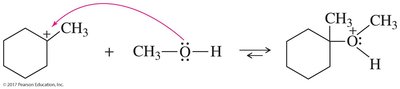
The SN1 reaction proceeds via a two-step mechanism: first, the leaving group departs to form a carbocation intermediate (rate-determining step), then the nucleophile attacks the carbocation. If the nucleophile is neutral, a third step (deprotonation) is required.
Mechanism: Step 1: Ionization to form a carbocation. Step 2: Nucleophilic attack. Step 3: Deprotonation (if needed).
Rate Law: (first order)
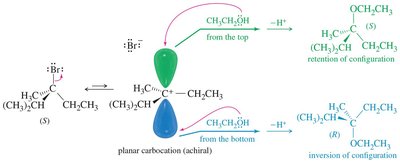
Stereochemistry: Mixture of retention and inversion due to planar carbocation intermediate.
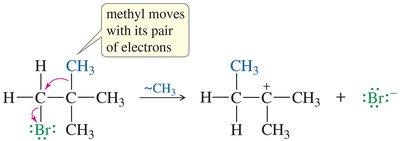
Rearrangements: Carbocations may rearrange to form more stable intermediates (hydride or methyl shifts).

Carbocation Structure and Rearrangements
Carbocations are sp2 hybridized and trigonal planar, allowing nucleophilic attack from either side. Rearrangements (hydride or methyl shifts) can occur to generate more stable carbocations.
Summary Table: SN1 vs SN2
Promoting Factors | SN1 | SN2 |
|---|---|---|
Nucleophile | Weak nucleophiles are OK | Strong nucleophile needed |
Substrate (RX) | 3° > 2° | CH3X > 1° > 2° |
Solvent | Good ionizing solvent needed | Wide variety of solvents |
Leaving group | Good one required | Good one required |
Other | AgNO3 forces ionization | — |
Characteristics | SN1 | SN2 |
|---|---|---|
Kinetics | First order, | Second order, |
Stereochemistry | Mixture of inversion and retention | Complete inversion |
Rearrangements | Common | Impossible |
Elements of Unsaturation
Definition and Calculation
An element of unsaturation is a structural feature that reduces the number of hydrogens in a molecule compared to a saturated hydrocarbon. Each ring or double bond counts as one element of unsaturation; a triple bond counts as two. The index of hydrogen deficiency (IHD) is calculated as follows:
Find the number of hydrogens in the saturated formula ().
Subtract the actual number of hydrogens.
Divide the difference by 2.
Halogens are counted as hydrogens, oxygen is ignored, and for each nitrogen, add one hydrogen to the formula.

IUPAC Nomenclature of Alkenes
Rules for Naming Alkenes
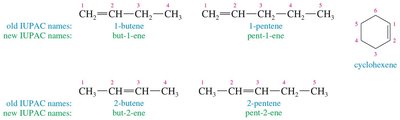
To name alkenes according to IUPAC rules:
Find the longest chain containing the double bond.
Change the -ane ending to -ene.
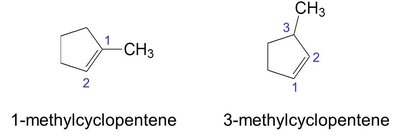
Number the chain to give the double bond the lowest possible number.
For rings, the double bond is assumed between C-1 and C-2.
E-Z Nomenclature
The E-Z system uses the Cahn-Ingold-Prelog priority rules to distinguish stereoisomers of alkenes:
Z (zusammen): High-priority groups on the same side.
E (entgegen): High-priority groups on opposite sides.
Relative Stabilities of Alkenes
Stability Trends
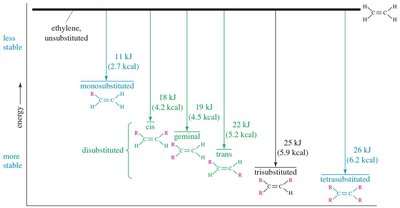
Alkene stability increases with substitution: tetrasubstituted > trisubstituted > disubstituted > monosubstituted. Trans alkenes are generally more stable than cis due to less steric strain.
Elimination Reactions: E1 and E2
Overview
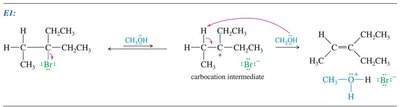
Elimination reactions convert alkyl halides or alcohols to alkenes by removing atoms or groups from adjacent carbons. The two main mechanisms are E1 (unimolecular) and E2 (bimolecular).
E1: Two-step, forms a carbocation intermediate, often competes with SN1.
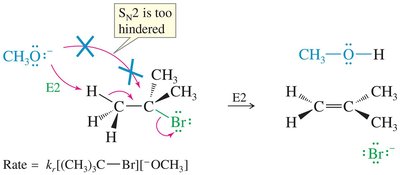
E2: One-step, concerted removal of a proton and leaving group, requires a strong base.
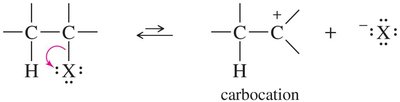

Dehydration of Alcohols (E1 Mechanism)
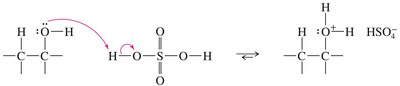
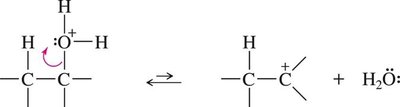
Alcohols can be dehydrated to alkenes using strong acid (e.g., H2SO4 or H3PO4) and heat. The reaction proceeds via an E1 mechanism, often with rearrangements, and follows Zaitsev's rule (the more substituted alkene is favored).
Bulky Bases and Hofmann Orientation
Bulky bases (e.g., tert-butoxide) favor elimination to give the less substituted (Hofmann) alkene, contrary to Zaitsev's rule. This is due to steric hindrance preventing removal of more hindered hydrogens.

Substitution or Elimination?
The outcome depends on the structure of the alkyl halide, the strength and bulk of the base/nucleophile, and reaction conditions (temperature, solvent). Primary halides favor SN2, tertiary halides favor E1/E2, and high temperature or bulky bases favor elimination.
Summary Table: Substrate Reactivity
Substrate | SN1 Conditions (weak nucleophile) | SN2 Conditions (strong nucleophile) |
|---|---|---|
Methyl halides (CH3X) | No reaction (methyl cation too unstable) | SN2 is unhindered and favored |
Primary halides (RCH2X) | Rarely react unless resonance-stabilized cation can form | SN2 is favored unless R group is bulky |
Secondary halides (R2CHX) | SN1 (often with rearrangement) in good solvent | SN2 can occur unless hindered |
Tertiary halides (R3CX) | SN1 occurs readily in good solvent | SN2 cannot occur (steric hindrance) |
Additional info: These notes provide a comprehensive overview of the substitution and elimination reactions of alkyl halides, including mechanisms, stereochemistry, and factors affecting reactivity, as well as the nomenclature and stability of alkenes. The included images and tables reinforce key mechanistic and conceptual points for exam preparation.
