 Back
BackSubstitution and Elimination Reactions of Alkyl Halides
Study Guide - Smart Notes
 Tailored notes based on your materials, expanded with key definitions, examples, and context.
Substitution and Elimination Reactions of Alkyl Halides
Overview of Alkyl Halides and Their Reactions
Alkyl halides are organic compounds containing a halogen atom (Cl, Br, I, or F) bonded to an sp3-hybridized carbon. Their reactivity is central to organic synthesis, particularly through nucleophilic substitution and elimination reactions. These reactions are influenced by the structure of the alkyl halide, the nature of the leaving group, the base/nucleophile, and reaction conditions.

Characteristic Reactions: Nucleophilic Substitution and Elimination
Nucleophilic Substitution (SN1 and SN2): The halide is replaced by a nucleophile. SN2 is a one-step, concerted mechanism, while SN1 proceeds via a carbocation intermediate.
Elimination (E1 and E2): The halide and a β-hydrogen are removed, forming an alkene. E2 is a concerted, one-step process, while E1 involves a carbocation intermediate.
Zaitsev's Rule and Product Distribution
Zaitsev's Rule
Zaitsev's Rule states that in elimination reactions, the more substituted (and thus more stable) alkene is generally the major product. This is because more substituted alkenes are stabilized by hyperconjugation and alkyl group electron donation.
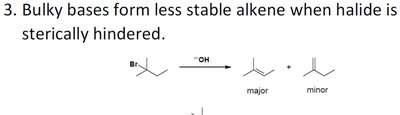
Exception: When the base or the leaving group is bulky, the less substituted alkene (Hofmann product) may predominate.
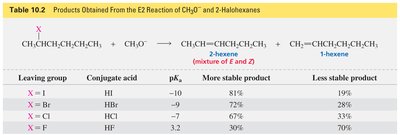
Table Purpose: The table above compares the effect of different leaving groups on the product distribution in E2 reactions. It shows that better leaving groups (I, Br) favor the more stable (Zaitsev) product, while poor leaving groups (F) favor the less stable product.
Relative Stabilities of Carbanions
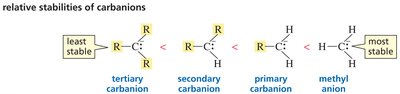
The stability of carbanions formed during elimination reactions follows the order: methyl > primary > secondary > tertiary. This is the opposite of carbocation stability, due to electron-donating alkyl groups destabilizing the negative charge.
Bulky Bases and Steric Hindrance
Bulky bases, such as tert-butoxide, favor the formation of less substituted alkenes because steric hindrance prevents them from abstracting the more hindered β-hydrogen.
Mechanistic Pathways: SN1, SN2, E1, and E2
Quick Review of Mechanisms
SN2: Bimolecular, concerted, backside attack, inversion of configuration.
SN1: Unimolecular, carbocation intermediate, racemization possible.
E2: Bimolecular, concerted, requires anti-coplanar geometry.
E1: Unimolecular, carbocation intermediate, often competes with SN1.
Syn and Anti Elimination
In E2 reactions, the base abstracts a β-hydrogen anti to the leaving group (anti-coplanar geometry), which is favored due to lower energy (staggered conformation). Syn elimination (eclipsed conformation) is less common due to higher energy.

Factors Affecting Substitution vs. Elimination
Structure of Alkyl Halide
Primary Alkyl Halides: Favor SN2 and E2 (with strong base), primarily substitution unless bulky base is used.
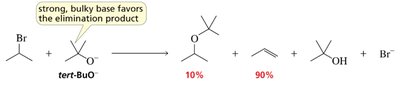
Secondary Alkyl Halides: Both substitution and elimination are possible; strong/bulky bases favor elimination.
Tertiary Alkyl Halides: Favor SN1 and E1 (with weak base/nucleophile), elimination is favored at high temperature.


Effect of Base Strength and Bulk
Strong, Bulky Bases: Favor E2 elimination, especially for secondary and tertiary alkyl halides.
Weak Bases: Favor substitution (SN1 or SN2) over elimination.
Effect of Temperature
Higher temperatures favor elimination (E1/E2) over substitution due to the greater increase in entropy () in elimination reactions.
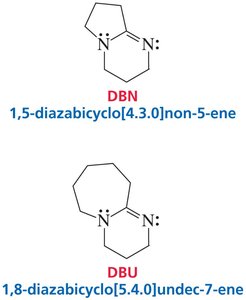
Special Cases: Benzylic and Allylic Halides
Benzylic and allylic halides are more reactive in both substitution and elimination due to resonance stabilization of intermediates. All four mechanisms (SN1, SN2, E1, E2) are possible depending on the degree of substitution and reaction conditions.
SN2: Possible with 1° and 2° benzylic/allylic halides.
E2: Possible with 2° and 3° benzylic/allylic halides.
SN1/E1: Possible with 1°, 2°, and 3° benzylic/allylic halides due to resonance stabilization of the carbocation.
Note: Resonance can lead to constitutional isomers as products.
Summary Table: Product Distribution in E2 Reactions
Leaving group | Conjugate acid | pKa | More stable product | Less stable product |
|---|---|---|---|---|
I | HI | -10 | 81% | 19% |
Br | HBr | -9 | 72% | 28% |
Cl | HCl | -7 | 67% | 33% |
F | HF | 3.2 | 30% | 70% |
Additional info: This table demonstrates that the better the leaving group, the more the reaction favors the more substituted (Zaitsev) alkene.
Key Definitions and Concepts
Alkyl Halide: An organic molecule containing a halogen atom bonded to an sp3 carbon.
Leaving Group: An atom or group that can depart with a pair of electrons in a substitution or elimination reaction.
Nucleophile: A species that donates an electron pair to form a new covalent bond.
Base: A species that abstracts a proton (H+).
Zaitsev Product: The more substituted alkene formed in an elimination reaction.
Hofmann Product: The less substituted alkene formed, often favored by bulky bases or poor leaving groups.
