 Back
BackThe Periodic Table: Foundation for Organic Chemistry
Study Guide - Smart Notes
 Tailored notes based on your materials, expanded with key definitions, examples, and context.
The Periodic Table of the Elements
Overview and Relevance to Organic Chemistry
The Periodic Table of the Elements is a fundamental tool in chemistry, organizing all known elements according to their atomic number, electron configuration, and recurring chemical properties. Understanding the periodic table is essential for organic chemistry, as it provides insight into the behavior of atoms, their bonding tendencies, and their roles in organic molecules.
Atomic Number: Indicates the number of protons in an atom, which determines the element's identity.
Groups and Periods: Elements are arranged in columns (groups) and rows (periods). Groups share similar chemical properties due to similar valence electron configurations.
Valence Electrons: The outermost electrons are crucial for chemical bonding, especially in organic compounds.
Key Elements in Organic Chemistry: Carbon (C), Hydrogen (H), Oxygen (O), Nitrogen (N), Sulfur (S), and Phosphorus (P) are the primary elements found in organic molecules.
Electronic Structure and Bonding
Organic chemistry focuses on the structure and bonding of carbon and other elements. The periodic table helps predict:
Bonding Patterns: Elements in the same group often form similar types of bonds.
Electronegativity: The tendency of an atom to attract electrons, which affects bond polarity and reactivity.
Hybridization: The mixing of atomic orbitals in elements like carbon, leading to different molecular geometries.
Example: Carbon's Central Role
Carbon (C), found in group 14, has four valence electrons, allowing it to form four covalent bonds. This versatility is the basis for the vast diversity of organic compounds.
Periodic Table Image
The following image visually represents the periodic table, highlighting the arrangement and classification of elements:
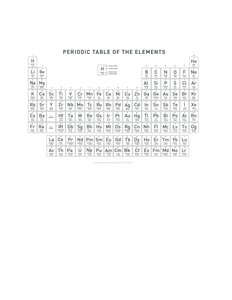
Additional info: The periodic table is referenced in nearly every chapter of organic chemistry, especially in discussions of electronic structure, bonding, and reactivity (Ch. 1, Ch. 2, Ch. 3).
