 Back
BackThermodynamic and Kinetic Effects in Solid Synthesis: Nucleation, Growth, and Liquid Phase Approaches
Study Guide - Smart Notes
 Tailored notes based on your materials, expanded with key definitions, examples, and context.
Macromolecules and Materials: Synthesis and Properties
Thermodynamic and Kinetic Effects in Solid Synthesis
This section explores the fundamental principles governing the synthesis of solid phases, focusing on thermodynamic and kinetic effects. Understanding these concepts is essential for controlling the formation, stability, and properties of materials, especially in the context of solid-state and liquid-phase synthesis.
Kinetic Effects in Solid-State Reactions
Solid-state reactions are often slow due to limited atomic mobility. Atoms must diffuse through a solid lattice, and the rate of diffusion is a key factor in determining how quickly a reaction proceeds.
Diffusion in Solids: Occurs via random jumps between lattice sites, requiring thermal activation to overcome energy barriers.
Fick's Laws: Describe the diffusion process mathematically. The diffusion coefficient, D, is temperature-dependent and follows Boltzmann statistics:
Higher Temperatures: Increase diffusion rates, accelerating solid-state reactions.
Particle Size: Larger particles require longer diffusion times.
Retaining Desired Phases
After synthesis, it is crucial to retain the desired phase at ambient conditions. This can be achieved by:
Ensuring the phase remains thermodynamically stable.
Tweaking system parameters to maintain stability.
Trapping metastable products by rapid cooling (quenching), which prevents diffusion and nucleation of other phases.
Nucleation: Thermodynamics and Kinetics
Nucleation is the initial step in phase transformation, where a new phase forms within the parent phase. The process is governed by thermodynamic driving forces and kinetic barriers.
Thermodynamic Driving Force
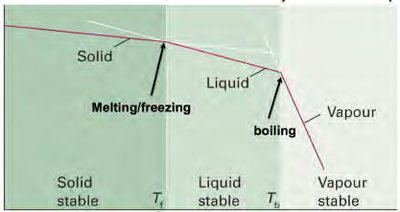
Gibbs Free Energy Change:
At equilibrium temperature ():
Excess Gibbs energy available for transformation is proportional to supercooling ():
Energy Barriers and Critical Nucleus
Surface Energy: Creating an interface costs energy due to unsatisfied bonding (surface tension, ).
Volume vs Surface: Driving energy is proportional to the volume, while the cost is proportional to the surface area.
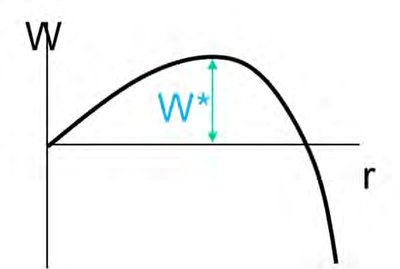
Critical Radius (): If a nucleus is larger than , it will grow; if smaller, it will shrink.
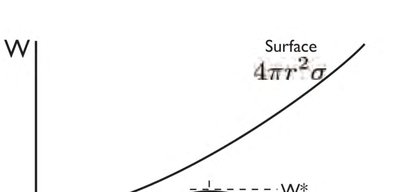
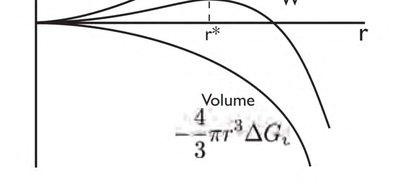
The total energy barrier () for nucleation is at the maximum of the curve:

Homogeneous vs Heterogeneous Nucleation
Homogeneous Nucleation: Occurs uniformly throughout the material, requiring higher energy barriers.
Heterogeneous Nucleation: Occurs at pre-existing interfaces (e.g., container walls, impurities), lowering the energy barrier and facilitating nucleation.

Kinetics of Nucleation
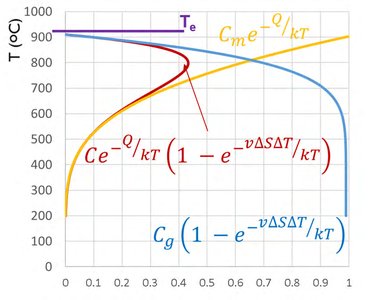
The population of critical nuclei follows an Arrhenius distribution.
The rate of nucleation depends on both the energy barrier () and the activation energy for diffusion ():
Kinetics of Growth
Once nucleated, growth rate is determined by the difference in atoms jumping to/from the new phase at the interface.
Growth rate equation:
Time-Temperature-Transformation (TTT) Diagrams
TTT diagrams are used to visualize the fraction of material transformed at a given temperature and time. They are essential for understanding how cooling rates affect the formation of stable or metastable phases.
Critical Cooling Rate: Cooling faster than a critical rate avoids thermodynamic transitions, forming metastable states (e.g., glass).
TTT Diagram: Shows the relationship between temperature, time, and phase transformation.
First Order vs Second Order Transitions
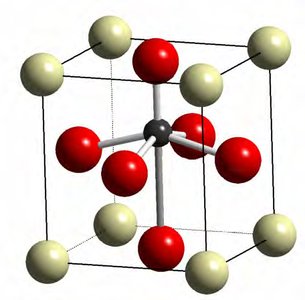
First Order (Diffusive) Transitions: Characterized by nucleation and growth, with discontinuity in the first derivative of Gibbs energy.
Second Order (Displacive) Transitions: Structure changes continuously without nucleation or diffusion; discontinuity is in the second derivative.
Synthesis of Solids: Liquid Phase Approaches
Overview of Synthesis Methods
Solid materials can be synthesized using various methods, each with specific advantages and limitations. The choice of method depends on the desired properties, scale, and application.
Liquid Phase Syntheses: Melts, Czochralski crystal growth, hydrothermal/solvothermal synthesis, precipitation, sol-gel synthesis.
Dry Syntheses: Solid state reactions, mechanosynthesis, combustion/flame synthesis, sealed tube/vapour transport, physical vapour deposition (PVD), molecular beam epitaxy, atomic layer deposition (ALD), chemical vapour deposition (CVD).
Melts
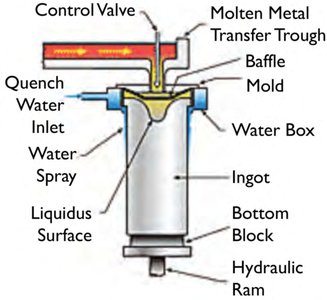
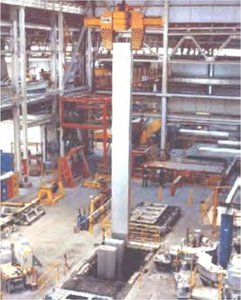
Ingredients are melted in correct proportions, cooled in a mould.
Allows control of shape and processing of large quantities.
Phase and TTT diagrams are used to control product and microstructure.
Important for inorganic glasses and metal alloys.
Some systems have impractical melting points or decompose before melting.
Czochralski Method
Used to produce single crystals, especially semiconductors (Si, Ge, GaAs).
Seed crystal is dipped into the melt and slowly pulled out to form a crystal boule.
Wafers are sliced and labelled by Miller indices.
Hydrothermal/Solvothermal Synthesis
Species are transported by a medium (water or solvent), often supercritical.
Templating agents may be added.
Materials are made in a heated autoclave (high pressure vessel), typically 100-500°C.
Slow, costly, batch process, but produces high-quality crystals.
Precipitation
Simple reaction and precipitation from a solvent, often used for purification or separation.
Example: Sulphate process for titania (TiO2) production.
Bulk process, but generates significant acid waste.
Sol-Gel Synthesis
Avoids unwanted phase separation seen in simple precipitation.
Allows control of product format (colloidal powders, glass fibres, garnets).
Sol: Colloidal suspension of solid particles in a liquid.
Gel: Interconnected semi-rigid network with pores and chains.
Commonly starts with alkoxides (e.g., TEOS for silica, TTIP for titania).
Acid or base-catalysed hydrolysis generates hydroxides, which condense to form networks.
Commercial silica gel is used as chromatography medium, desiccant, catalyst support, ink additive, etc.
Summary Table: Synthesis Methods
Method | Key Features | Applications | Advantages | Disadvantages |
|---|---|---|---|---|
Melts | Bulk processing, phase control | Glasses, alloys | Large scale, shape control | High melting points |
Czochralski | Single crystal growth | Semiconductors | High purity, orientation control | Slow, costly |
Hydrothermal | Medium transport, autoclave | Functional crystals, zeolites | Lower temp, high quality | Batch, slow |
Precipitation | Solvent reaction | Pigments, purification | Simple, bulk | Waste generation |
Sol-Gel | Colloidal, network formation | Powders, gels | Format control, fast diffusion | Complexity |
Additional info: These synthesis methods are foundational for materials chemistry and are relevant for understanding the formation and properties of inorganic and organic solids, including polymers, catalysts, and functional materials.
