Ch. 1 - Remembering General Chemistry: Electronic Structure and Bonding (Part 1)
Bruice - Organic Chemistry 8th Edition
Bruice8th EditionOrganic ChemistryISBN: 9780135213711Not the one you use?Change textbook
Chapter 1, Problem 38(2)

a. Which bond would be longer?
b. Which bond would be stronger?
2. C—C or C—Cl

Verified step by step guidance
1
Step 1: Understand the factors that influence bond length. Bond length is determined by the size of the atoms involved and the type of bond (single, double, or triple). Larger atoms tend to form longer bonds because their electron clouds are farther apart.
Step 2: Compare the atomic sizes of carbon (C) and chlorine (Cl). Chlorine is a larger atom than carbon because it has more electron shells. Therefore, a C—Cl bond will generally be longer than a C—C bond.
Step 3: Understand the factors that influence bond strength. Bond strength is determined by the bond order (single, double, or triple) and the overlap of atomic orbitals. Stronger bonds have greater orbital overlap and higher bond dissociation energy.
Step 4: Compare the bond types. Both C—C and C—Cl bonds are single bonds, so the bond strength will depend on the nature of the atoms involved. Carbon-carbon bonds are typically stronger because the overlap between two carbon atoms' orbitals is more effective than the overlap between carbon and chlorine orbitals.
Step 5: Conclude that the C—Cl bond is longer due to the larger size of chlorine, while the C—C bond is stronger due to better orbital overlap and higher bond dissociation energy.

Verified video answer for a similar problem:

This video solution was recommended by our tutors as helpful for the problem above.
Video duration:
3m
Was this helpful?

Key Concepts

Here are the essential concepts you must grasp in order to answer the question correctly.

Bond Length

Bond length refers to the distance between the nuclei of two bonded atoms. Generally, bond length is influenced by the size of the atoms involved and the type of bond (single, double, or triple). In the case of C—C and C—Cl bonds, the presence of a larger chlorine atom compared to carbon can lead to a longer bond length in C—Cl due to increased atomic size.
Recommended video:
Guided course
06:00
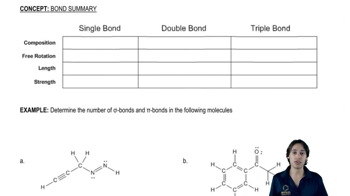
Single bonds, double bonds, and triple bonds.

Bond Strength

Bond strength is a measure of the energy required to break a bond between two atoms. Stronger bonds have higher bond dissociation energies. In comparing C—C and C—Cl bonds, the C—C bond is typically stronger because it is a pure carbon-carbon bond, while the C—Cl bond involves a polar covalent interaction, which is generally weaker due to the difference in electronegativity between carbon and chlorine.
Recommended video:
Guided course
06:00
Single bonds, double bonds, and triple bonds.

Electronegativity

Electronegativity is the tendency of an atom to attract electrons in a chemical bond. In the context of C—C and C—Cl bonds, chlorine is more electronegative than carbon, leading to a polar bond in C—Cl. This difference in electronegativity affects both the bond length and strength, as the C—Cl bond is less stable and longer than the C—C bond due to the partial positive charge on carbon in the C—Cl bond.
Recommended video:
Guided course
1:47
Electronegativity