
Ch. 1 - Remembering General Chemistry: Electronic Structure and Bonding (Part 1)
Bruice - Organic Chemistry 8th Edition
Bruice8th EditionOrganic ChemistryISBN: 9780135213711Not the one you use?Change textbook
Chapter 1, Problem 16a,b

Give each atom the appropriate formal charge:
a.
b.

Verified step by step guidance
1
Step 1: Recall the formula for calculating formal charge: Formal charge = (Valence electrons of the atom) - (Non-bonding electrons) - (1/2 × Bonding electrons).
Step 2: For the first molecule (CH3-O-CH3 with a hydrogen attached to oxygen), calculate the formal charge of each atom. Oxygen has 6 valence electrons, 4 non-bonding electrons (two lone pairs), and is involved in 3 bonds (6 bonding electrons). Use the formula to determine its formal charge.
Step 3: For the carbon atoms in the first molecule, each carbon has 4 valence electrons, no lone pairs, and is involved in 4 bonds (8 bonding electrons). Apply the formula to calculate their formal charges.
Step 4: For the second molecule (H-C-H with a lone pair on carbon), calculate the formal charge of the carbon atom. Carbon has 4 valence electrons, 2 non-bonding electrons (one lone pair), and is involved in 3 bonds (6 bonding electrons). Use the formula to determine its formal charge.
Step 5: For the hydrogen atoms in both molecules, each hydrogen has 1 valence electron, no lone pairs, and is involved in 1 bond (2 bonding electrons). Apply the formula to calculate their formal charges.

Verified video answer for a similar problem:

This video solution was recommended by our tutors as helpful for the problem above.
Video duration:
5m
Was this helpful?

Key Concepts

Here are the essential concepts you must grasp in order to answer the question correctly.

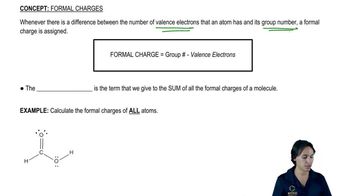
Formal Charge

Formal charge is a theoretical charge assigned to an atom in a molecule, calculated by comparing the number of valence electrons in the free atom to the number of electrons assigned to it in the molecule. It helps in determining the most stable structure of a molecule by minimizing the formal charges across the atoms.
Recommended video:
Guided course
01:34
Calculating formal and net charge.

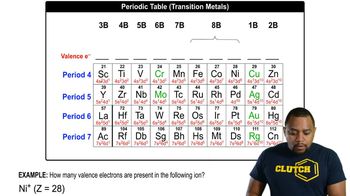
Valence Electrons

Valence electrons are the outermost electrons of an atom that are involved in forming bonds with other atoms. Understanding the number of valence electrons is crucial for calculating formal charges and predicting how atoms will interact in a molecule.
Recommended video:
Guided course
03:40
Valence Electrons of Transition Metals

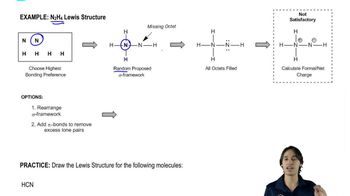
Lewis Structures

Lewis structures are diagrams that represent the bonding between atoms in a molecule and the lone pairs of electrons that may exist. They are essential for visualizing the arrangement of electrons, which aids in the calculation of formal charges and understanding molecular geometry.
Recommended video:
Guided course
04:12
Drawing the Lewis Structure for N2H4.