Ch. 1 - Remembering General Chemistry: Electronic Structure and Bonding (Part 2)
Bruice - Organic Chemistry 8th Edition
Bruice8th EditionOrganic ChemistryISBN: 9780135213711Not the one you use?Change textbook
Chapter 2, Problem 19a,b,c

Draw the lone-pair electrons that are not shown in the following condensed structures:
a. CH3CH2NH2
b. CH3NHCH3
c. CH3CH2OH

Verified step by step guidance
1
Step 1: Understand the concept of lone-pair electrons. Lone-pair electrons are valence electrons that are not involved in bonding and are localized on an atom. In organic molecules, these are typically found on heteroatoms such as nitrogen and oxygen.
Step 2: Analyze the structure of CH3CH2NH2. Nitrogen in this molecule has five valence electrons. Two of these electrons are involved in bonding with hydrogen and carbon, leaving one lone pair of electrons on the nitrogen atom. Draw the lone pair as two dots next to the nitrogen atom.
Step 3: Examine the structure of CH3NHCH3. Similar to the previous example, the nitrogen atom has one lone pair of electrons. Draw the lone pair as two dots next to the nitrogen atom in the structure.
Step 4: Investigate the structure of CH3CH2OH. Oxygen has six valence electrons. Two of these electrons are involved in bonding with hydrogen and carbon, leaving two lone pairs of electrons on the oxygen atom. Draw these lone pairs as two sets of dots next to the oxygen atom.
Step 5: Verify your drawings. Ensure that the lone pairs are correctly placed on the heteroatoms (nitrogen and oxygen) and that the total number of valence electrons for each atom matches its expected count based on the periodic table.

Verified video answer for a similar problem:

This video solution was recommended by our tutors as helpful for the problem above.
Video duration:
8m
Was this helpful?

Key Concepts

Here are the essential concepts you must grasp in order to answer the question correctly.

Lone Pair Electrons

Lone pair electrons are pairs of valence electrons that are not involved in bonding and are localized on a single atom. In organic molecules, these electrons can significantly influence the molecule's reactivity and geometry. Understanding where these lone pairs are located is crucial for predicting molecular behavior and interactions.
Recommended video:
Guided course
02:33
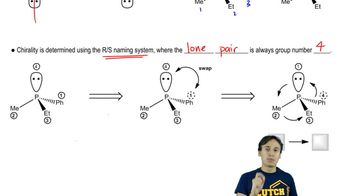
Determining R and S with Lone Pairs

Condensed Structures

Condensed structures are a simplified way of representing organic molecules, where bonds and lone pairs are often omitted for clarity. They provide a quick overview of the molecular formula and connectivity but require an understanding of how to interpret the implied hydrogen atoms and lone pairs. Recognizing the limitations of condensed structures is essential for accurately depicting molecular geometry.
Recommended video:
Guided course
06:06
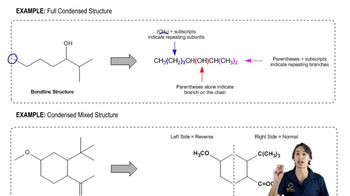
How to interpret condensed structures.

Functional Groups

Functional groups are specific groups of atoms within molecules that are responsible for the characteristic chemical reactions of those molecules. In the given question, the presence of amine (NH2) and alcohol (OH) functional groups indicates where lone pairs may be located. Identifying these groups helps in understanding the reactivity and properties of the compounds involved.
Recommended video:
Guided course
02:36
Identifying Functional Groups