Ch. 1 - Remembering General Chemistry: Electronic Structure and Bonding (Part 2)
Bruice - Organic Chemistry 8th Edition
Bruice8th EditionOrganic ChemistryISBN: 9780135213711Not the one you use?Change textbook
Chapter 2, Problem 13

Explain why HCl has a smaller dipole moment than HF, even though the H—Cl bond is longer than the H—F bond.

Verified step by step guidance
1
Dipole moment (μ) is calculated using the formula: μ = q × d, where q is the magnitude of the charge separation and d is the bond length. While bond length (d) is a factor, the magnitude of the charge separation (q) plays a critical role in determining the dipole moment.
The electronegativity of fluorine (F) is significantly higher than that of chlorine (Cl). This means that the electron density in the H—F bond is pulled more strongly toward the fluorine atom, resulting in a larger charge separation (q) compared to the H—Cl bond.
Although the H—Cl bond is longer than the H—F bond, the smaller charge separation in the H—Cl bond due to chlorine's lower electronegativity reduces its contribution to the dipole moment.
In the case of H—F, the combination of a shorter bond length and a much larger charge separation results in a higher dipole moment compared to H—Cl.
Thus, the smaller dipole moment of HCl is primarily due to the lower electronegativity of chlorine, which leads to a smaller charge separation, even though the bond length is longer.

Verified video answer for a similar problem:

This video solution was recommended by our tutors as helpful for the problem above.
Video duration:
1m
Was this helpful?

Key Concepts

Here are the essential concepts you must grasp in order to answer the question correctly.

Electronegativity

Electronegativity is a measure of an atom's ability to attract and hold onto electrons in a chemical bond. In the case of HCl and HF, fluorine is more electronegative than chlorine, which means that the H—F bond has a greater polarity. This difference in electronegativity contributes significantly to the dipole moment, as the more electronegative atom (F) pulls the electron density closer, creating a stronger dipole.
Recommended video:
Guided course
1:47
Electronegativity

Bond Length and Dipole Moment

The dipole moment of a molecule is influenced by both the bond length and the difference in electronegativity between the bonded atoms. Although H—Cl is longer than H—F, the dipole moment is not solely determined by bond length. The greater electronegativity of fluorine results in a stronger dipole moment in HF, despite the shorter bond length, leading to a higher overall dipole moment compared to HCl.
Recommended video:
Guided course
01:46
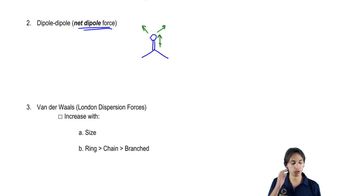
How dipole-dipole forces work.

Vector Nature of Dipole Moments

Dipole moments are vector quantities, meaning they have both magnitude and direction. The overall dipole moment of a molecule is the vector sum of the individual bond dipoles. In HCl, the bond dipole is less significant due to the lower electronegativity of chlorine compared to fluorine, resulting in a smaller net dipole moment for HCl, despite the longer bond length.
Recommended video:
Guided course
01:46
How dipole-dipole forces work.