Ch. 1 - Remembering General Chemistry: Electronic Structure and Bonding (Part 2)
Bruice - Organic Chemistry 8th Edition
Bruice8th EditionOrganic ChemistryISBN: 9780135213711Not the one you use?Change textbook
Chapter 2, Problem 32(1)

For each of the given species:
a. Draw its Lewis structure.
b. Describe the orbitals used by each carbon atom in bonding and indicate the approximate bond angles.
1. H2CO2

Verified step by step guidance
1
Step 1: Draw the Lewis structure for H₂CO₂. Start by identifying the total number of valence electrons. Carbon has 4 valence electrons, each hydrogen has 1 valence electron, and each oxygen has 6 valence electrons. Add these together to determine the total number of valence electrons available for bonding.
Step 2: Arrange the atoms with carbon as the central atom (since it is less electronegative than oxygen). Attach the two hydrogens and two oxygens to the carbon atom using single bonds. Distribute the remaining electrons to satisfy the octet rule for each atom, starting with the outer atoms (oxygen) and then the central atom (carbon).
Step 3: Check for formal charges on each atom. If necessary, adjust the structure by converting lone pairs on oxygen into double bonds with carbon to minimize formal charges and achieve the most stable structure. This will result in one oxygen atom being double-bonded to carbon and the other oxygen being single-bonded to carbon with a hydrogen attached to it.
Step 4: Describe the orbitals used by each carbon atom in bonding. Carbon in H₂CO₂ is sp² hybridized because it forms three sigma bonds (one with the double-bonded oxygen, one with the single-bonded oxygen, and one with a hydrogen atom) and has one unhybridized p orbital that participates in the π bond of the C=O double bond.
Step 5: Indicate the approximate bond angles. Since the carbon atom is sp² hybridized, the geometry around it is trigonal planar, and the bond angles are approximately 120°.

Verified video answer for a similar problem:

This video solution was recommended by our tutors as helpful for the problem above.
Video duration:
6m
Was this helpful?

Key Concepts

Here are the essential concepts you must grasp in order to answer the question correctly.

Lewis Structures

Lewis structures are diagrams that represent the bonding between atoms in a molecule and the lone pairs of electrons that may exist. They help visualize the arrangement of electrons and the connectivity of atoms, allowing for a better understanding of molecular geometry and reactivity. In the case of H2CO2, drawing the Lewis structure involves determining the total number of valence electrons and distributing them to satisfy the octet rule for each atom.
Recommended video:
Guided course
04:12
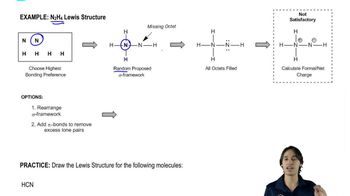
Drawing the Lewis Structure for N2H4.

Hybridization

Hybridization is the concept of mixing atomic orbitals to form new hybrid orbitals that can accommodate bonding. For carbon atoms in H2CO2, the hybridization can be determined based on the number of sigma bonds and lone pairs. For example, a carbon atom involved in double bonding typically exhibits sp2 hybridization, which influences the geometry and bond angles around the atom.
Recommended video:
Guided course
10:43
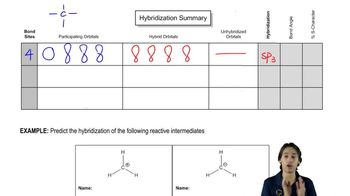
Using bond sites to predict hybridization

Bond Angles

Bond angles are the angles formed between adjacent bonds in a molecule, which are influenced by the hybridization of the central atom and the presence of lone pairs. In H2CO2, the bond angles can be approximated based on the hybridization of the carbon atoms; for instance, sp2 hybridized carbon typically has bond angles around 120 degrees. Understanding bond angles is crucial for predicting the three-dimensional shape of the molecule.
Recommended video:
Guided course
02:46
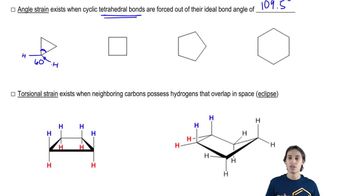
What is angle strain?