Ch. 10 - Reactions of Alcohols, Ethers, Epoxides, Amines, and Sulfur-Containing Compounds
Bruice - Organic Chemistry 8th Edition
Bruice8th EditionOrganic ChemistryISBN: 9780135213711Not the one you use?Change textbook
Chapter 11, Problem 5b

Explain how 1-butanol can be converted into the following compounds:
b.

Verified step by step guidance
1
Step 1: Begin with 1-butanol (CH3CH2CH2CH2OH), which is a primary alcohol. The goal is to convert it into the quaternary ammonium salt shown in the image.
Step 2: Convert 1-butanol into 1-bromobutane (CH3CH2CH2CH2Br) via a substitution reaction. This can be achieved by reacting 1-butanol with hydrobromic acid (HBr) in the presence of sulfuric acid (H2SO4). The hydroxyl group (-OH) is replaced by a bromine atom (-Br).
Step 3: React 1-bromobutane with trimethylamine (N(CH3)3) in a nucleophilic substitution reaction. The bromine atom is replaced by the trimethylamine group, forming butyltrimethylammonium bromide (CH3CH2CH2CH2N+(CH3)3 Br−).
Step 4: To isolate the quaternary ammonium salt, ensure the reaction mixture is purified. This can involve recrystallization or other purification techniques to remove any unreacted starting materials or by-products.
Step 5: Confirm the structure of the product using spectroscopic techniques such as NMR or IR to ensure the desired quaternary ammonium salt has been synthesized.

Verified video answer for a similar problem:

This video solution was recommended by our tutors as helpful for the problem above.
Video duration:
1m
Was this helpful?

Key Concepts

Here are the essential concepts you must grasp in order to answer the question correctly.

Alcohol Functional Group

1-butanol is a primary alcohol characterized by the presence of a hydroxyl (-OH) group attached to a four-carbon chain. Understanding the properties of alcohols, including their reactivity and ability to undergo various chemical transformations, is essential for predicting how 1-butanol can be converted into other compounds.
Recommended video:
Guided course
02:36
Identifying Functional Groups

Oxidation Reactions

Oxidation reactions involve the loss of electrons or an increase in oxidation state, often resulting in the conversion of alcohols to aldehydes or ketones. In the case of 1-butanol, oxidation can lead to the formation of butanal or butanone, depending on the reaction conditions and reagents used.
Recommended video:
Guided course
03:20
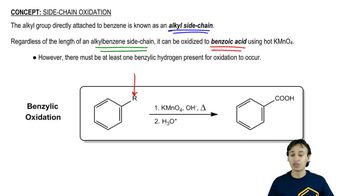
Benzylic Oxidation

Functional Group Interconversion

Functional group interconversion refers to the transformation of one functional group into another through various chemical reactions. This concept is crucial for understanding how 1-butanol can be converted into different compounds, as it involves changing the -OH group into other functional groups, such as carbonyls or esters, through specific reaction pathways.
Recommended video:
Guided course
02:36
Identifying Functional Groups