Ch. 10 - Reactions of Alcohols, Ethers, Epoxides, Amines, and Sulfur-Containing Compounds
Bruice - Organic Chemistry 8th Edition
Bruice8th EditionOrganic ChemistryISBN: 9780135213711Not the one you use?Change textbook
Chapter 11, Problem 56a,b

Indicate which alcohol in each pair undergoes an elimination reaction more rapidly when heated with H2SO4.
a.
b.

Verified step by step guidance
1
Step 1: Understand the mechanism of elimination reactions in alcohols. Alcohols undergo elimination reactions to form alkenes when treated with strong acids like H2SO4. This process typically follows the E1 mechanism, which involves the formation of a carbocation intermediate.
Step 2: Consider the stability of the carbocation formed during the reaction. The rate of elimination is influenced by the stability of the carbocation intermediate. More stable carbocations lead to faster elimination reactions.
Step 3: Analyze the structure of each alcohol in the pair. Identify the type of alcohol (primary, secondary, or tertiary) as this affects the stability of the carbocation. Tertiary alcohols generally form more stable carbocations compared to secondary and primary alcohols.
Step 4: Compare the alcohols in each pair based on their ability to form stable carbocations. The alcohol that forms the more stable carbocation will undergo elimination more rapidly.
Step 5: Consider any additional factors such as steric hindrance or resonance that might affect carbocation stability. Resonance can stabilize carbocations, while steric hindrance can slow down the reaction. Use these considerations to make a final comparison between the alcohols in each pair.

Verified video answer for a similar problem:

This video solution was recommended by our tutors as helpful for the problem above.
Video duration:
6m
Was this helpful?

Key Concepts

Here are the essential concepts you must grasp in order to answer the question correctly.

Elimination Reactions

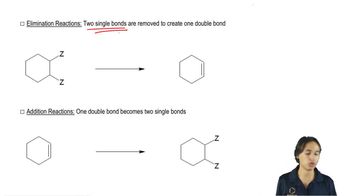
Elimination reactions involve the removal of a small molecule from a larger one, typically resulting in the formation of a double bond. In organic chemistry, these reactions often occur with alcohols when treated with strong acids like H2SO4, leading to the formation of alkenes. The rate of elimination can depend on the structure of the alcohol, including factors like steric hindrance and the stability of the resulting alkene.
Recommended video:
Guided course
00:40
Recognizing Elimination Reactions.

Alcohol Structure and Stability

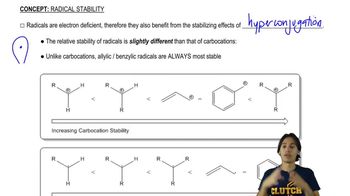
The structure of an alcohol significantly influences its reactivity in elimination reactions. Tertiary alcohols generally undergo elimination more readily than primary or secondary alcohols due to the stability of the carbocation intermediate formed during the reaction. The more substituted the alkene product, the more stable it is, which also drives the elimination process.
Recommended video:
Guided course
03:43
The radical stability trend.

Role of H2SO4 in Elimination

H2SO4 acts as a strong acid that protonates the hydroxyl group of the alcohol, converting it into a better leaving group. This protonation step is crucial for facilitating the elimination reaction. Additionally, H2SO4 can promote dehydration, where water is removed, leading to the formation of alkenes. The temperature and concentration of H2SO4 can also affect the rate of the elimination reaction.
Recommended video:
Guided course
00:38
Intro to Substitution/Elimination Problems