Ch. 10 - Reactions of Alcohols, Ethers, Epoxides, Amines, and Sulfur-Containing Compounds
Bruice - Organic Chemistry 8th Edition
Bruice8th EditionOrganic ChemistryISBN: 9780135213711Not the one you use?Change textbook
Chapter 11, Problem 83a

Propose a mechanism for each of the following reactions:
a. Chemical reaction diagram showing alcohol condensation to form an ether, with reactants, catalyst, and products labeled.

Verified step by step guidance
1
Step 1: Protonation of one of the hydroxyl groups. The sulfuric acid (H₂SO₄) acts as a strong acid and donates a proton (H⁺) to one of the hydroxyl groups (-OH) on the molecule, forming a good leaving group (water, H₂O).
Step 2: Formation of a carbocation intermediate. The protonated hydroxyl group leaves as water (H₂O), generating a carbocation at the adjacent carbon. This carbocation is stabilized by the molecular structure.
Step 3: Intramolecular nucleophilic attack. The remaining hydroxyl group (-OH) acts as a nucleophile and attacks the carbocation, forming a new bond and creating a cyclic intermediate.
Step 4: Deprotonation of the oxygen atom. The oxygen atom in the newly formed cyclic structure is protonated due to the acidic environment. A base (likely HSO₄⁻) removes the proton, stabilizing the cyclic ether product.
Step 5: Final product formation. The reaction results in the formation of a cyclic ether (tetrahydropyran) and hydronium ion (H₃O⁺) as the byproduct.

Verified video answer for a similar problem:

This video solution was recommended by our tutors as helpful for the problem above.
Video duration:
1m
Was this helpful?

Key Concepts

Here are the essential concepts you must grasp in order to answer the question correctly.

Ethanol Dehydration

Ethanol dehydration is a chemical reaction where ethanol (an alcohol) loses a water molecule to form an ether. This process typically requires an acid catalyst, such as sulfuric acid, and heat to facilitate the removal of water. Understanding this mechanism is crucial for predicting the products of the reaction and the conditions under which it occurs.
Recommended video:
Guided course
01:23
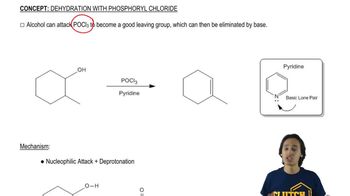
General Reaction of Dehydration with POCl3

Acid-Catalyzed Reaction Mechanism

In acid-catalyzed reactions, the acid donates a proton (H+) to the reactant, increasing its electrophilicity and making it more reactive. This mechanism often involves the formation of a carbocation intermediate, which can then react with nucleophiles. Recognizing this mechanism is essential for proposing accurate reaction pathways in organic chemistry.
Recommended video:
Guided course
06:34
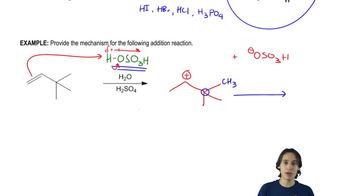
Acid-catalyzed hydration mechanism

Ether Formation

Ether formation involves the reaction of two alcohol molecules, leading to the creation of an ether and water. This process can occur through various mechanisms, including the condensation of alcohols in the presence of an acid catalyst. Understanding the structural features of the reactants and the conditions required for ether formation is vital for predicting the outcome of the reaction.
Recommended video:
Guided course
04:22
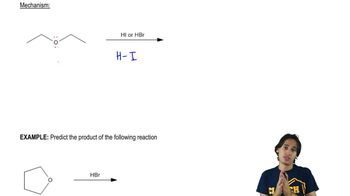
How to predict the products of Ether Cleavage.