

Ch. 10 - Reactions of Alcohols, Ethers, Epoxides, Amines, and Sulfur-Containing Compounds
Bruice - Organic Chemistry 8th Edition
Bruice8th EditionOrganic ChemistryISBN: 9780135213711Not the one you use?Change textbook
Chapter 11, Problem 91b

Propose a mechanism for each of the following reactions:
b. Chemical reaction diagram illustrating epoxide reactions with reactants, catalysts, and products labeled.

Verified step by step guidance
1
Step 1: Analyze the starting material and reaction conditions. The starting material is an epoxide-containing molecule with multiple double bonds. The reaction conditions include sulfuric acid (H₂SO₄) and water (H₂O), which suggest an acid-catalyzed ring-opening of the epoxide followed by electrophilic addition to the double bonds.
Step 2: Protonate the epoxide. In the presence of H₂SO₄, the oxygen atom in the epoxide is protonated, making it more electrophilic and susceptible to nucleophilic attack. This step generates a carbocation intermediate.
Step 3: Nucleophilic attack by water. Water acts as a nucleophile and attacks the carbocation formed after the epoxide ring opens. This results in the formation of a hydroxyl group (-OH) at the site of the epoxide.
Step 4: Electrophilic addition to the double bonds. The protonated sulfuric acid can further protonate one of the double bonds, generating a carbocation at the allylic position. Subsequent rearrangements and nucleophilic attacks by water lead to the formation of hydroxyl groups and the cyclization of the molecule.
Step 5: Final product formation. The reaction proceeds through multiple steps of protonation, carbocation rearrangement, and nucleophilic attack, ultimately leading to the formation of the polycyclic alcohol product shown in the image. The stereochemistry is determined by the stability of the intermediates and the regioselectivity of the reaction.

Verified video answer for a similar problem:

This video solution was recommended by our tutors as helpful for the problem above.
Video duration:
10m
Was this helpful?

Key Concepts

Here are the essential concepts you must grasp in order to answer the question correctly.

Epoxide Chemistry

Epoxides are three-membered cyclic ethers that are highly reactive due to the strain in their ring structure. They can undergo various nucleophilic ring-opening reactions, where nucleophiles attack the less hindered carbon atom of the epoxide, leading to the formation of diols or other functional groups. Understanding the reactivity of epoxides is crucial for proposing mechanisms in organic reactions.
Recommended video:
Guided course
02:19
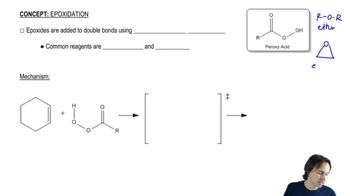
General properties of epoxidation.

Acid-Catalyzed Reactions

In acid-catalyzed reactions, a strong acid, such as sulfuric acid (H2SO4), is used to protonate a substrate, increasing its electrophilicity. This process facilitates nucleophilic attack by water or other nucleophiles, leading to the formation of new bonds. Recognizing how acids influence reaction mechanisms is essential for predicting the products of reactions involving epoxides.
Recommended video:
Guided course
03:09
Acid Catalyzed

Nucleophilic Attack

Nucleophilic attack is a fundamental concept in organic chemistry where a nucleophile, which is an electron-rich species, attacks an electron-deficient site, typically a carbon atom. In the context of epoxide reactions, water acts as a nucleophile that opens the epoxide ring, resulting in the formation of a diol. Understanding the nature of nucleophiles and their reactivity is vital for elucidating reaction mechanisms.
Recommended video:
Guided course
08:27
Nucleophilic Addition