

Ch. 10 - Reactions of Alcohols, Ethers, Epoxides, Amines, and Sulfur-Containing Compounds
Bruice - Organic Chemistry 8th Edition
Bruice8th EditionOrganic ChemistryISBN: 9780135213711Not the one you use?Change textbook
Chapter 11, Problem 86

Propose a mechanism for the following reaction:

Verified step by step guidance
1
Step 1: Recognize the reaction type. This is an acid-catalyzed dehydration of an alcohol, where the hydroxyl group (-OH) is removed, and a double bond is formed in the product. The catalyst is sulfuric acid (H₂SO₄), and heat is applied to drive the reaction forward.
Step 2: Protonation of the alcohol group. The sulfuric acid donates a proton (H⁺) to the hydroxyl group (-OH) of the alcohol, converting it into a better leaving group, water (H₂O). The structure now contains a positively charged oxonium ion.
Step 3: Formation of the carbocation intermediate. The water molecule leaves, resulting in the formation of a carbocation at the carbon where the hydroxyl group was originally attached. This is the rate-determining step of the reaction.
Step 4: Rearrangement of the carbocation (if necessary). In this case, no rearrangement is needed because the carbocation is already on a secondary carbon, which is relatively stable.
Step 5: Elimination to form the alkene. A proton is removed from a neighboring carbon atom by a base (often HSO₄⁻ from the sulfuric acid), leading to the formation of a double bond between the carbons. This results in the final alkene product and regenerates the acid catalyst.

Verified video answer for a similar problem:

This video solution was recommended by our tutors as helpful for the problem above.
Was this helpful?

Key Concepts

Here are the essential concepts you must grasp in order to answer the question correctly.

Reaction Mechanism

A reaction mechanism is a step-by-step description of how a chemical reaction occurs at the molecular level. It outlines the sequence of elementary steps, including bond breaking and formation, and the intermediates formed during the reaction. Understanding the mechanism is crucial for predicting the products and the conditions under which the reaction occurs.
Recommended video:
Guided course
02:16
Heck Reaction Mechanism

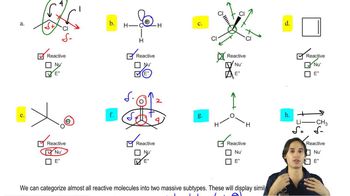
Nucleophiles and Electrophiles

Nucleophiles are species that donate an electron pair to form a chemical bond, while electrophiles are electron-deficient species that accept an electron pair. Identifying these species in a reaction is essential for proposing a mechanism, as it helps to determine the flow of electrons and the formation of new bonds during the reaction.
Recommended video:
Guided course
03:
Nucleophile or Electrophile

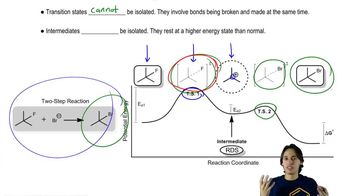
Transition States and Intermediates

Transition states are high-energy states that occur during the transformation from reactants to products, representing the point of maximum energy along the reaction pathway. Intermediates are species that are formed and consumed during the reaction but are not present in the final products. Understanding these concepts is vital for accurately depicting the mechanism and predicting the reaction's rate and outcome.
Recommended video:
Guided course
06:55
Intermediates vs. Transition States