Ch. 10 - Reactions of Alcohols, Ethers, Epoxides, Amines, and Sulfur-Containing Compounds
Bruice - Organic Chemistry 8th Edition
Bruice8th EditionOrganic ChemistryISBN: 9780135213711Not the one you use?Change textbook
Chapter 11, Problem 50b

Using an alkyl halide and a thiol as starting materials, how would you prepare the following thioethers?
b.

Verified step by step guidance
1
Step 1: Identify the target thioether structure. The given structure contains a sulfur atom bonded to a methyl group and a tert-butyl group. This indicates that the starting materials should include a thiol (R-SH) and an alkyl halide (R-X) that can form these groups.
Step 2: Select the thiol starting material. To introduce the methyl group bonded to sulfur, use methanethiol (CH₃SH) as the thiol starting material.
Step 3: Select the alkyl halide starting material. To introduce the tert-butyl group bonded to sulfur, use tert-butyl bromide (C(CH₃)₃Br) as the alkyl halide starting material.
Step 4: Perform the nucleophilic substitution reaction. The thiol (CH₃SH) acts as a nucleophile and attacks the alkyl halide (C(CH₃)₃Br) in an SN2 reaction mechanism, displacing the bromide ion and forming the thioether product.
Step 5: Ensure reaction conditions are suitable. Use a polar aprotic solvent (e.g., acetone or DMSO) to facilitate the SN2 reaction and maintain mild conditions to avoid side reactions.

Verified video answer for a similar problem:

This video solution was recommended by our tutors as helpful for the problem above.
Video duration:
2m
Was this helpful?

Key Concepts

Here are the essential concepts you must grasp in order to answer the question correctly.

Alkyl Halides

Alkyl halides are organic compounds containing a carbon atom bonded to a halogen atom (such as chlorine, bromine, or iodine). They are key reactants in nucleophilic substitution reactions, where the halogen can be replaced by a nucleophile, such as a thiol, to form new compounds. Understanding the reactivity and structure of alkyl halides is essential for predicting the outcomes of reactions involving these molecules.
Recommended video:
Guided course
01:52
How to name alkyl halides

Thiol

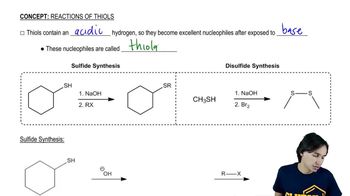
Thiol compounds, also known as mercaptans, are characterized by the presence of a sulfhydryl group (-SH) attached to a carbon atom. They are nucleophilic in nature, meaning they can donate a pair of electrons to form a bond with electrophiles, such as alkyl halides. This property makes thiols valuable in the synthesis of thioethers through nucleophilic substitution reactions.
Recommended video:
Guided course
03:21
The mechanism of Sulfide Synthesis.

Thioether Formation

Thioethers are organic compounds formed by the reaction of an alkyl halide with a thiol, resulting in the substitution of the halogen atom with the thiol's sulfur atom. This reaction typically occurs via an SN2 mechanism, where the nucleophile (thiol) attacks the electrophilic carbon of the alkyl halide, leading to the formation of a thioether and the release of a halide ion. Understanding this mechanism is crucial for successfully synthesizing thioethers.
Recommended video:
Guided course
02:26
Formation of Enolates