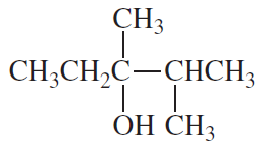
Which of the following alcohols dehydrates the fastest when heated with acid?
Ch. 10 - Reactions of Alcohols, Ethers, Epoxides, Amines, and Sulfur-Containing Compounds
All textbooks
Bruice 8th Edition
Ch. 10 - Reactions of Alcohols, Ethers, Epoxides, Amines, and Sulfur-Containing Compounds
Problem 14a
Bruice 8th Edition
Ch. 10 - Reactions of Alcohols, Ethers, Epoxides, Amines, and Sulfur-Containing Compounds
Problem 14aChapter 11, Problem 14a
What is the major product obtained when each of the following alcohols is heated in the presence of H2SO4?
a. 
Verified step by step guidance1
Step 1: Recognize the reaction type. Heating an alcohol in the presence of H2SO4 typically leads to an elimination reaction (E1 mechanism), resulting in the formation of an alkene. The sulfuric acid acts as a catalyst, protonating the alcohol group to form a good leaving group (water).
Step 2: Analyze the structure of the alcohol. The given alcohol is a tertiary alcohol because the carbon attached to the hydroxyl group is connected to three other carbon atoms. Tertiary alcohols undergo elimination reactions readily due to the stability of the carbocation intermediate formed.
Step 3: Protonation of the hydroxyl group. The hydroxyl group (-OH) is protonated by H2SO4, converting it into water (a good leaving group). This step facilitates the departure of the water molecule, leaving behind a tertiary carbocation.
Step 4: Formation of the carbocation intermediate. The tertiary carbocation formed is highly stable due to hyperconjugation and inductive effects from the surrounding alkyl groups. This stability drives the reaction forward.
Step 5: Determine the major product. The elimination of a proton from a β-carbon (adjacent to the carbocation) leads to the formation of the most substituted alkene (following Zaitsev's rule). The major product will be the alkene with the highest degree of substitution, as this is thermodynamically favored.

Verified video answer for a similar problem:
This video solution was recommended by our tutors as helpful for the problem above.
Video duration:
3mWas this helpful?
Key Concepts
Here are the essential concepts you must grasp in order to answer the question correctly.
Dehydration of Alcohols
Dehydration of alcohols is a chemical reaction where an alcohol loses a water molecule, typically in the presence of an acid catalyst like sulfuric acid (H2SO4). This process often leads to the formation of alkenes, as the elimination of water results in the formation of a double bond between carbon atoms. Understanding this reaction is crucial for predicting the products formed when heating alcohols.
Recommended video:
Guided course
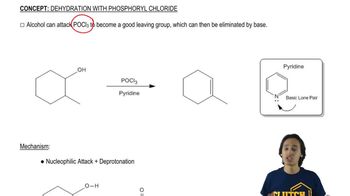
General Reaction of Dehydration with POCl3
Acid Catalysis
Acid catalysis involves the use of an acid to increase the rate of a chemical reaction. In the dehydration of alcohols, H2SO4 donates protons (H+) to the alcohol, enhancing its electrophilicity and facilitating the loss of water. This concept is essential for understanding how the reaction proceeds and the stability of the intermediates formed during the process.
Recommended video:
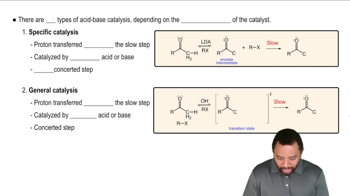
Acid-Base Catalysis Concept 3
Carbocation Stability
Carbocation stability is a key factor in determining the major product of dehydration reactions. More stable carbocations, such as tertiary carbocations, are favored during the reaction because they can better accommodate the positive charge. The stability of the carbocation intermediate influences the pathway of the reaction and the final alkene product formed after dehydration.
Recommended video:
Guided course
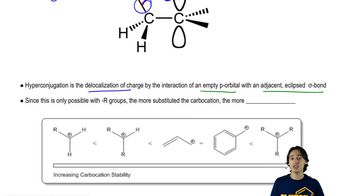
Determining Carbocation Stability
Related Practice
Textbook Question
1579
views
Textbook Question
Show how 1-propanol can be converted into the following compounds by means of a sulfonate ester:
a. CH3CH2CH2SCH2CH3
658
views
Textbook Question
Show how 1-propanol can be converted into the following compounds by means of a sulfonate ester:
b.
1337
views
Textbook Question
Heating an alcohol with sulfuric acid is a good way to prepare a symmetrical ether such as diethyl ether.
b. How would you synthesize ethyl propyl ether?
1110
views
Textbook Question
What is the major product obtained when each of the following alcohols is heated in the presence of H2SO4?
b.
1415
views
Textbook Question
Heating an alcohol with sulfuric acid is a good way to prepare a symmetrical ether such as diethyl ether.
a. Explain why it is not a good way to prepare an unsymmetrical ether such as ethyl propyl ether.
1202
views