Ch. 10 - Reactions of Alcohols, Ethers, Epoxides, Amines, and Sulfur-Containing Compounds
Bruice - Organic Chemistry 8th Edition
Bruice8th EditionOrganic ChemistryISBN: 9780135213711Not the one you use?Change textbook
Chapter 11, Problem 71

What product would be formed if the four-membered ring alcohol in Problem 70 were heated with an equivalent amount of HBr rather than with a catalytic amount of H2SO4?

Verified step by step guidance
1
Identify the structure of the four-membered ring alcohol from Problem 70. A four-membered ring alcohol typically contains a hydroxyl (-OH) group attached to a carbon in a strained cyclobutane ring.
Understand the reaction conditions: Heating the alcohol with an equivalent amount of HBr suggests that this is an acid-catalyzed substitution reaction, where the hydroxyl group (-OH) will be replaced by a bromine atom (Br).
Protonate the hydroxyl group: The HBr will donate a proton (H⁺) to the hydroxyl group, forming a good leaving group, water (H₂O). This step can be represented as: R(OH)+HBrR(OH2+)+Br-
Form a carbocation intermediate: The protonated hydroxyl group will leave as water, generating a carbocation intermediate. Due to the strain in the four-membered ring, the carbocation may undergo ring-opening or rearrangement to relieve strain, depending on the specific structure of the alcohol.
Attack by bromide ion: The bromide ion (Br⁻) will act as a nucleophile and attack the carbocation, forming the final product. The product will likely be a brominated compound, and its structure will depend on whether the carbocation underwent rearrangement or not.

Verified video answer for a similar problem:

This video solution was recommended by our tutors as helpful for the problem above.
Video duration:
3m
Was this helpful?

Key Concepts

Here are the essential concepts you must grasp in order to answer the question correctly.

Electrophilic Addition Reactions

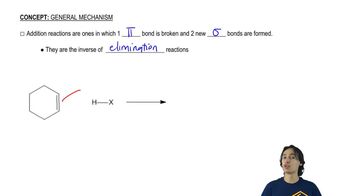
Electrophilic addition reactions involve the addition of an electrophile to a nucleophile, typically occurring in alkenes and alcohols. In this context, HBr acts as the electrophile, donating a proton (H+) to the alcohol, which can lead to the formation of a bromide ion. Understanding this mechanism is crucial for predicting the products formed when heating the four-membered ring alcohol with HBr.
Recommended video:
Guided course
05:39
Features of Addition Mechanisms.

Ring Strain in Four-Membered Rings

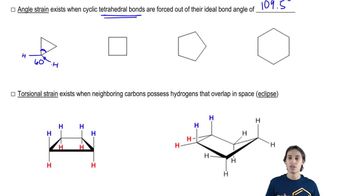
Four-membered rings, such as cyclobutyl structures, exhibit significant ring strain due to their bond angles being forced to deviate from the ideal tetrahedral angle of 109.5 degrees. This strain makes them more reactive than larger rings. When heated, the ring can undergo cleavage or rearrangement, influencing the final product when reacted with HBr.
Recommended video:
Guided course
02:46
What is angle strain?

Hydrobromic Acid (HBr) Reactivity

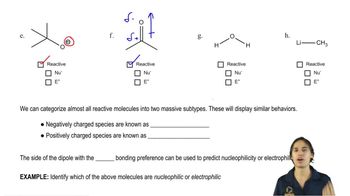
Hydrobromic acid is a strong acid that dissociates completely in solution, providing a high concentration of H+ ions and Br- ions. Its reactivity with alcohols typically leads to the formation of alkyl bromides through protonation of the alcohol followed by nucleophilic substitution. This concept is essential for predicting the product when the four-membered ring alcohol is treated with HBr.
Recommended video:
Guided course
01:17
Reactivity of Molecules