Ch. 10 - Reactions of Alcohols, Ethers, Epoxides, Amines, and Sulfur-Containing Compounds
Bruice - Organic Chemistry 8th Edition
Bruice8th EditionOrganic ChemistryISBN: 9780135213711Not the one you use?Change textbook
Chapter 11, Problem 19b

What stereoisomers are formed in the following reactions? Which stereoisomer is the major product?
b. the acid-catalyzed dehydration of 3,4-dimethyl-3-hexanol to 3,4-dimethyl-3-hexene

Verified step by step guidance
1
Identify the reaction type: The problem involves the acid-catalyzed dehydration of an alcohol, which is an elimination reaction (E1 mechanism). This reaction typically proceeds through the formation of a carbocation intermediate, followed by the elimination of water to form an alkene.
Determine the structure of the starting material: The starting compound is 3,4-dimethyl-3-hexanol. The hydroxyl group (-OH) is attached to the third carbon of the hexane chain, and there are methyl groups on both the third and fourth carbons.
Analyze the carbocation intermediate: During the E1 mechanism, the hydroxyl group is protonated by the acid catalyst, converting it into a good leaving group (water). The departure of water forms a carbocation at the third carbon. This carbocation is tertiary, which is relatively stable. No rearrangement is expected because the carbocation is already in its most stable form.
Determine the possible stereoisomers: The elimination step involves the removal of a β-hydrogen from one of the adjacent carbons (C2 or C4). This can lead to the formation of two possible stereoisomers of 3,4-dimethyl-3-hexene: the E (trans) and Z (cis) isomers. The E isomer has the two largest groups on opposite sides of the double bond, while the Z isomer has them on the same side.
Predict the major product: According to Zaitsev's rule, the more substituted alkene is generally the major product. Additionally, the E (trans) isomer is typically more stable than the Z (cis) isomer due to reduced steric hindrance between substituents. Therefore, the E isomer of 3,4-dimethyl-3-hexene is expected to be the major product.

Verified video answer for a similar problem:

This video solution was recommended by our tutors as helpful for the problem above.
Video duration:
5m
Was this helpful?

Key Concepts

Here are the essential concepts you must grasp in order to answer the question correctly.

Stereoisomerism

Stereoisomerism refers to the phenomenon where compounds have the same molecular formula and connectivity of atoms but differ in the spatial arrangement of their atoms. This can lead to different physical and chemical properties. In organic chemistry, stereoisomers can be classified into enantiomers and diastereomers, which are crucial for understanding the behavior of molecules in reactions.
Recommended video:
Guided course
01:58
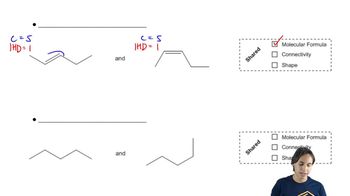
Determining when molecules are stereoisomers.

Acid-Catalyzed Dehydration

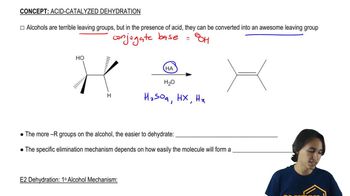
Acid-catalyzed dehydration is a reaction where an alcohol is converted into an alkene through the removal of a water molecule, facilitated by an acid. This process typically involves protonation of the alcohol, leading to the formation of a carbocation intermediate, which can rearrange and lose a proton to form the double bond. Understanding this mechanism is essential for predicting the stereoisomers formed.
Recommended video:
Guided course
06:01
General features of acid-catalyzed dehydration.

Zaitsev's Rule

Zaitsev's Rule states that in elimination reactions, the more substituted alkene is generally the major product. This is due to the stability of more substituted alkenes, which are favored because they have greater hyperconjugation and less steric strain. Applying this rule helps in determining which stereoisomer will be predominant in the dehydration of alcohols.
Recommended video:
Guided course
01:18
Defining Zaitsev’s Rule