Ch. 12 - Radicals
Bruice - Organic Chemistry 8th Edition
Bruice8th EditionOrganic ChemistryISBN: 9780135213711Not the one you use?Change textbook
Chapter 13, Problem 48

A possible alternative mechanism to that shown in Problem 47 for the monochlorination of methane involves the following propagation steps:

How do you know that the reaction does not take place by this mechanism?

Verified step by step guidance
1
Step 1: Analyze the proposed mechanism. The propagation steps involve two reactions: (1) CH₃-H reacts with a chlorine radical (•Cl) to form CH₃-Cl and a hydrogen radical (•H), and (2) the hydrogen radical (•H) reacts with Cl₂ to form H-Cl and regenerate the chlorine radical (•Cl).
Step 2: Consider the stability of the hydrogen radical (•H). Hydrogen radicals are highly reactive and unstable, making their formation and persistence in the reaction unlikely under typical conditions.
Step 3: Evaluate the energy requirements. The bond dissociation energy for breaking the H-H bond to form a hydrogen radical is extremely high, suggesting that this step is energetically unfavorable.
Step 4: Compare with the established mechanism. The widely accepted mechanism for methane monochlorination involves the formation of methyl radicals (•CH₃) rather than hydrogen radicals (•H). This mechanism is supported by experimental evidence and aligns with the principles of radical stability.
Step 5: Conclude why the proposed mechanism is unlikely. The formation of hydrogen radicals (•H) is not consistent with the observed reaction pathway, and the energetics and stability considerations strongly suggest that the reaction does not proceed via this alternative mechanism.

Verified video answer for a similar problem:

This video solution was recommended by our tutors as helpful for the problem above.
Video duration:
7m
Was this helpful?

Key Concepts

Here are the essential concepts you must grasp in order to answer the question correctly.

Radical Mechanism

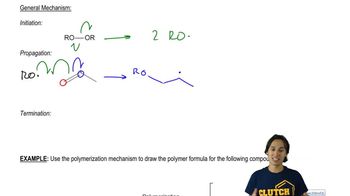
A radical mechanism involves the formation of reactive species called radicals, which have unpaired electrons. In the context of monochlorination of methane, the reaction proceeds through initiation, propagation, and termination steps, where radicals are generated and react with other molecules. Understanding this mechanism is crucial to analyze alternative pathways for the reaction.
Recommended video:
Guided course
03:28
The mechanism of Radical Polymerization.

Selectivity in Halogenation

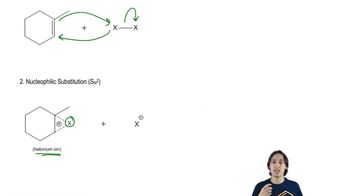
Selectivity in halogenation refers to the preference of a halogen to react with certain hydrogen atoms over others in a hydrocarbon. In the case of methane, chlorine can abstract hydrogen atoms from different positions, but the mechanism's selectivity can indicate whether a proposed pathway is feasible. Analyzing the selectivity helps determine if the alternative mechanism is plausible.
Recommended video:
Guided course
03:45
Halogenation Mechanism

Energy Barrier and Reaction Pathway

The energy barrier of a reaction pathway is the difference in energy between the reactants and the transition state. For a reaction to occur via a specific mechanism, the energy barrier must be surmountable under the given conditions. Evaluating the energy profiles of the proposed propagation steps can reveal whether the alternative mechanism is energetically favorable compared to the established one.
Recommended video:
1:08
Energy Production In Biochemical Pathways Example 1