Ch. 12 - Radicals
Bruice - Organic Chemistry 8th Edition
Bruice8th EditionOrganic ChemistryISBN: 9780135213711Not the one you use?Change textbook
Chapter 13, Problem 45

At 600 °C, the ratio of the relative rates of formation of a tertiary, a secondary, and a primary radical by a chlorine radical is 2.6 : 2.1 : 1. Explain the change in the degree of regioselectivity compared to what was found in Problem 44.

Verified step by step guidance
1
Understand the context: The problem involves the regioselectivity of radical formation during a chlorination reaction. Chlorine radicals are less selective than bromine radicals, and the regioselectivity depends on the relative stability of the radicals formed (tertiary > secondary > primary). The given ratio (2.6 : 2.1 : 1) reflects the relative rates of radical formation at 600 °C.
Recall the concept of regioselectivity: Regioselectivity refers to the preference for forming one constitutional isomer over another. In this case, the preference is based on the stability of the radicals formed. Tertiary radicals are the most stable due to hyperconjugation and inductive effects, followed by secondary and then primary radicals.
Compare with Problem 44: In Problem 44, the regioselectivity might have been different (likely higher) because the temperature or halogen used (e.g., bromine) could have influenced the selectivity. Higher temperatures, as in this problem (600 °C), reduce regioselectivity because the reaction becomes more kinetically controlled, and the energy difference between forming different radicals becomes less significant.
Explain the effect of temperature: At higher temperatures, the energy barrier for radical formation is more easily overcome, and the reaction becomes less selective. This is why the ratio of 2.6 : 2.1 : 1 shows a smaller difference between the rates of tertiary, secondary, and primary radical formation compared to what might have been observed at lower temperatures or with bromine radicals.
Summarize the change in regioselectivity: The degree of regioselectivity decreases at higher temperatures because the reaction becomes less dependent on the stability of the radicals and more dependent on the kinetic factors. This explains why the ratio of radical formation rates is closer together (2.6 : 2.1 : 1) compared to the likely higher regioselectivity in Problem 44.

Verified video answer for a similar problem:

This video solution was recommended by our tutors as helpful for the problem above.
Video duration:
6m
Was this helpful?

Key Concepts

Here are the essential concepts you must grasp in order to answer the question correctly.

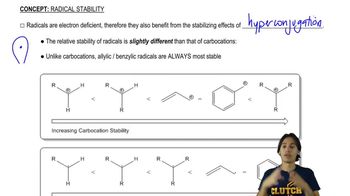
Radical Stability

The stability of radicals is crucial in organic chemistry, as it influences their reactivity and formation rates. Tertiary radicals are more stable than secondary and primary radicals due to hyperconjugation and inductive effects from surrounding alkyl groups. This stability hierarchy explains why tertiary radicals are formed preferentially in reactions involving radical mechanisms.
Recommended video:
Guided course
03:43
The radical stability trend.

Regioselectivity

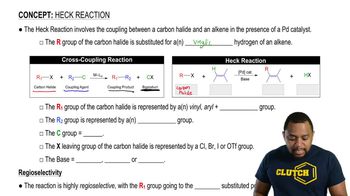
Regioselectivity refers to the preference of a chemical reaction to occur at one site over another in a molecule. In radical reactions, the regioselectivity can shift based on the stability of the resulting radicals. The observed ratio of radical formation indicates that the reaction conditions, such as temperature, can significantly influence which radicals are favored.
Recommended video:
Guided course
05:09
Heck Reaction

Temperature Effects on Reaction Rates

Temperature plays a vital role in chemical reactions, affecting the kinetic energy of molecules and the rates of reaction. At higher temperatures, the increased energy can lead to a greater formation of radicals and can alter the selectivity of the reaction. In this case, the elevated temperature of 600 °C likely enhances the formation of more stable tertiary radicals, thus changing the regioselectivity compared to lower temperature conditions.
Recommended video:
5:07
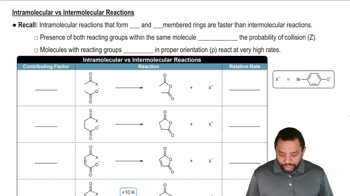
Rates of Intramolecular Reactions Concept 2