Ch. 12 - Radicals
Bruice - Organic Chemistry 8th Edition
Bruice8th EditionOrganic ChemistryISBN: 9780135213711Not the one you use?Change textbook
Chapter 13, Problem 8b

What is the anticipated percent yield of the major product?

Verified step by step guidance
1
Step 1: Analyze the reaction. The reaction involves the chlorination of isobutane (2-methylpropane) under photochemical conditions (Cl₂ and hv). This is a free radical halogenation reaction.
Step 2: Identify the major and minor products. The major product is formed by substitution at the tertiary carbon (most stable radical), while the minor product is formed by substitution at a primary carbon.
Step 3: Understand the mechanism. The reaction proceeds via the formation of a chlorine radical, which abstracts a hydrogen atom from the substrate to form a carbon radical. The tertiary radical is more stable than the primary radical due to hyperconjugation and inductive effects.
Step 4: Calculate the anticipated percent yield. The yield of the major product depends on the relative stability of the radicals formed during the reaction. Since the tertiary radical is significantly more stable, the major product will have a higher yield compared to the minor product.
Step 5: Consider experimental factors. The excess of chlorine ensures that the reaction proceeds efficiently, and the photochemical conditions favor radical formation. The anticipated percent yield of the major product can be estimated based on the ratio of tertiary to primary hydrogens in the substrate and the stability of the radicals.

Verified video answer for a similar problem:

This video solution was recommended by our tutors as helpful for the problem above.
Video duration:
7m
Was this helpful?

Key Concepts

Here are the essential concepts you must grasp in order to answer the question correctly.

Radical Reactions

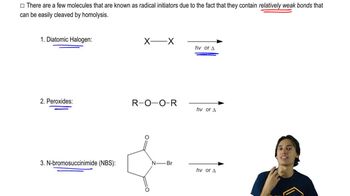
Radical reactions involve the formation and reaction of free radicals, which are highly reactive species with unpaired electrons. In the presence of light or heat, halogens like Cl2 can undergo homolytic cleavage to generate chlorine radicals. These radicals can then abstract hydrogen atoms from alkenes, leading to the formation of alkyl radicals that can further react to produce various products.
Recommended video:
Guided course
03:49
What are Radical Initiators?

Selectivity in Halogenation

Selectivity in halogenation refers to the preference of a halogen radical to react with certain hydrogen atoms over others, often based on the stability of the resulting radical. In the case of chlorine, it tends to favor the formation of more stable tertiary radicals over less stable primary ones, leading to the formation of major and minor products. Understanding this selectivity is crucial for predicting the major product in a reaction.
Recommended video:
Guided course
03:45
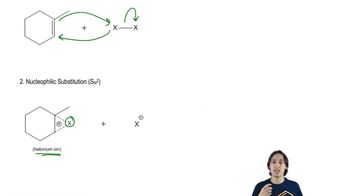
Halogenation Mechanism

Percent Yield

Percent yield is a measure of the efficiency of a chemical reaction, calculated as the ratio of the actual yield of a product to the theoretical yield, multiplied by 100. In the context of radical reactions, determining the percent yield of the major product involves analyzing the amounts of major and minor products formed and understanding the reaction conditions that influence these outcomes.
Recommended video:
Guided course
04:37
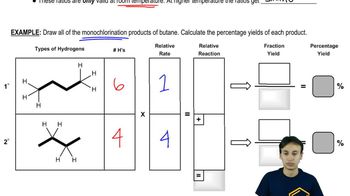
Draw all of the monochlorination products and calculate percentage yields.