Ch. 12 - Radicals
Bruice - Organic Chemistry 8th Edition
Bruice8th EditionOrganic ChemistryISBN: 9780135213711Not the one you use?Change textbook
Chapter 13, Problem 18a

Two products are formed when methylenecyclohexane reacts with NBS? Show how each is formed. Disregard stereoisomers.

Verified step by step guidance
1
Step 1: Recognize that NBS (N-Bromosuccinimide) is used for allylic bromination. This reaction occurs in the presence of heat (Δ) and a radical initiator like peroxide, which generates bromine radicals.
Step 2: Identify the allylic position in methylenecyclohexane. The allylic position is the carbon atom adjacent to the double bond, which is more reactive due to resonance stabilization of the resulting radical.
Step 3: Generate a bromine radical from NBS. The bromine radical abstracts a hydrogen atom from the allylic position of methylenecyclohexane, forming an allylic radical.
Step 4: The allylic radical undergoes resonance stabilization, creating two possible resonance structures. These resonance structures correspond to two different positions where bromine can add.
Step 5: Bromine from NBS reacts with the allylic radical at each resonance structure, forming two products: (1) 1-bromo-3-methylenecyclohexane and (2) 3-bromo-1-methylenecyclohexane. Disregard stereoisomers as specified in the problem.

Verified video answer for a similar problem:

This video solution was recommended by our tutors as helpful for the problem above.
Video duration:
2m
Was this helpful?

Key Concepts

Here are the essential concepts you must grasp in order to answer the question correctly.

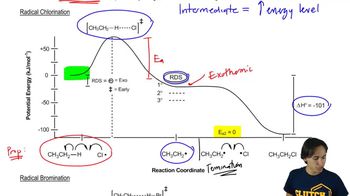
Radical Bromination

Radical bromination is a reaction where bromine (Br2) is used to add bromine atoms to an alkene or alkane through a radical mechanism. In the presence of light or heat, Br2 dissociates into two bromine radicals, which can then react with the double bond of methylenecyclohexane, leading to the formation of brominated products. This process is crucial for understanding how N-bromosuccinimide (NBS) facilitates bromination in organic reactions.
Recommended video:
Guided course
05:20
Using the Hammond Postulate to describe radical bromination.

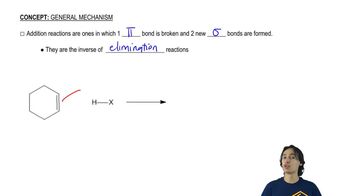
Mechanism of Electrophilic Addition

The mechanism of electrophilic addition involves the attack of an electrophile on a nucleophilic site, typically a double bond in alkenes. In the case of methylenecyclohexane reacting with NBS, the double bond acts as a nucleophile, allowing the bromine radical to add across the double bond, resulting in the formation of two distinct products. Understanding this mechanism is essential for predicting the products formed in the reaction.
Recommended video:
Guided course
05:39
Features of Addition Mechanisms.

Regioselectivity

Regioselectivity refers to the preference of a chemical reaction to yield one structural isomer over others when multiple products are possible. In the reaction of methylenecyclohexane with NBS, the formation of different brominated products can occur at various positions on the cyclohexane ring. Recognizing the regioselectivity helps in determining which products are likely to be formed based on the stability of the resulting radicals and the structure of the starting material.
Recommended video:
Guided course
05:09
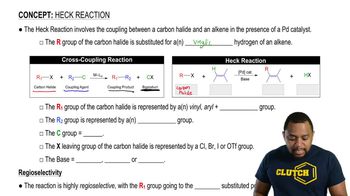
Heck Reaction