


When 2-methylpropane is monochlorinated in the presence of light at room temperature, 36% of the product is 2-chloro-2-methylpropane and 64% is 1-chloro-2-methylpropane. From these data, calculate how much easier it is to remove a hydrogen atom from a tertiary carbon than from a primary carbon under these conditions.
Ch. 12 - Radicals
Chapter 13, Problem 31b
What is the major product of the following reactions? Disregard stereoisomers:
b. 
Verified step by step guidance1
Step 1: Recognize the reagents and conditions. NBS (N-Bromosuccinimide) is used for allylic or benzylic bromination in the presence of a radical initiator, such as peroxide and heat.
Step 2: Identify the allylic position in the molecule. The allylic position is the carbon atom adjacent to the double bond in the cyclopentene structure.
Step 3: Understand the mechanism. The reaction proceeds via a radical mechanism. Peroxide and heat generate radicals, which abstract a hydrogen atom from the allylic position, forming an allylic radical.
Step 4: Bromine from NBS reacts with the allylic radical to form the major product. The bromine atom attaches to the allylic position, resulting in an allylic bromide.
Step 5: Consider resonance stabilization. The allylic radical is resonance-stabilized, so bromination can occur at either of the two equivalent allylic positions. Disregard stereoisomers as instructed.

Verified video answer for a similar problem:
This video solution was recommended by our tutors as helpful for the problem above.
Video duration:
2mWas this helpful?
Key Concepts
Here are the essential concepts you must grasp in order to answer the question correctly.
Reaction Mechanisms
Understanding reaction mechanisms is crucial in organic chemistry as they describe the step-by-step process by which reactants transform into products. This includes identifying intermediates, transition states, and the movement of electrons. Familiarity with mechanisms helps predict the major products of reactions based on the stability of intermediates and the energy changes involved.
Recommended video:
Guided course
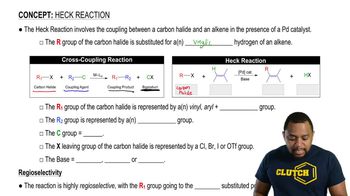
Heck Reaction Mechanism
Functional Groups
Functional groups are specific groups of atoms within molecules that are responsible for the characteristic chemical reactions of those molecules. Recognizing functional groups allows chemists to predict how a compound will react in a given reaction. Different functional groups can influence the reactivity and the type of products formed during chemical reactions.
Recommended video:
Guided course
Identifying Functional Groups
Regioselectivity
Regioselectivity refers to the preference of a chemical reaction to occur at one location over another in a molecule. This concept is essential for predicting the major product of a reaction, as certain pathways may lead to more stable or favorable products. Understanding regioselectivity helps in determining which isomer will be formed when multiple possibilities exist.
Recommended video:
Guided course
Heck Reaction
Related Practice
Textbook Question
2472
views
Textbook Question
What is the major product of the following reactions? Disregard stereoisomers:
a.
822
views
Textbook Question
What are the answers to Problem 29 when the same compounds are treated with Br2 at 125 °C?
c.
1066
views
Textbook Question
What is the major product of the following reactions? Disregard stereoisomers:
d.
1723
views
Textbook Question
What is the major product obtained from treating an excess of each of the following compounds with Cl2 in the presence of ultraviolet light at room temperature? Disregard stereoisomers.
c.
1160
views
Textbook Question
What is the major product of the following reactions? Disregard stereoisomers:
c.
1411
views
