Ch. 13 - Mass Spectrometry; Infrared Spectroscopy; UV/Vis Spectroscopy
Bruice - Organic Chemistry 8th Edition
Bruice8th EditionOrganic ChemistryISBN: 9780135213711Not the one you use?Change textbook
Chapter 14, Problem 30c,d

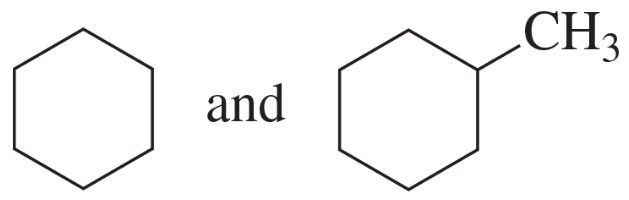
For each of the following pairs of compounds, name one absorption band that can be used to distinguish between them.
c.
d.

Verified step by step guidance
1
Step 1: Analyze the first pair of compounds (I). The first compound is cyclopentane, a saturated cyclic hydrocarbon, while the second compound is methylcyclopentane, which has a methyl group attached to the cyclopentane ring.
Step 2: Identify the functional groups or structural differences in the first pair. Cyclopentane lacks any substituents, while methylcyclopentane has a methyl group (-CH₃). This difference can be detected using IR spectroscopy by looking for the C-H stretching vibrations of the methyl group.
Step 3: In IR spectroscopy, the methyl group in methylcyclopentane will show absorption bands around 1375 cm⁻¹ and 1450 cm⁻¹ due to C-H bending vibrations, which are absent in cyclopentane.
Step 4: Analyze the second pair of compounds (II). Both compounds are alkynes, but the first compound is a terminal alkyne (with a hydrogen attached to the triple bond), while the second compound is an internal alkyne (with no hydrogen attached to the triple bond).
Step 5: In IR spectroscopy, terminal alkynes exhibit a sharp absorption band around 3300 cm⁻¹ due to the C-H stretching vibration of the terminal alkyne hydrogen. This band is absent in internal alkynes, which can be used to distinguish between the two compounds.

Verified video answer for a similar problem:

This video solution was recommended by our tutors as helpful for the problem above.
Video duration:
3m
Was this helpful?

Key Concepts

Here are the essential concepts you must grasp in order to answer the question correctly.

Infrared (IR) Spectroscopy

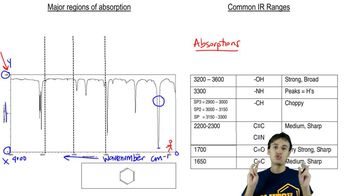
IR spectroscopy is a technique used to identify functional groups in organic compounds by measuring the absorption of infrared light. Different bonds absorb characteristic frequencies of IR radiation, leading to distinct absorption bands in the spectrum. This method is crucial for distinguishing between compounds based on their molecular vibrations.
Recommended video:
Guided course
16:04
General Features of IR Spect

Functional Groups

Functional groups are specific groups of atoms within molecules that are responsible for the characteristic chemical reactions of those molecules. In the context of IR spectroscopy, the presence of different functional groups, such as alkenes, alkynes, or cyclic structures, can lead to unique absorption bands that help differentiate between compounds.
Recommended video:
Guided course
02:36
Identifying Functional Groups

Absorption Bands

Absorption bands in an IR spectrum correspond to specific vibrational transitions of molecular bonds. Each type of bond (e.g., C-H, C=C, C≡C) has a unique absorption frequency, allowing chemists to identify and distinguish between compounds. Recognizing these bands is essential for interpreting IR spectra and determining the structure of organic molecules.
Recommended video:
Guided course
02:02
Major IR absorptions