Ch. 13 - Mass Spectrometry; Infrared Spectroscopy; UV/Vis Spectroscopy
Bruice - Organic Chemistry 8th Edition
Bruice8th EditionOrganic ChemistryISBN: 9780135213711Not the one you use?Change textbook
Chapter 14, Problem 72c

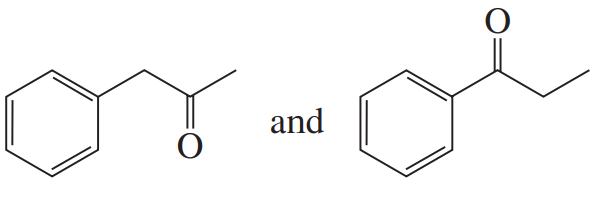
How can you use UV spectroscopy to distinguish between the compounds in each of the following pairs?
c. Chemical structures of two compounds with carbon rings and carbonyl groups, labeled "and" between them.

Verified step by step guidance
1
Step 1: Analyze the structures of compounds A and B. Compound A is acetophenone, which contains a phenyl group directly attached to a carbonyl group. Compound B is propiophenone, which has a phenyl group attached to a carbonyl group via a methylene (-CH2-) bridge.
Step 2: Understand the principle of UV spectroscopy. UV spectroscopy measures the absorption of ultraviolet light by a compound, which is influenced by the presence of conjugated systems. Conjugation increases the wavelength of maximum absorption (λmax).
Step 3: Compare the conjugation in the two compounds. In acetophenone (A), the phenyl group is directly conjugated with the carbonyl group, leading to a higher degree of conjugation. In propiophenone (B), the methylene bridge interrupts conjugation between the phenyl group and the carbonyl group, resulting in less conjugation.
Step 4: Predict the UV absorption behavior. Due to the greater conjugation in acetophenone (A), it will have a higher λmax compared to propiophenone (B). Propiophenone (B) will absorb UV light at a shorter wavelength because of the reduced conjugation.
Step 5: Use UV spectroscopy to distinguish between the two compounds. Measure the λmax for each compound. Acetophenone (A) will show a λmax at a longer wavelength, while propiophenone (B) will show a λmax at a shorter wavelength. This difference in λmax can be used to identify and distinguish the two compounds.

Verified video answer for a similar problem:

This video solution was recommended by our tutors as helpful for the problem above.
Video duration:
3m
Was this helpful?

Key Concepts

Here are the essential concepts you must grasp in order to answer the question correctly.

UV-Vis Spectroscopy

UV-Vis spectroscopy is an analytical technique that measures the absorbance of ultraviolet or visible light by a substance. It is particularly useful for identifying compounds with conjugated systems, as these systems absorb light at specific wavelengths due to electronic transitions. The resulting spectrum provides information about the energy levels of electrons in the molecule, which can be used to distinguish between different compounds.
Recommended video:
2:56
The UV-Vis Spectroscopy Concept 1

Conjugation

Conjugation refers to the overlap of p-orbitals across adjacent double bonds or between double bonds and lone pairs, allowing for delocalization of electrons. This delocalization lowers the energy of the electronic transitions, resulting in absorption of light at longer wavelengths (lower energy). The extent of conjugation in a molecule affects its UV-Vis spectrum, making it a key factor in distinguishing between compounds with different conjugated systems.
Recommended video:
Guided course
03:27
Conjugated states

Functional Groups

Functional groups are specific groups of atoms within molecules that are responsible for the characteristic chemical reactions of those molecules. In the context of UV spectroscopy, different functional groups can influence the absorption properties of a compound. For example, carbonyl groups (C=O) and aromatic rings can significantly affect the UV spectrum, allowing for differentiation between compounds based on their functional group composition.
Recommended video:
Guided course
02:36
Identifying Functional Groups