Ch. 13 - Mass Spectrometry; Infrared Spectroscopy; UV/Vis Spectroscopy
Bruice - Organic Chemistry 8th Edition
Bruice8th EditionOrganic ChemistryISBN: 9780135213711Not the one you use?Change textbook
Chapter 14, Problem 37b

Rank each set of compounds in order of decreasing λmax:
b.

Verified step by step guidance
1
Step 1: Understand the concept of λmax (maximum wavelength of absorption). λmax is influenced by the extent of conjugation in a molecule. Greater conjugation leads to a longer λmax due to lower energy transitions between molecular orbitals.
Step 2: Analyze compound A. It contains an aromatic ring (benzene) conjugated with a nitrogen atom. The lone pair on the nitrogen can participate in resonance with the aromatic ring, increasing conjugation and λmax.
Step 3: Analyze compound B. It has a saturated cyclohexane ring with no conjugation. The nitrogen atom is not part of a conjugated system, so this compound will have the shortest λmax.
Step 4: Analyze compound C. Similar to compound A, it has an aromatic ring conjugated with a nitrogen atom. However, the nitrogen in compound C is part of a dimethylamino group, which is electron-donating and enhances resonance, potentially increasing λmax compared to A.
Step 5: Analyze compound D. It contains an aromatic ring conjugated with a positively charged nitrogen atom. The positive charge reduces the ability of the nitrogen to donate electrons into the aromatic ring, decreasing conjugation compared to A and C, but still higher than B.

Verified video answer for a similar problem:

This video solution was recommended by our tutors as helpful for the problem above.
Video duration:
3m
Was this helpful?

Key Concepts

Here are the essential concepts you must grasp in order to answer the question correctly.

Conjugation

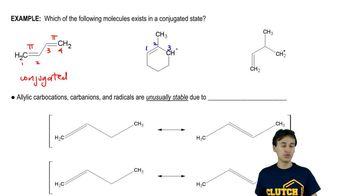
Conjugation refers to the overlap of p-orbitals across adjacent double bonds or lone pairs, allowing for delocalization of electrons. This delocalization lowers the energy of the molecule and can increase the wavelength of light absorbed (lmax). In the context of the compounds shown, the extent of conjugation will influence their respective lmax values.
Recommended video:
Guided course
03:27
Conjugated states

Electron-Withdrawing and Electron-Donating Groups

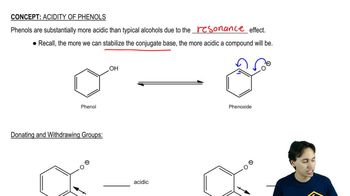
The presence of electron-withdrawing groups (EWGs) or electron-donating groups (EDGs) can significantly affect the electronic properties of a compound. EWGs tend to lower the energy of the highest occupied molecular orbital (HOMO), while EDGs raise it, thus influencing the lmax. In the provided structures, the nature of the substituents on the aromatic ring will determine their lmax ranking.
Recommended video:
Guided course
02:37
Donating vs Withdrawing Groups

Aromaticity

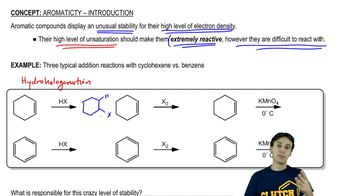
Aromatic compounds are characterized by their cyclic structure, planar geometry, and delocalized pi electrons, which contribute to their stability and unique electronic properties. The degree of aromaticity can affect the lmax, as more stable aromatic systems with greater electron delocalization typically absorb light at longer wavelengths. The structures A, B, C, and D will exhibit varying levels of aromaticity, impacting their lmax values.
Recommended video:
Guided course
08:19
Intro to Aromaticity