Ch. 13 - Mass Spectrometry; Infrared Spectroscopy; UV/Vis Spectroscopy
Bruice - Organic Chemistry 8th Edition
Bruice8th EditionOrganic ChemistryISBN: 9780135213711Not the one you use?Change textbook
Chapter 14, Problem 2

What distinguishes the mass spectrum of 2,2-dimethylpropane from the mass spectra of pentane and isopentane?

Verified step by step guidance
1
Understand the structure of the compounds: 2,2-dimethylpropane is a highly branched alkane, while pentane is a straight-chain alkane, and isopentane is a branched alkane with one branch. The degree of branching affects the fragmentation pattern in mass spectrometry.
Recall the principle of mass spectrometry: In mass spectrometry, molecules are ionized, and the resulting ions fragment into smaller pieces. The mass-to-charge ratio (m/z) of these fragments is detected, producing a spectrum that reflects the structure of the molecule.
Analyze the fragmentation of 2,2-dimethylpropane: Due to its high degree of branching, 2,2-dimethylpropane tends to produce a very prominent peak corresponding to the tert-butyl cation (C4H9+) at m/z = 57. This is a characteristic feature of its mass spectrum.
Compare with pentane and isopentane: Pentane, being a straight-chain alkane, fragments more evenly, producing a wider range of peaks without a dominant fragment like the tert-butyl cation. Isopentane, with moderate branching, may show some prominent peaks but not as distinct as the tert-butyl cation peak in 2,2-dimethylpropane.
Conclude the distinguishing feature: The mass spectrum of 2,2-dimethylpropane is characterized by a dominant peak at m/z = 57 (tert-butyl cation), which is not observed in the spectra of pentane or isopentane. This makes it easily distinguishable from the other two compounds.

Verified video answer for a similar problem:

This video solution was recommended by our tutors as helpful for the problem above.
Video duration:
9m
Was this helpful?

Key Concepts

Here are the essential concepts you must grasp in order to answer the question correctly.

Mass Spectrometry

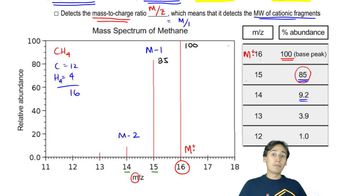
Mass spectrometry is an analytical technique used to measure the mass-to-charge ratio of ions. It involves ionizing chemical species and sorting the ions based on their mass. The resulting mass spectrum provides information about the molecular weight and structure of the compounds, allowing for the identification of different isomers.
Recommended video:
Guided course
01:25
How to Read a Mass Spectrum

Isomerism

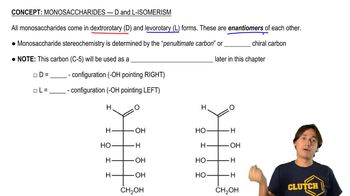
Isomerism refers to the phenomenon where compounds have the same molecular formula but different structural arrangements or spatial orientations. In the case of pentane, isopentane, and 2,2-dimethylpropane, they are structural isomers, meaning they differ in how their carbon atoms are connected, which affects their mass spectra and fragmentation patterns.
Recommended video:
Guided course
06:47
Monosaccharides - D and L Isomerism

Fragmentation Patterns

Fragmentation patterns in mass spectrometry describe how a molecule breaks apart into smaller ions during ionization. Different compounds exhibit unique fragmentation pathways based on their structure. The distinct branching and connectivity in 2,2-dimethylpropane compared to pentane and isopentane lead to different fragmentation patterns, which can be observed in their respective mass spectra.
Recommended video:
Guided course
08:06
Common Splitting Patterns