Ch. 13 - Mass Spectrometry; Infrared Spectroscopy; UV/Vis Spectroscopy
Bruice - Organic Chemistry 8th Edition
Bruice8th EditionOrganic ChemistryISBN: 9780135213711Not the one you use?Change textbook
Chapter 14, Problem 22

Which occurs at a larger wavenumber:
a. the C–O stretch of phenol or the C–O stretch of cyclohexanol?
b. the C=O stretch of a ketone or the C=O stretch of an amide?
c. the C–N stretch of cyclohexylamine or the C–N stretch of aniline?

Verified step by step guidance
1
Step 1: Understand the factors affecting wavenumber in IR spectroscopy. Wavenumber is inversely proportional to bond length and directly proportional to bond strength. Additionally, resonance, hybridization, and hydrogen bonding can influence the wavenumber of a functional group.
Step 2: For part (a), compare the C-O stretch of phenol and cyclohexanol. Phenol has a conjugated aromatic ring, which can delocalize electrons and reduce the bond strength of the C-O bond, leading to a lower wavenumber. Cyclohexanol lacks this conjugation, so its C-O bond is stronger and occurs at a higher wavenumber.
Step 3: For part (b), compare the C=O stretch of a ketone and an amide. The amide group has resonance between the lone pair on nitrogen and the carbonyl group, which reduces the double-bond character of the C=O bond, lowering its wavenumber. Ketones lack this resonance effect, so their C=O stretch occurs at a higher wavenumber.
Step 4: For part (c), compare the C-N stretch of cyclohexylamine and aniline. Aniline has a conjugated aromatic ring, which allows resonance between the lone pair on nitrogen and the ring, reducing the bond strength of the C-N bond and lowering its wavenumber. Cyclohexylamine lacks this conjugation, so its C-N stretch occurs at a higher wavenumber.
Step 5: Summarize the trends: (a) Cyclohexanol has a larger wavenumber than phenol for the C-O stretch. (b) Ketones have a larger wavenumber than amides for the C=O stretch. (c) Cyclohexylamine has a larger wavenumber than aniline for the C-N stretch.

Verified video answer for a similar problem:

This video solution was recommended by our tutors as helpful for the problem above.
Video duration:
5m
Was this helpful?

Key Concepts

Here are the essential concepts you must grasp in order to answer the question correctly.

Infrared Spectroscopy

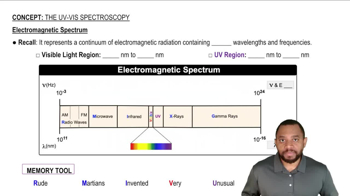
Infrared (IR) spectroscopy is a technique used to identify functional groups in organic compounds by measuring the absorption of infrared light. Different bonds absorb IR radiation at characteristic wavenumbers, allowing chemists to deduce the presence of specific functional groups based on their absorption peaks.
Recommended video:
2:56
The UV-Vis Spectroscopy Concept 1

Wavenumber and Bond Strength

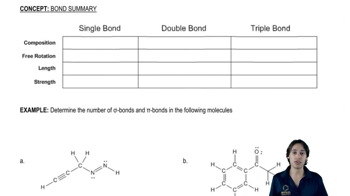
Wavenumber, measured in cm⁻¹, is inversely related to the wavelength of light and is commonly used in IR spectroscopy. Generally, stronger bonds and more electronegative atoms lead to higher wavenumbers. For example, C=O stretches typically occur at higher wavenumbers than C-O stretches due to the greater bond strength of the carbonyl group.
Recommended video:
Guided course
06:00
Single bonds, double bonds, and triple bonds.

Substituent Effects on Stretching Frequencies

The presence of different substituents on a molecule can influence the stretching frequencies of bonds. Electron-donating or withdrawing groups can alter the electron density around a bond, affecting its strength and, consequently, the wavenumber at which it absorbs IR radiation. For instance, the presence of an amine group can lower the wavenumber of a C-N stretch compared to a simple alkyl amine.
Recommended video:
2:02
Directing Effects in Substituted Pyrroles, Furans, and Thiophenes Concept 1