Ch. 14 - NMR Spectroscopy
Bruice - Organic Chemistry 8th Edition
Bruice8th EditionOrganic ChemistryISBN: 9780135213711Not the one you use?Change textbook
Chapter 15, Problem 9a

If two signals differ by 1.5 ppm in a 300 MHz spectrometer, by how much do they differ in a 500 MHz spectrometer?

Verified step by step guidance
1
Understand the relationship between the chemical shift difference (in ppm) and the spectrometer frequency. The chemical shift difference in ppm is independent of the spectrometer frequency, but the actual frequency difference (in Hz) depends on the spectrometer's operating frequency.
Calculate the frequency difference in Hz for the 300 MHz spectrometer. Use the formula: \( \text{Frequency Difference (Hz)} = \text{Chemical Shift Difference (ppm)} \times \text{Spectrometer Frequency (MHz)} \). Substituting the given values: \( 1.5 \times 300 \).
Determine the frequency difference in Hz for the 500 MHz spectrometer. Since the chemical shift difference remains the same (1.5 ppm), use the same formula: \( \text{Frequency Difference (Hz)} = \text{Chemical Shift Difference (ppm)} \times \text{Spectrometer Frequency (MHz)} \). Substituting the values: \( 1.5 \times 500 \).
Compare the frequency differences calculated for the 300 MHz and 500 MHz spectrometers. Note that the frequency difference in Hz will be larger for the 500 MHz spectrometer because the operating frequency is higher.
Conclude that while the chemical shift difference in ppm remains constant, the actual frequency difference in Hz scales proportionally with the spectrometer's operating frequency.

Verified video answer for a similar problem:

This video solution was recommended by our tutors as helpful for the problem above.
Video duration:
2m
Was this helpful?

Key Concepts

Here are the essential concepts you must grasp in order to answer the question correctly.

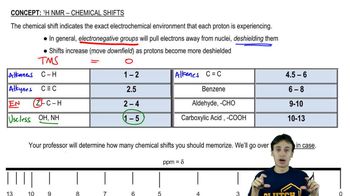
Chemical Shift

Chemical shift is a measure of the resonance frequency of a nucleus relative to a standard in a magnetic field, expressed in parts per million (ppm). It reflects the electronic environment surrounding the nucleus and is crucial for interpreting NMR spectra. The ppm scale allows for comparison across different magnetic field strengths, making it a fundamental concept in NMR spectroscopy.
Recommended video:
Guided course
11:44
1H NMR Chemical Shifts

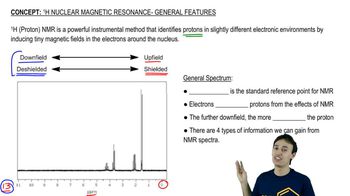
NMR Spectroscopy

Nuclear Magnetic Resonance (NMR) spectroscopy is a technique used to determine the structure of organic compounds by observing the magnetic properties of certain nuclei. The frequency of the signals detected in NMR is dependent on the strength of the magnetic field applied, which is why the same chemical shift can appear differently at different field strengths. Understanding how to relate these shifts across different spectrometers is essential for accurate analysis.
Recommended video:
Guided course
10:06
General NMR Features

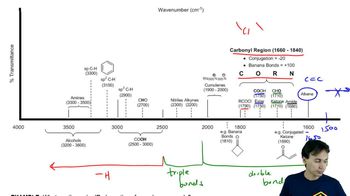
Frequency and Magnetic Field Relationship

The frequency of the NMR signal is directly proportional to the strength of the magnetic field applied, as described by the Larmor equation. This relationship means that when the magnetic field strength increases, the frequency of the signals also increases. Consequently, to find the difference in chemical shifts at different frequencies, one must understand how to scale the ppm values according to the respective magnetic field strengths.
Recommended video:
Guided course
16:47
Common IR Frequencies