Explain why the chemical shift of the OH proton of a carboxylic acid is at a higher frequency than the chemical shift of an OH proton of an alcohol.
Ch. 14 - NMR Spectroscopy
Chapter 15, Problem 41(9)
Answer the following questions for each compound:
a. How many signals are in its 13C NMR spectrum?
b. Which signal is at the lowest frequency?
9. CH2=CHBr
Verified step by step guidance1
Step 1: Analyze the molecular structure of the compound. The given compound is 1-chloropropene, which contains three carbon atoms: one in the methyl group (CH3), one in the double bond (CH), and one in the double bond attached to chlorine (C-Cl).
Step 2: Determine the number of unique carbon environments. In 13C NMR spectroscopy, each unique carbon environment corresponds to a distinct signal. The methyl group (CH3) is in a unique environment, the CH carbon in the double bond is in another unique environment, and the C-Cl carbon in the double bond is in a third unique environment. Therefore, there are three signals in the 13C NMR spectrum.
Step 3: Identify the signal at the lowest frequency. In 13C NMR, the chemical shift is influenced by the electronic environment of the carbon atoms. The methyl group (CH3) is less deshielded compared to the carbons in the double bond, as it is not directly attached to electronegative atoms or involved in π-bonding. Thus, the signal for the methyl group (CH3) will appear at the lowest frequency (upfield).
Step 4: Consider the effect of electronegativity and π-bonding. The C-Cl carbon is more deshielded due to the electronegative chlorine atom, and the CH carbon in the double bond is deshielded due to π-bonding. These factors cause their signals to appear at higher frequencies (downfield) compared to the methyl group.
Step 5: Summarize the findings. The compound has three signals in its 13C NMR spectrum, and the signal at the lowest frequency corresponds to the methyl group (CH3).

Verified video answer for a similar problem:
This video solution was recommended by our tutors as helpful for the problem above.
Video duration:
3mWas this helpful?
Key Concepts
Here are the essential concepts you must grasp in order to answer the question correctly.
13C NMR Spectroscopy
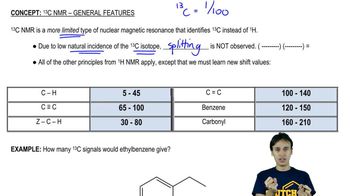
13C NMR (Nuclear Magnetic Resonance) spectroscopy is a technique used to determine the structure of organic compounds by analyzing the environment of carbon atoms. Each unique carbon environment in a molecule produces a distinct signal in the NMR spectrum, allowing chemists to infer the number of different carbon atoms present and their connectivity.
Recommended video:
Guided course
13C NMR General Features
Chemical Shifts
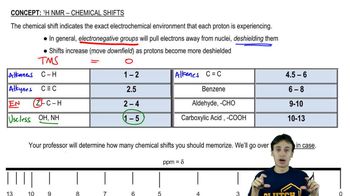
Chemical shifts in NMR spectroscopy refer to the position of the signals in the spectrum, measured in parts per million (ppm). The chemical environment surrounding a carbon atom affects its resonance frequency, with electronegative atoms or groups (like chlorine) typically causing a downfield shift (lower frequency) due to deshielding effects. This helps in identifying the most deshielded carbon in the molecule.
Recommended video:
Guided course
1H NMR Chemical Shifts
Signal Counting in NMR
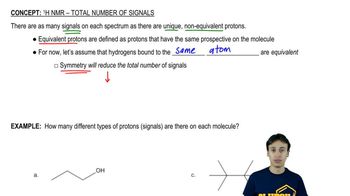
In 13C NMR, the number of signals corresponds to the number of unique carbon environments in a molecule. Equivalent carbons, which are in the same electronic environment, will produce a single signal. Understanding symmetry and the presence of functional groups is crucial for accurately counting these signals and interpreting the spectrum.
Recommended video:
Guided course
General Assumption for 1H NMR Signals
Related Practice
Textbook Question
1286
views
Textbook Question
Describe the proton-coupled 13C NMR spectra for compound 5 in Problem 41, indicating the relative positions of the signals.
5.
1345
views
Textbook Question
Answer the following questions for each compound:
a. How many signals are in its 13C NMR spectrum? b. Which signal is at the lowest frequency?
7.
1701
views
Textbook Question
Describe the proton-coupled 13C NMR spectra for compound 3 in Problem 41, indicating the relative positions of the signals.
3.
1208
views
Textbook Question
Propose a mechanism for proton exchange of an alcohol in aqueous base.
685
views
Textbook Question
Answer the following questions for each compound:
a. How many signals are in its 13C NMR spectrum?
b. Which signal is at the lowest frequency?
8.
936
views